Artemis II Astronauts Launch Toward
Four astronauts launched toward the Moon on April 1 and today face the critical Trans-Lunar Injection burn, the last engine firing before a 685,000-mile free-return loop around the Moon.
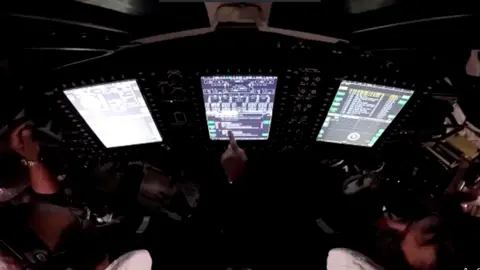
The 322-foot Space Launch System cleared Kennedy Space Center's Launch Complex 39B at 6:35 PM EDT on April 1, carrying the Orion capsule "Integrity" and four astronauts into a high elliptical orbit roughly 46,000 miles above Earth. Commander Reid Wiseman, Pilot Victor Glover, Mission Specialist Christina Koch, and Mission Specialist Jeremy Hansen spent their first night in space working through a structured checklist designed to verify every critical system before the mission's point of no return.
That point arrives today.
Shortly after liftoff, the Interim Cryogenic Propulsion Stage executed two engine burns: a perigee raise maneuver at 49 minutes after launch, followed by an apogee raise burn at one hour and 48 minutes. Together, those firings shaped the high Earth orbit that served as a proving ground for Integrity's life-support systems, including temperature regulation and air quality management. The crew also completed a proximity operations demonstration, manually flying the spacecraft to verify handling characteristics, a check that doubles as a contingency skill for any scenario requiring manual control during the mission.
Today, April 2, Koch helps prepare for the Trans-Lunar Injection burn, the last major engine firing of the entire mission. When that burn completes, Orion will break free of Earth's gravity and set a course for the Moon. There are no more large engine firings planned. The spacecraft will coast the remainder of the journey on the physics of its free-return trajectory, a path engineered so that even without propulsion, the Moon's gravity swings Orion back toward Earth.
The roughly three-day lunar transit covers approximately 685,000 total miles. By Day 5, around April 6, Orion enters the Moon's gravitational sphere of influence but will not brake into lunar orbit. The mission's purpose is to test the integrated Orion-SLS system with humans aboard under actual deep-space conditions, gathering data on crew health, spacecraft thermal performance, and life-support endurance that ground controllers cannot replicate any other way.
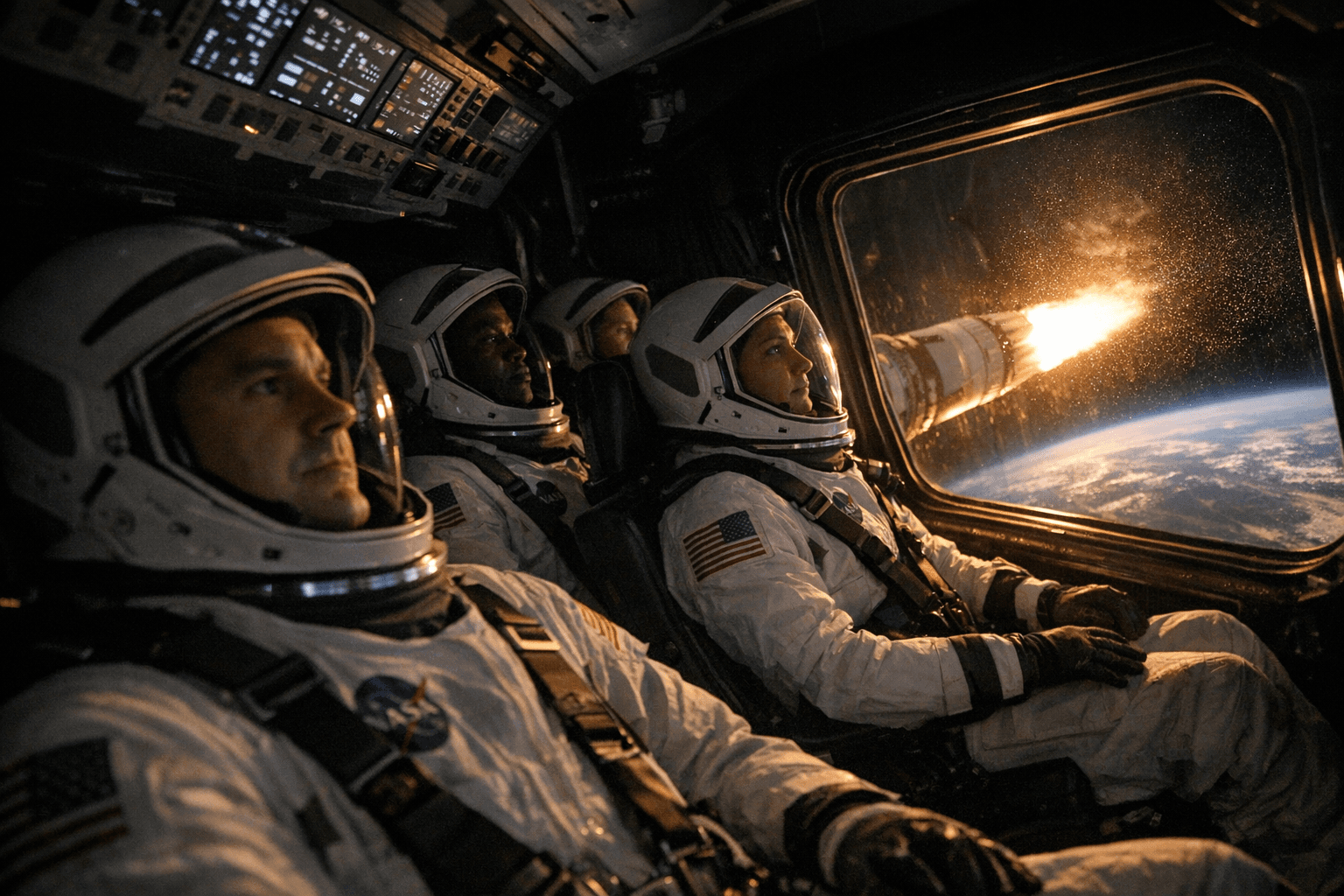
Day 6, approximately April 7, brings the mission's most consequential passage. The crew swings around the Moon's far side, losing radio contact with Earth for several minutes. Depending on the exact trajectory flown, Wiseman, Glover, Koch, and Hansen may break the all-time record for the farthest any human has traveled from Earth, a distance record set by the Apollo 13 crew in April 1970 under considerably more dire circumstances.
Each crew member carries a historic distinction. Glover is the first Black astronaut to travel toward the Moon. Koch is the first woman to travel beyond low Earth orbit. Hansen, representing the Canadian Space Agency, is the first Canadian to reach deep space. Wiseman, a former NASA chief astronaut and U.S. Navy test pilot who logged 165 days aboard the International Space Station, commands the first crewed mission toward the Moon since Apollo 17 in December 1972.
The four days of return transit end with what engineers describe as the fastest atmospheric reentry ever attempted: Orion hits Earth's atmosphere at approximately 25,000 mph, a full-stress test of the heat shield whose performance data will directly shape every crewed Artemis mission that follows. Splashdown in the Pacific Ocean near San Diego is targeted for around April 10, with U.S. Navy recovery teams standing by to assess crew health before towing the capsule in.
Artemis II will not land on the Moon. That milestone is assigned to Artemis III, currently planned for mid-2027 and contingent on readiness certification of commercial lunar landers from Blue Origin or SpaceX. The actual first landing may slip further still. Artemis II's job is narrower and more foundational: prove that humans can reach the Moon's neighborhood, endure the transit, and come home safely. Everything else comes after.
Know something we missed? Have a correction or additional information?
Submit a Tip

