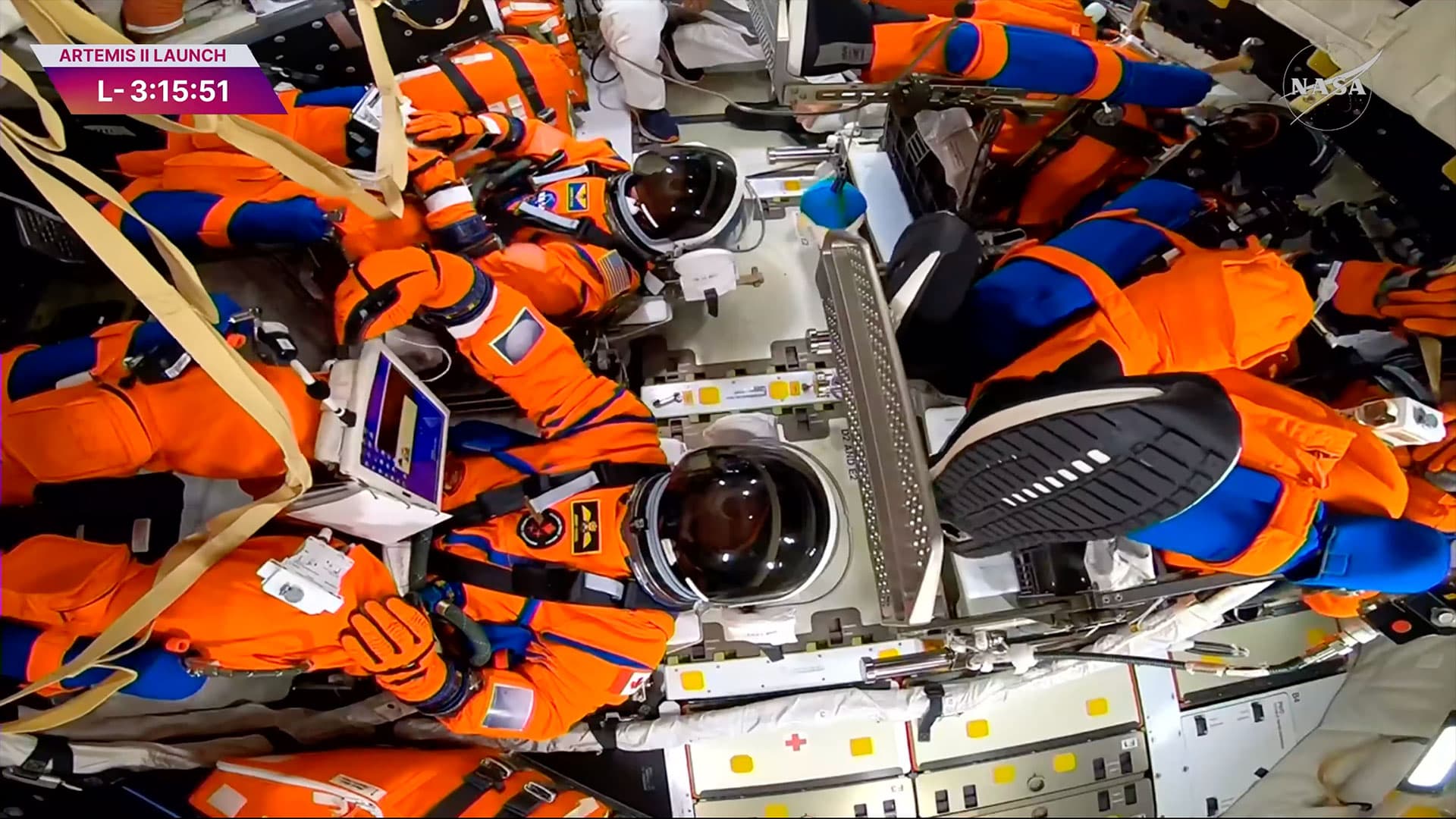
Artemis II Crew Captures Stunning Earth Photo, Complete With Auroras, En Route to Moon
NASA titled Wiseman's Orion window photo 'Hello, World' after he captured Earth framed by auroras hours into the first crewed lunar journey since 1972.
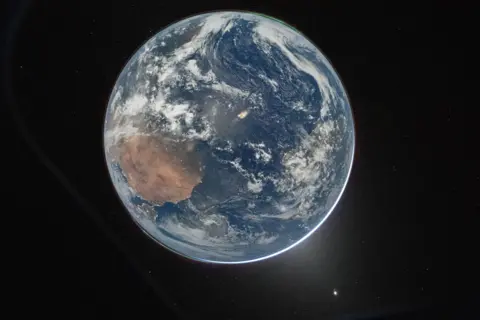
NASA titled the photograph "Hello, World." The crew member who took it used a tablet.
Commander Reid Wiseman raised his Personal Computing Device, a standard mission-issued tablet that includes a camera, to one of four windows aboard the Orion capsule on April 2, 2026, and photographed Earth from the other side of the translunar injection burn. The resulting image shows the full globe framed by two auroras, one at the top right and one at the bottom left, with zodiacal light visible at the bottom right as Earth eclipses the Sun. A second image, which NASA described as "a pale blue dot seen through the crew's eyes," shows roughly one-third of Earth visible past the capsule wall and window frame.
The photographs were not incidental. They were captured on Day 2 of the mission, after the crew had completed the engine burn that committed Orion to its lunar trajectory. Mission control at Johnson Space Center in Houston had just reoriented the spacecraft when Wiseman spotted the view, and he described it during a downlink event with media: "There was a moment about an hour ago where Mission Control Houston reoriented our spacecraft as the sun was setting behind the Earth. And I don't know what we all expected to see at that moment, but you could see the entire globe, from pole to pole. You could see Africa, Europe, and if you looked really close, you could see the northern lights. It was the most spectacular moment, and it paused all four of us in our tracks."
Mission control described the first image as "a reminder that no matter how far we go, we are still one world, watching, hoping and reaching higher."
The successful translunar injection burn that preceded the photographs is itself a critical data point for NASA's broader lunar program. Artemis II launched at 6:35 p.m. EDT on April 1, 2026, atop NASA's Space Launch System rocket from Launch Complex 39B at Kennedy Space Center in Florida, carrying no surface landing in its profile. Its purpose is validation: flying four astronauts through the complete lunar transit sequence, including the translunar injection, the free-return trajectory around the Moon, and Orion's high-speed Earth reentry, generates the performance data NASA needs before committing a crew to a surface landing on Artemis III. Every nominal system confirmed on this flight reduces risk for the missions that follow.
The 10-day mission covers approximately 685,000 miles in total, and the crew, aboard a spacecraft they named "Integrity," is on track to potentially surpass the record for the farthest humans have ever traveled from Earth, currently 248,655 miles set by the Apollo 13 crew.
It is the first crewed deep-space flight since Apollo 17 in December 1972, a gap of more than 50 years. The crew carries that milestone alongside four separate historic firsts. Pilot Victor Glover will be the first person of color to travel around the Moon. Mission Specialist Christina Koch will be the first woman. Mission Specialist Jeremy Hansen of the Canadian Space Agency, whose inclusion follows a 2020 treaty between the United States and Canada, will be the first non-American to make the journey. Wiseman, a former U.S. Navy test pilot who logged 165 days aboard the International Space Station, will become the oldest person to travel around the Moon.
The photograph titled "Hello, World" arrived on Day 2 as evidence that Orion's crew could see clearly, communicate with Houston, and operate comfortably enough to pause at the windows and look back.
Know something we missed? Have a correction or additional information?
Submit a Tip