Artemis II Crew Faces 40-Minute Communication Blackout Behind the Moon
NASA's Artemis II crew will go completely dark for 40 minutes Monday as the Moon blocks all signals, making them the most isolated humans since the Apollo era.
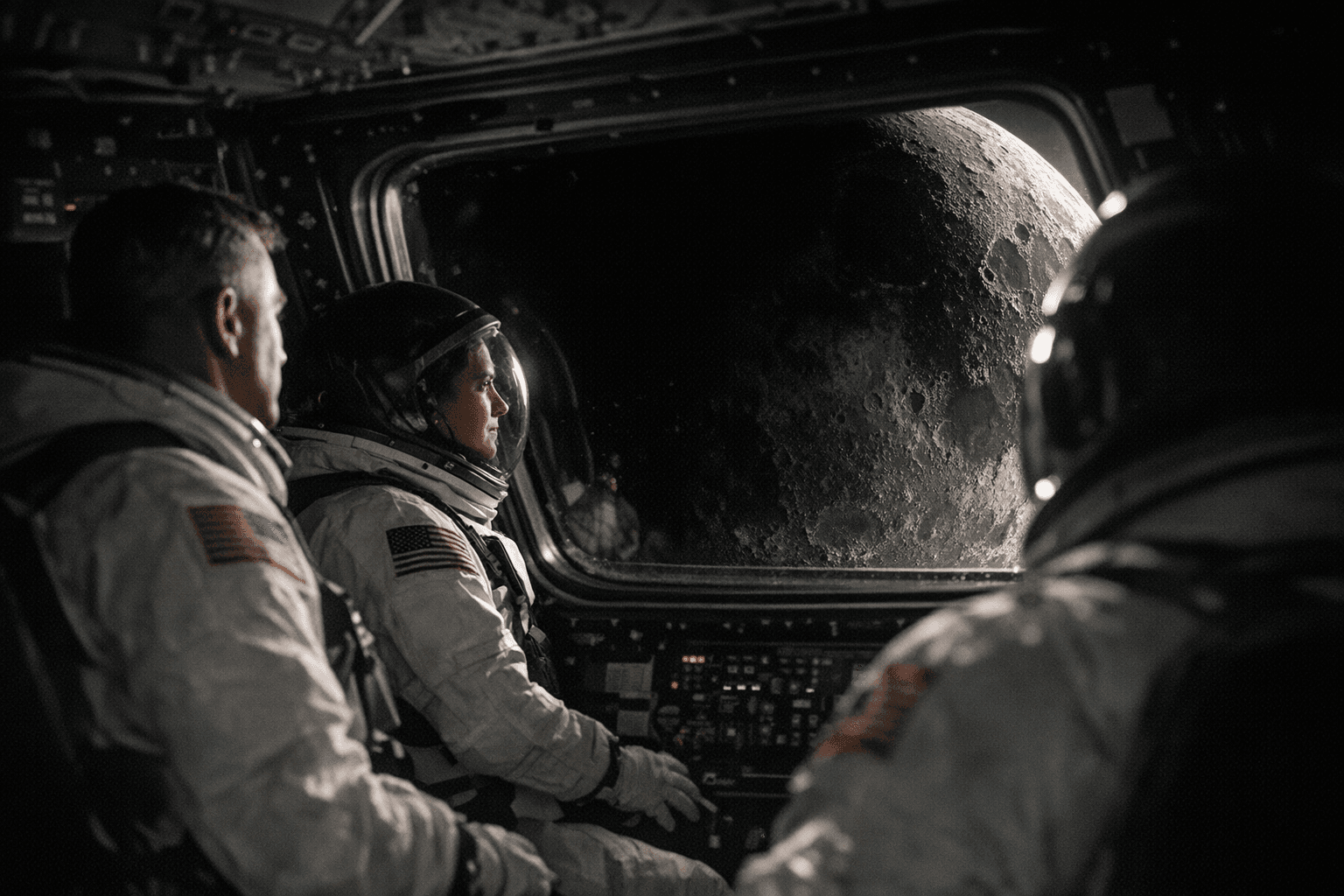
The most isolated humans in more than 50 years will spend 40 minutes behind the Moon on Monday with no contact, no telemetry, and no backup from the ground, a planned silence that NASA Artemis II flight director Judd Frieling summarized in a single word: "Physics."
When Orion passes behind the Moon at approximately 5:47 p.m. ET on April 6, commander Reid Wiseman, pilot Victor Glover, and mission specialists Christina Koch and Jeremy Hansen will enter a communications blackout that severs every link with Mission Control in Houston. No voice, no video, no telemetry data will travel between the crew and Earth. The Moon itself is the barrier: its mass physically interrupts radio transmission between the spacecraft and NASA's Deep Space Network, a constellation of giant dish antennas, each roughly 230 feet wide, stationed in California, Spain, and Australia.
For 40 minutes, Orion's onboard computers will manage navigation and flight systems automatically, without real-time guidance from the ground. If minor system fluctuations arise, the crew will handle them independently. In the unlikely event of a major failure, Wiseman, Glover, Koch, and Hansen, who trained specifically for communications-loss scenarios, will have no lifeline. Mission Control can only wait.
Similar blackouts occurred on every crewed Apollo lunar mission and on Artemis I, the uncrewed test flight. Monday will be the first time humans have experienced the enforced silence since the Apollo era ended in 1972. Artemis II, which launched from Kennedy Space Center on April 1, is humanity's first crewed journey toward the Moon in more than 50 years.
The blackout falls within a roughly six-hour lunar flyby beginning at approximately 2:45 p.m. ET on April 6, during which Orion will pass within 4,066 miles of the lunar surface. Earlier in that window, at 1:56 p.m. ET, the crew will break Apollo 13's human distance record of 248,655 miles from Earth, a mark that has stood since 1970. Artemis II will reach its maximum distance of 252,757 miles at 7:05 p.m. ET, placing Wiseman, Glover, Koch, and Hansen farther from Earth than any humans in history, by 4,102 miles.
The flyby also carries one unrepeatable spectacle: a total solar eclipse observed from space. As Orion, the Moon, and the Sun align, the Sun will disappear behind the lunar disc for approximately one hour, leaving the crew with a view of the solar corona, the Sun's outermost atmosphere, that no Earth-based telescope can replicate.
The mission is also testing a laser communications system aboard Orion capable of streaming 4K video from near the Moon, a potential breakthrough for deep-space data transmission. That system, like everything else dependent on line-of-sight radio contact, will go silent during Monday's 40-minute blackout.
What the crew faces behind the Moon is a preview of the communications environment that will define any Mars mission, where one-way signal delays can stretch to 24 minutes. The enforced autonomy, the absence of real-time support, and the requirement that the crew make critical decisions without assistance from the ground are not contingencies. For deep-space exploration, they are the job.
This article was produced by Prism’s automated news system from verified source data, official records, and press releases, then run through automated quality and moderation checks before publishing. The system is built and supervised by the people who set the standards it runs under. Read our full AI policy.
Did this article answer your question?