Transportation Secretary Sean Duffy Issues Statement for 60 Minutes Ghost Train Report
Sean Duffy's "Golden Age" rail pledge offers no timelines or named projects, even as 16 years and $15B produced zero track in California.
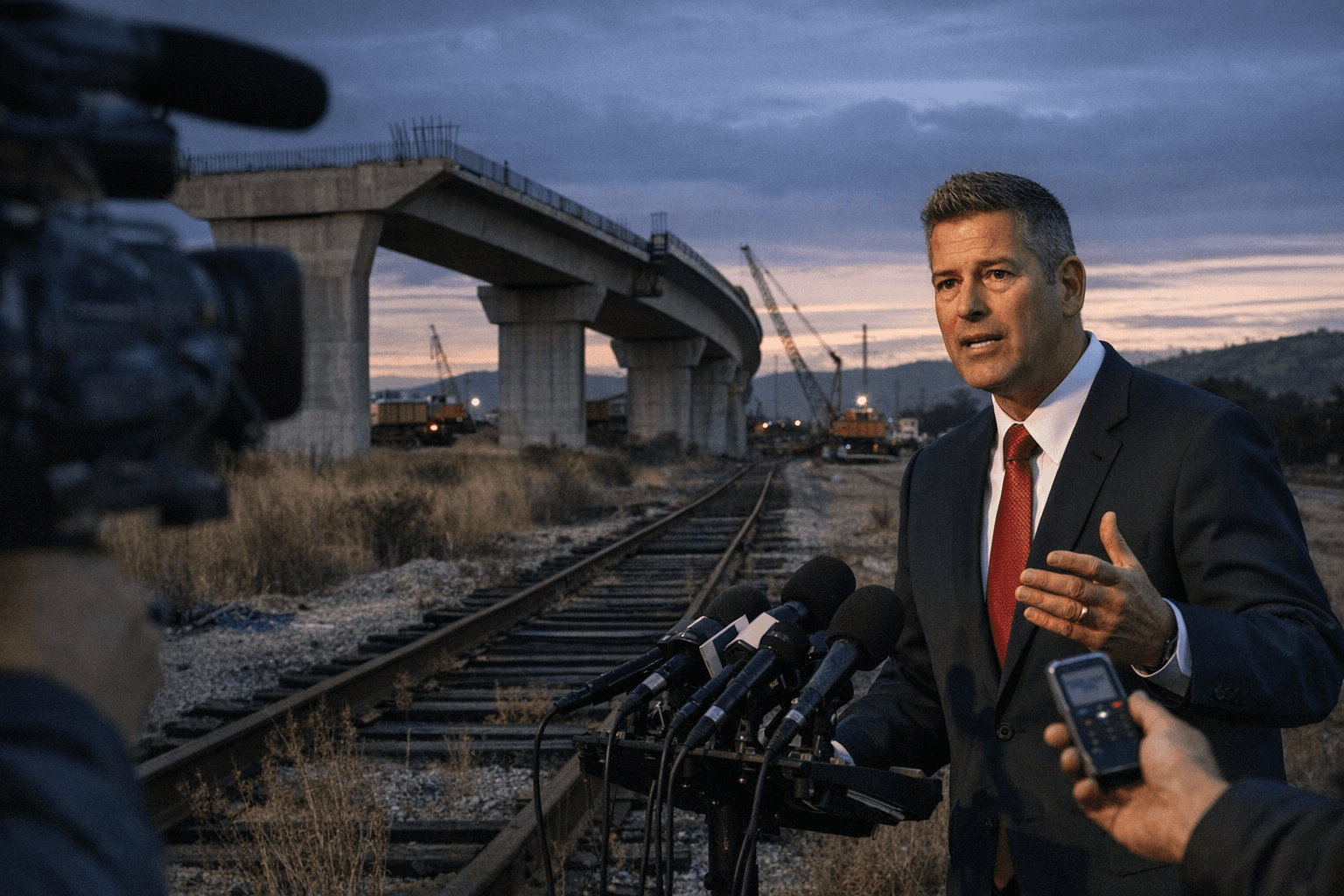
Transportation Secretary Sean Duffy pledged Sunday that the Trump administration is working toward a "Golden Age of Transportation" that includes high-speed rail, while simultaneously defending the cancellation of roughly $4 billion in federal grants to California's long-stalled bullet train project. The statement, issued in response to correspondent Jon Wertheim's "Ghost Train" report, frames the administration's position as pro-rail in principle and anti-California-project in practice. What the statement does not include: a single timeline, a named alternative project, or a measurable benchmark for what success looks like.
Duffy's full statement read, in part: "This Administration is working to usher in a Golden Age of Transportation. That vision includes high speed rail and we're exploring opportunities to efficiently build that infrastructure in America. What this administration won't stand for is boondoggle projects like Newsom's Train to Nowhere that wasted billions in taxpayer dollars yet delivered nothing to the American people." Duffy added that the administration had "created the first Trump Infrastructure Dividend," saying those redirected dollars "will now actually fund critical projects that enhance safety on rail networks across America." No projects were identified by name.
The backdrop against which Duffy issued those words is stark. After 16 years and approximately $15 billion spent, the California High-Speed Rail Authority has not laid a single mile of high-speed track. The project voters approved in 2008 carried a price tag of $33 billion for a 220-mph train connecting San Francisco and Los Angeles. The current projected cost has ballooned to $135 billion, with no completion date in sight. The Federal Railroad Administration terminated approximately $4 billion in unspent federal funding, composed of a $929 million cooperative agreement from 2010 and a $3.07 billion agreement from more recent years.
Congressman Vince Fong, a Republican from Bakersfield who sits on the House Transportation Committee, put the gap between the original promise and current reality in unsparing terms during the Wertheim report: "We're now in 2026. There are no trains. There's no track laid. It was a complete bait and switch." California Secretary of Transportation Toks Omishakin, who inherited the project from his predecessors, acknowledged the institutional failure: "I don't think the voters fully understood and neither did we in the public sector what it was going to take to actually get this project delivered."
Omishakin told Wertheim that the California High-Speed Rail Authority believes it can complete the initial Central Valley segment without federal money, but conceded that building out the full 494-mile route from Los Angeles to San Francisco without Washington's involvement "will be challenging." Infrastructure analyst Lou Thompson offered the starker assessment: that large-scale projects like high-speed rail require the kind of consistent, stable federal funding that built the interstate highway system 70 years ago, and that completing this one without it is not merely difficult but inadvisable.
That is the accountability gap Duffy's statement leaves open. The administration's position establishes what it opposes, but the "Trump Infrastructure Dividend" it promotes remains undefined, its recipient projects unnamed and its funding amounts unspecified. For the riders and Central Valley communities who were promised a transformative connection and received years of cost overruns instead, the question of what "building again" actually means in practice remains unanswered.
This article was produced by Prism’s automated news system from verified source data, official records, and press releases, then run through automated quality and moderation checks before publishing. The system is built and supervised by the people who set the standards it runs under. Read our full AI policy.
Did this article answer your question?