Artemis II Crew Glimpsed Parts of the Moon No Human Had Ever Seen
Artemis II astronauts spent seven hours viewing craters, swirls, and basins on the moon's far side that no human eye had ever seen, setting a scientific baseline for future landings.
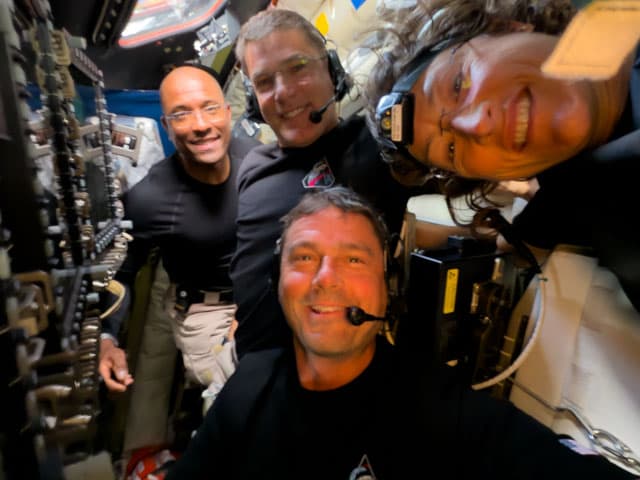
For seven hours on April 6, the four astronauts of NASA's Artemis II mission pressed their faces against the windows of the Orion spacecraft and gazed at a version of the moon that had never been seen by human eyes. Working in pairs at the windows, commander Reid Wiseman, pilot Victor Glover, and mission specialists Christina Koch and Jeremy Hansen photographed and narrated roughly 35 geological features on the lunar far side as scientists at Mission Control in Houston listened in real time.
"We have two folks at the window deep in discussion, talking about all of the awesome features that they're seeing," Koch relayed to Mission Control. The view unsettled her in precisely the right way. "The darker parts just aren't quite in the right place," she said. "And something about you senses that is not the moon that I'm used to seeing."
The far side of the moon is markedly different from the near side, which faces Earth: the far side has hardly any of the vast lava flows that mark the near side, but it has a thicker crust and many more impact craters. The distance Orion traveled during the flyby let the crew see the entire lunar disk, including features Apollo astronauts never observed. Among the most significant was the Orientale basin: only half of the giant crater is visible from Earth, but the Artemis II astronauts were able to see it in its entirety. Koch also marveled at Hertzsprung basin, comparing it to Orientale, a 3.8 billion-year-old crater that formed when a large object smashed into the moon's surface.
Artemis II had 10 science objectives for the flyby, one of which was to observe color variations on the lunar surface, since changes in color can indicate mineral composition. Lunar scientist David Kring, who trained all four crew members in geology, had spent years trying to convey the scale of the moon's south pole terrain through photographs. The flyby made the abstract concrete. "The elevation changes are greater than the elevation of Mount Everest on Earth," Kring said. "I could hear Victor [Glover] finally getting it."
Kelsey Young, the Artemis II lunar science lead at NASA's Goddard Space Flight Center, described the crew's narrated observations as irreplaceable. "Those types of observations are things that humans are uniquely able to contribute," Young told the crew. Wiseman, for his part, was reluctant to be pulled away from the view at all. "You're pulling me away from the moon right now, so let's go," he told Young. Young coined a phrase for what her team was experiencing: "I have to say that 'moon joy' is the new term that's already become our team's new motto."
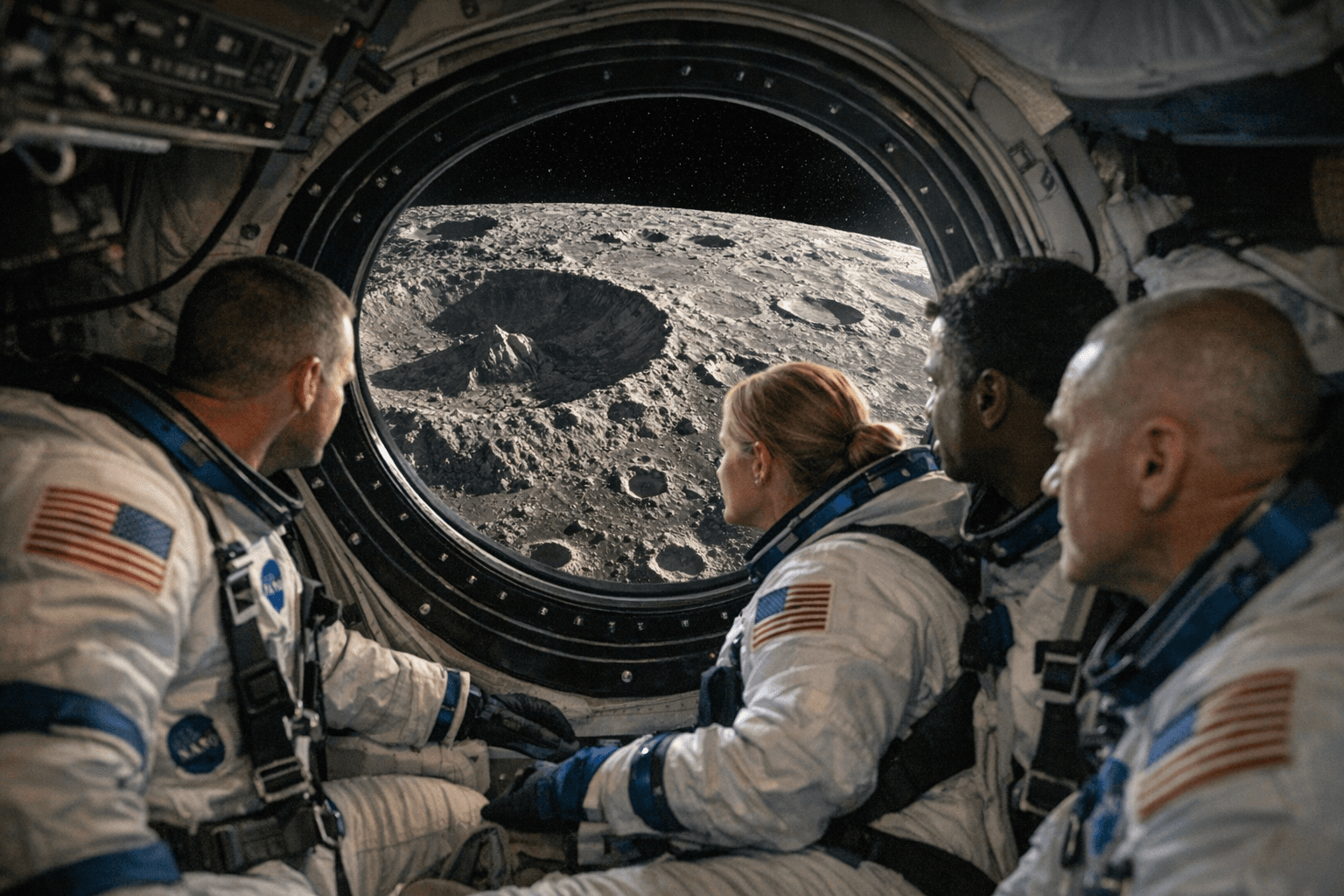
The crew also proposed names for two craters they spotted with the naked eye: one called Integrity, after their spacecraft, and a second called Carroll, in honor of Wiseman's late wife, Carroll Taylor Wiseman. After the mission is complete, the proposals will be formally submitted to the International Astronomical Union.
The astronauts also passed over Reiner Gamma, a bright and mysterious swirl on the near side that is a future landing site for NASA's Commercial Lunar Payload Services program, and Glushko, a bright 27-mile-wide crater known for white streaks shooting across the surface. Those two sites illustrate what Artemis II's observations mean in practical terms: human eyes providing baseline context for where robotic landers will eventually touch down and what surface science teams should expect.
The Artemis II crew broke the distance record for human spaceflight on April 7, reaching 252,756 miles from Earth, surpassing the record Apollo 13 set in 1970 by more than 4,000 miles. The Orion spacecraft is expected to splash down off the coast of San Diego on April 10. What the crew observed in those seven hours around the far side will be studied by scientists for years, informing where Artemis III lands and what targets still require robotic mapping and on-site sampling before humans can follow.
This article was produced by Prism’s automated news system from verified source data, official records, and press releases, then run through automated quality and moderation checks before publishing. The system is built and supervised by the people who set the standards it runs under. Read our full AI policy.
Did this article answer your question?