Artemis II Crew Reaches Day Six of Historic Crewed Lunar Journey
Artemis II reached its closest lunar approach Monday, passing within 4,066 miles of the Moon's surface in humanity's first crewed deep-space mission since 1972.
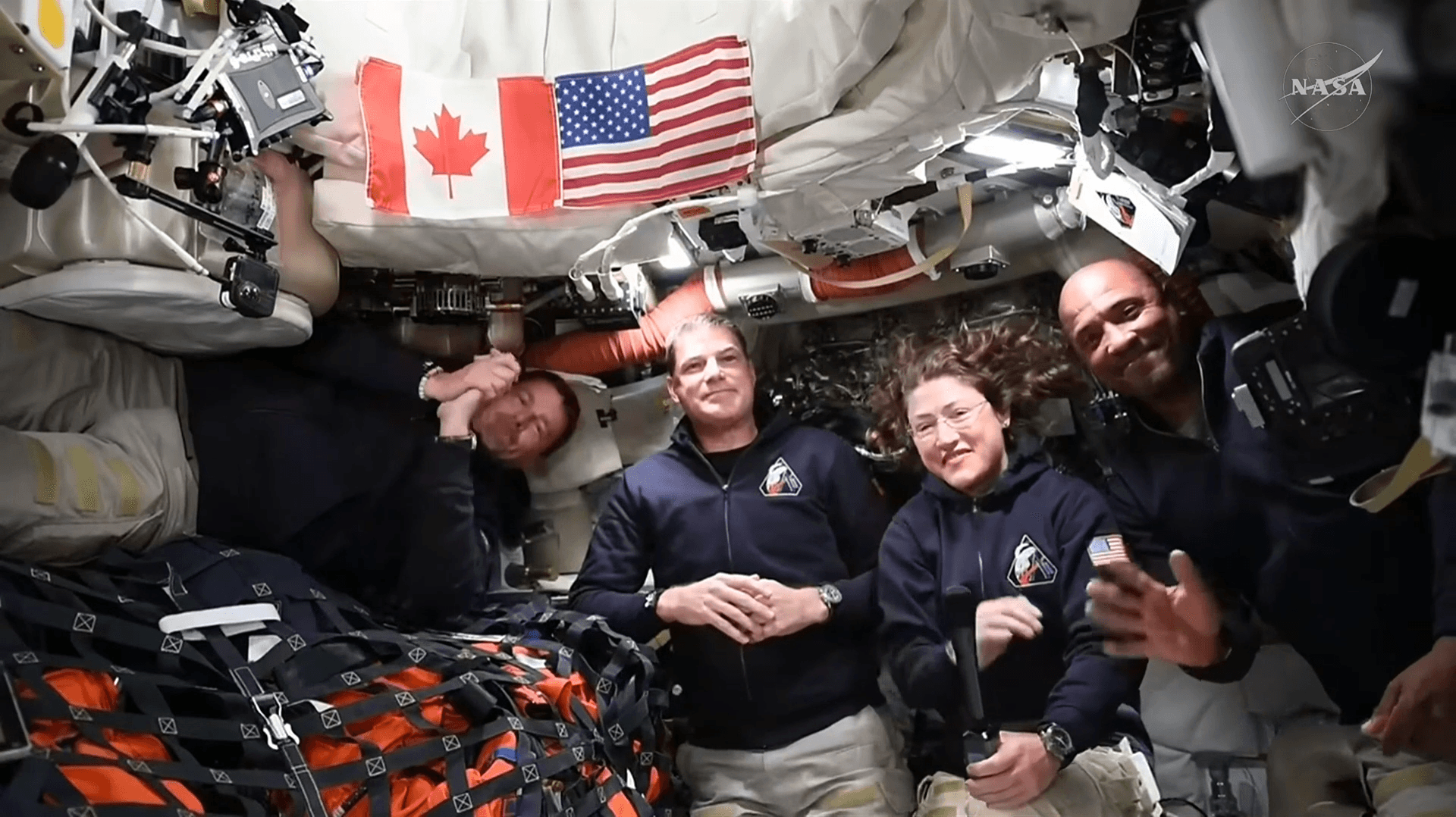
Six days after the most consequential rocket launch in more than half a century, Orion is at the Moon.
The Artemis II spacecraft, carrying Commander Reid Wiseman, Pilot Victor Glover, Mission Specialist Christina Koch, and Canadian Space Agency Mission Specialist Jeremy Hansen, completed its lunar flyby Monday, April 6, passing within 4,066 miles of the surface during an observation window that ran from 2:45 to 9:40 p.m. EDT. The crew photographed and filmed the Moon, capturing terrain near both poles and the far side at angles no crewed mission has held since Apollo.
The flyby is the scientific centerpiece of a 10-day, 695,081-mile mission that began with liftoff from Launch Complex 39B at Kennedy Space Center on April 1 at approximately 6:35 p.m. ET. On April 2, a roughly six-minute translunar injection burn at 7:49 p.m. EDT committed Orion to a free-return trajectory, using lunar gravity to arc the spacecraft back toward Earth without requiring a powered return burn. That maneuver, and the free-return design itself, is among the critical systems Artemis II was built to prove before NASA commits Artemis III to an actual landing.
Artemis II is the first crewed mission beyond low Earth orbit since Apollo 17 departed in December 1972, a gap of more than 53 years. When NASA confirmed liftoff, it noted that "for the first time since Apollo 17 in 1972, humans have departed Earth orbit." Three of the four crew members carried additional historic weight into that departure: Glover is the first person of color to travel toward the Moon, Koch is the first woman to make the lunar journey, and Hansen is the first non-American to travel around the Moon.
The mission also carries a generational dimension. Before launch, Apollo 13 astronaut Fred Haise found Koch and told her plainly: "I heard you're going to break our record." Haise's crew reached 248,655 miles from Earth during their 1970 emergency abort, a record that has stood for 56 years. Artemis II is expected to push that distance to approximately 252,757 miles at maximum separation. Koch described Haise's words as pulling her into a "camaraderie" that bridges the Apollo era and the present.

From deep space, the crew transmitted periodic dispatches that captured both the technical and emotional texture of the mission. After the translunar burn, Hansen said, "Humanity has once again shown what we are capable of." Glover delivered an Easter message from orbit, describing Earth as an "oasis" in the cosmos and telling viewers: "Trust us, you look amazing, you look beautiful." Koch, studying the Moon through Orion's windows, described its disorienting unfamiliarity: "The darker parts just aren't quite in the right place."
On Day 5, the crew demonstrated the Orion crew survival system spacesuit and reviewed science targets ahead of the flyby. Those activities reflect the mission's core purpose: Artemis II carries no lander and will not touch the lunar surface. Instead, every system test, from trajectory corrections to life-support performance to how Orion's thermal protection holds up during high-speed Pacific Ocean reentry, feeds directly into the go/no-go decisions that will determine Artemis III's readiness and timeline.
Orion remains on its free-return arc through Days 7 to 9, with splashdown planned for April 10 at approximately 8:06 p.m. EDT in the Pacific Ocean. The data Wiseman, Glover, Koch, and Hansen bring home will be the closest thing to a mission scorecard for the spacecraft that is supposed to carry the next crew all the way down.
Sources:
Know something we missed? Have a correction or additional information?
Submit a Tip