Astronauts Enter Lunar Sphere of Influence for First Time Since 1972
For the first time since Apollo 17, astronauts crossed into the moon's gravitational domain at 12:41 a.m. ET Monday, 39,000 miles from the lunar surface.
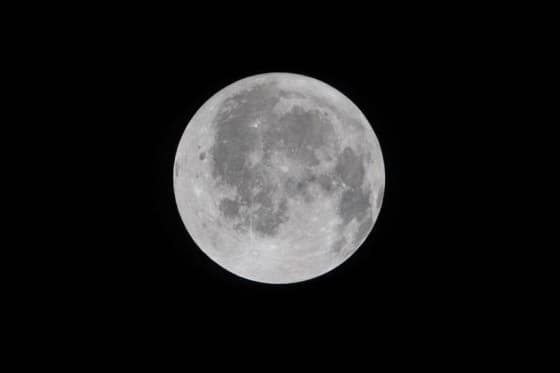
The Orion spacecraft crossed into the lunar sphere of influence at 12:41 a.m. ET Monday, placing the Artemis II crew in the moon's gravitational domain for the first time since Apollo 17 in December 1972. At the moment of crossing, the capsule was approximately 39,000 miles from the lunar surface, marking a threshold no human crew had passed in more than half a century.
The milestone came on the fifth day of a journey already stacked with historic firsts. Commander Reid Wiseman, pilot Victor Glover, and mission specialists Christina Koch and Jeremy Hansen launched from Kennedy Space Center's Launch Complex 39B on April 1, becoming the first crew to fly NASA's Space Launch System rocket and Orion spacecraft beyond low Earth orbit. Glover is the first Black astronaut assigned to a lunar mission. Koch, who holds the record for the longest single spaceflight by a woman at 328 days, became the first woman to travel this far from Earth. Hansen, representing the Canadian Space Agency, became the first Canadian to venture toward the moon.
NASA flight director Rick Henfling addressed the significance at a Sunday briefing. "That's a significant milestone on our mission," he said.
The sphere of influence is not a tangible border but a mathematical boundary: the point at which lunar gravity overtakes Earth's pull. Crossing it placed the crew squarely in territory only twelve Apollo astronauts had ever entered before, the last of them returning aboard Apollo 17 in December 1972.
Monday carried still more records. At 1:46 p.m. ET, the crew was expected to surpass the farthest distance ever traveled from Earth by humans, a mark set by the Apollo 13 crew in April 1970 at 248,655 miles. Artemis II is projected to reach a maximum of 252,757 miles from Earth, besting that record by approximately 4,102 miles.
The mission's centerpiece was the lunar flyby, running from 2:45 p.m. to 9:40 p.m. EDT, during which Orion was to pass within roughly 4,066 miles of the lunar surface at closest approach. As the spacecraft rounded the far side, all communication with Earth was expected to go dark for approximately 40 minutes. At the close of the flyby window, the crew was positioned to observe a solar eclipse as the Sun slipped behind the Moon for nearly an hour from Orion's vantage point.
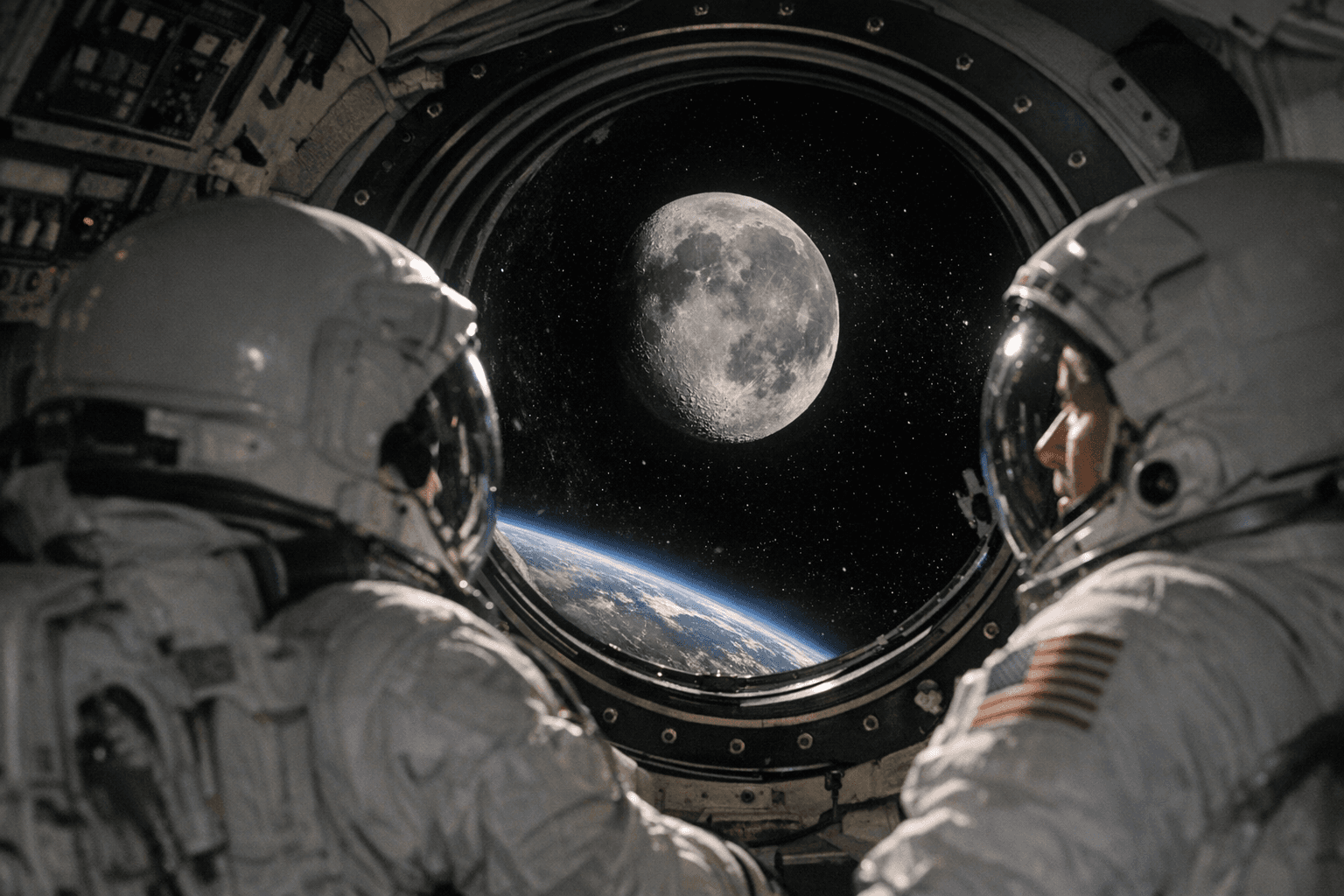
Mission control sent the crew a final list of 30 science targets ahead of the flyby. The Orientale basin, a 3.8-billion-year-old impact crater nearly 600 miles wide straddling the moon's near and far sides, ranked among the priorities. In the days before the flyby, the crew had already captured the first human-eye view of a portion of Orientale; only robotic imagers had previously seen the region. The crew was also tasked with studying the Hertzsprung basin, a nearly 400-mile-wide crater on the far side whose features have been degraded by subsequent impacts, allowing scientists to compare its geological evolution against the better-preserved Orientale. Artemis II lunar science lead Kelsey Young noted that human eyes can detect color variations on the lunar surface that satellite imagery struggles to resolve.
The trajectory to get there was nearly perfect. Orion's path was so precise that mission control scrapped the first two planned course-correction maneuvers entirely. A final brief adjustment Sunday night lasted just 17.5 seconds.
Koch, speaking from inside the Orion capsule, described her first look at the moon's far side in terms that conveyed the disorientation of a view no human had held in a lifetime: "The darker parts just aren't quite in the right place... That is the dark side. That is something we have never seen before."
Splashdown is expected April 10, after a total journey of 695,081 miles. If Artemis II completes its objectives, NASA's path to a crewed lunar landing in a subsequent Artemis mission will be considerably shorter.
This article was produced by Prism’s automated news system from verified source data, official records, and press releases, then run through automated quality and moderation checks before publishing. The system is built and supervised by the people who set the standards it runs under. Read our full AI policy.
Did this article answer your question?

