Artemis II Crew Reaches Far Side of Moon, First in 53 Years
Christina Koch called the far side of the Moon something "we have never seen before" as Artemis II marks humanity's first crewed venture beyond Earth orbit in 53 years.
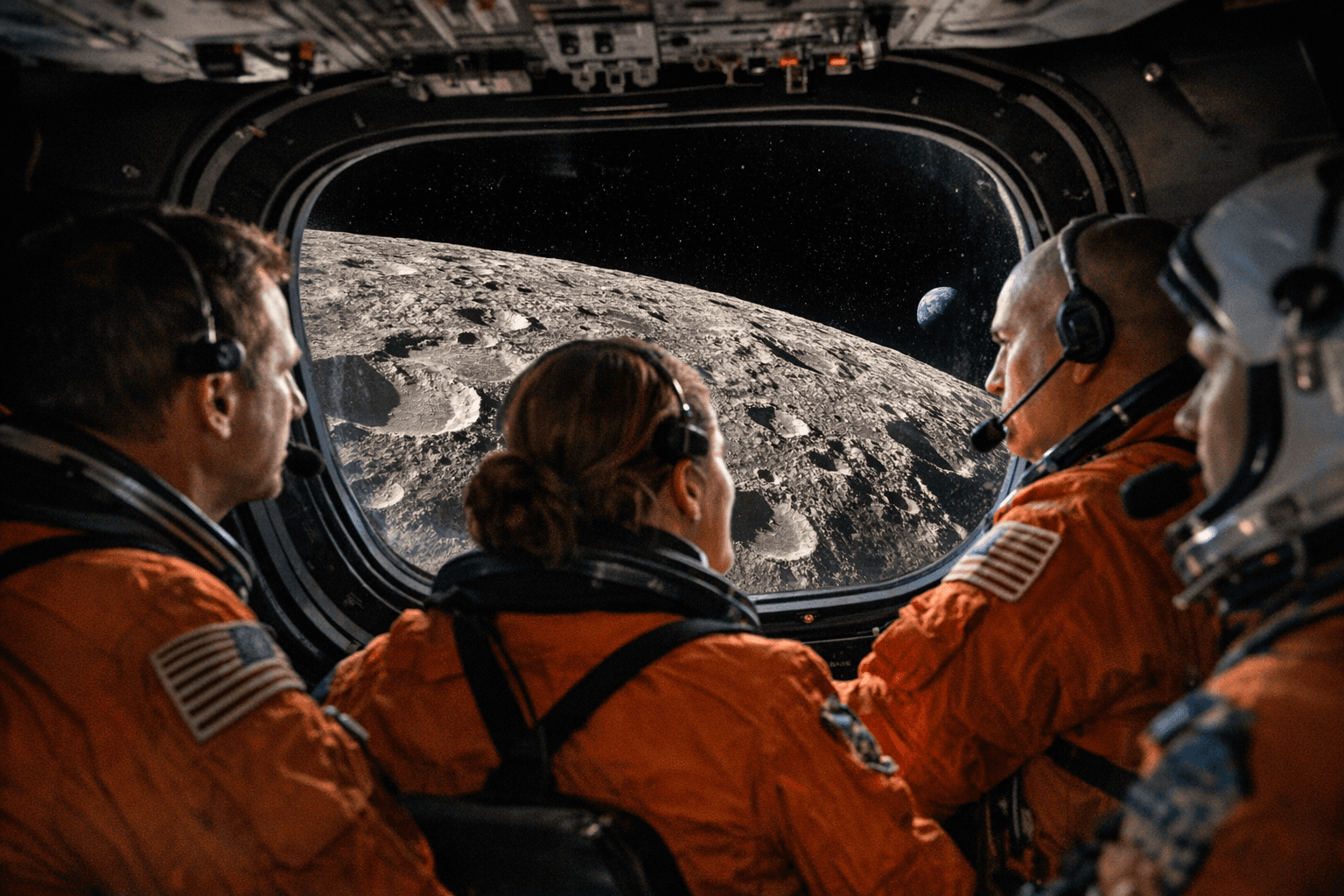
Christina Koch had studied maps and photographs. Nothing had prepared her for the actual view. Looking out from the Orion capsule, the NASA astronaut told NBC News that "the darker parts just aren't quite in the right place" and that "something about you senses that is not the moon that I'm used to seeing." Then came the moment of recognition: "That is the dark side. That is something we have never seen before."
Three days into their journey, the four-person Artemis II crew is rewriting the human spaceflight record books. Commander Reid Wiseman, Pilot Victor Glover, and Mission Specialists Koch and Canadian Jeremy Hansen are the first humans to venture beyond low Earth orbit since Apollo 17 in December 1972, a gap of more than 53 years. Their Orion spacecraft, riding on NASA's Space Launch System in its second-ever flight and Orion's first with a crew aboard, lifted off from Kennedy Space Center's Launch Pad 39B on April 1 at 6:35 p.m. EDT.
The mission's centerpiece arrives Monday, April 6, when a six-hour official lunar flyby period begins at 2:45 p.m. ET. The crew will come within approximately 4,600 miles of the lunar surface, far more distant than Apollo missions, which typically orbited less than 100 miles above the Moon. At closest approach, the Moon will appear roughly the size of a basketball held at arm's length. A roughly 40-minute communications blackout will cut all contact with Mission Control in Houston as the spacecraft passes behind the far side.
During that same flyby, the crew will surpass another record. At 1:56 p.m. ET on April 6, they are expected to eclipse the distance record set by Apollo 13 on April 15, 1970, when commander Jim Lovell, Fred Haise, and Jack Swigert looped around the far side aboard a crippled spacecraft following an oxygen tank explosion. That record stands at 248,655 miles. Artemis II's maximum expected distance is approximately 252,757 miles, some 4,100 miles further, reached at 7:05 p.m. ET.
The mission carries an extraordinary cluster of historic firsts beyond distance alone. Glover is the first person of color to travel beyond low Earth orbit toward the Moon. Koch is the first woman to reach this distance from Earth. Hansen, for whom this is his first spaceflight, is the first non-U.S. citizen to venture this far. Wiseman is the oldest person to have traveled this distance. Together, the four also set the record as the most people ever beyond low Earth orbit simultaneously.
Hansen captured the mood after the translunar injection burn on April 2: "Humanity has once again shown what we are capable of, and it's your hopes for the future that carry us now on this journey around the moon." Wiseman was equally direct: "There is nothing normal about this. Sending four humans 250,000 miles away is a herculean effort, and we are now just realizing the gravity of that."
The far side's geography will be only partially illuminated during the flyby, but Kelsey Young of NASA's Science Mission Directorate noted that the shadow conditions will actually enhance visibility, stretching across the surface to reveal ridges, slopes, and crater rims that are difficult to detect under full illumination. Apollo missions were planned around near-side lighting, leaving portions of the far side effectively "unfamiliar to human eyes." Mission scientist Barbara Cohen said the crew's geological training, conducted in part in Iceland, will be central to documenting craters and ancient lava flows during their close approach.
Artemis II is a test flight, not a landing. The spacecraft is following a free-return trajectory, a figure-eight loop in which lunar gravity will slingshot the crew back toward Earth, with splashdown planned in the Pacific Ocean off the coast of San Diego. The mission is designed to validate Orion in a deep space environment and lay groundwork for a targeted crewed Moon landing in 2028.
NASA Administrator Jared Isaacman framed the broader stakes: "Artemis II is the start of something bigger than any one mission. It marks our return to the Moon, not just to visit, but to eventually stay." Flight Director Judd Frieling put it more plainly: "I suspect everybody understands that this is a once-in-a-lifetime moment.
Sources:
Know something we missed? Have a correction or additional information?
Submit a Tip