Artemis II Crew Returns Safely After Breaking Distance Record Around Moon
Four Artemis II astronauts walked off the USS John P. Murtha under their own power after flying farther from Earth than any humans in history, reaching 252,756 miles past the Moon.
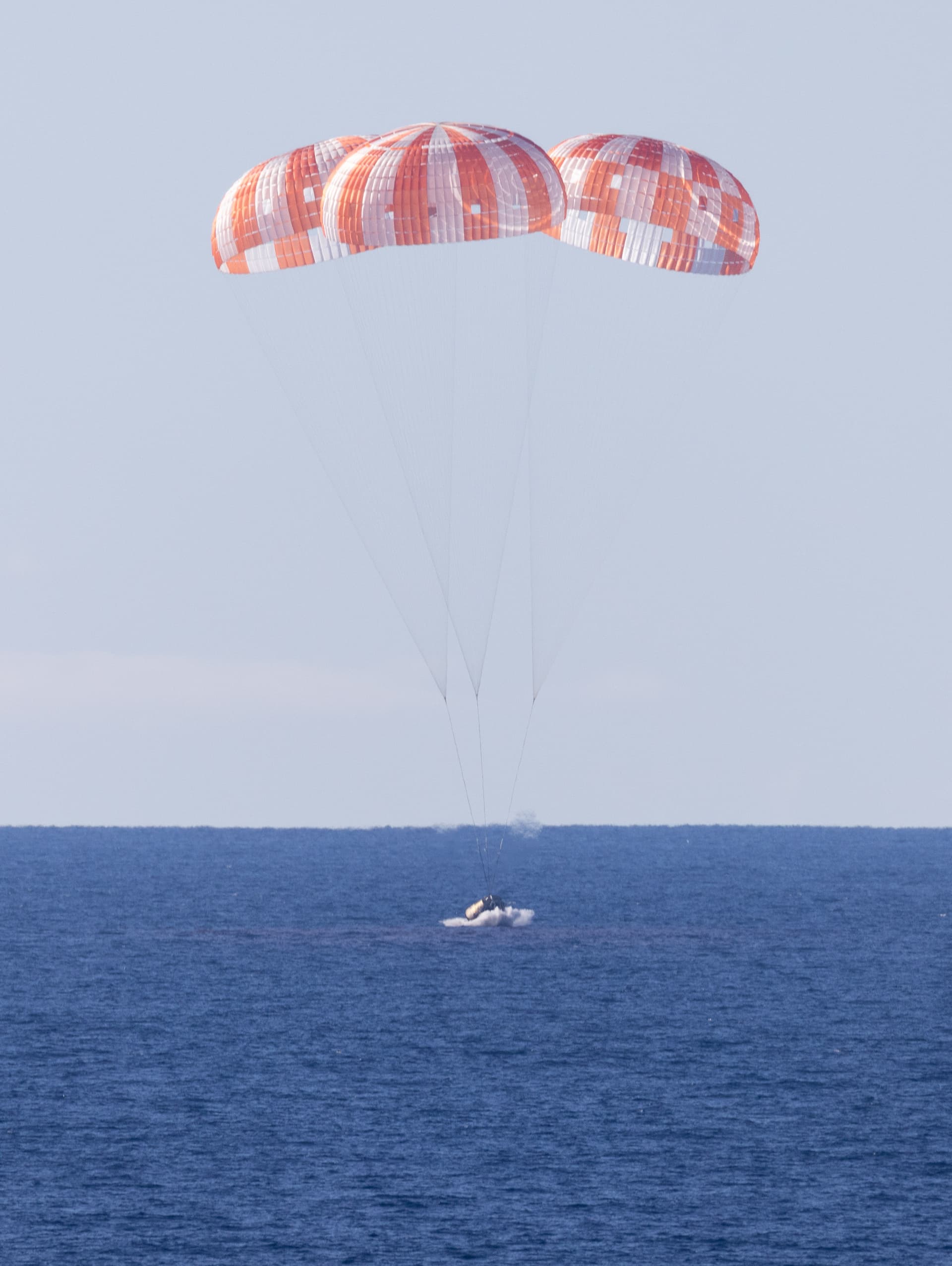
Four people walked off a Navy recovery ship under their own power on Friday afternoon, and that detail matters as much as the 694,481 miles they had just traveled.
Commander Reid Wiseman, Pilot Victor Glover, Mission Specialist Christina Koch, and Canadian Space Agency Mission Specialist Jeremy Hansen splashed down in the Pacific Ocean off San Diego at 5:07 p.m. PDT on April 10, completing a nine-day lunar voyage that began April 1 from Kennedy Space Center in Florida. When Navy crews aboard the USS John P. Murtha offered the four astronauts wheelchairs after a week and a half in microgravity, all four declined, walking to the medical bay themselves before being helicoptered to shore.
The gesture underscored what NASA most needed to demonstrate: that Orion and the systems supporting it can keep a crew alive, functional, and capable on a long deep-space mission. At their farthest point, the crew reached 252,756 miles from Earth, breaking the record of 248,655 miles set by the Apollo 13 crew in 1970. They were the first humans to travel to the Moon since Apollo 17 in December 1972, more than 53 years ago.
The mission packed an extraordinary cluster of historic firsts. Glover became the first person of color to travel beyond low Earth orbit; Koch became the first woman to do so; Hansen became the first non-U.S. citizen to join a lunar mission; and Wiseman, the mission's commander, became the oldest person to venture beyond low Earth orbit. Hansen, a Canadian fighter pilot, drew congratulations from Prime Minister Mark Carney as well as from President Donald Trump, who told Hansen during a phone call that Wayne Gretzky and Carney were "so proud of you." Trump later called the entire crew "modern-day pioneers" and said he looked forward to welcoming them at the White House.
The crew arrived at Ellington Field near Johnson Space Center in Houston on Saturday, April 11, the 56th anniversary of Apollo 13's launch. NASA Administrator Jared Isaacman called the flight "the opening act" in America's return to the Moon and greeted the crew with "Welcome home, Artemis." NASA Artemis program manager Lori Glaze was more direct after splashdown: "We did it. We sent four amazing people to the moon and safely returned them to Earth for the first time in more than 50 years."

The European Space Agency's European Service Module powered, propelled, and sustained the Orion spacecraft throughout the mission, a critical validation of the international hardware chain that NASA will depend on for every Artemis flight to come. The crew also captured striking imagery of Earth setting behind the lunar surface, an "Earthset" sequence that drew immediate comparisons to Apollo 8's iconic "Earthrise" photograph from 1968.
But the celebration now gives way to a more complicated set of decisions. Artemis II was explicitly a pathfinder test flight, not a landing. The next milestone, Artemis III, is currently targeted for mid-2027 and has been redesignated as a low-Earth orbit test mission, primarily to validate rendezvous and docking operations with the commercial Human Landing System. A crewed lunar landing has slipped to Artemis IV, targeted no earlier than early 2028. That landing will require either SpaceX's Starship HLS or Blue Origin's Blue Moon to be ready, and both vehicles face ongoing development delays. A Government Accountability Office review found that eight of thirteen key Human Landing System milestones had already slipped by at least six months before Artemis II even launched.
The financial math is stark. NASA's Office of Inspector General has calculated the operating cost of a single SLS and Orion flight at roughly $4 billion per launch. Total spending on the SLS rocket, Orion spacecraft, and Exploration Ground Systems had already exceeded $55 billion before April 1. The Trump administration's fiscal year 2026 budget proposal called for canceling SLS and Orion after Artemis III, raising unresolved questions about how subsequent lunar missions would be executed and at what cost.
For now, the program can claim what it set out to prove: that American astronauts can travel to the Moon and come back. The harder work, putting boots on the surface and sustaining the architecture to do it repeatedly, begins with the decisions Congress and the White House make in the next budget cycle.
Sources:
Know something we missed? Have a correction or additional information?
Submit a Tip