Artemis II Crew Tests Capsule Systems Before Friday Splashdown Near San Diego
Four Artemis II astronauts conducted radiation shelter and piloting tests aboard Orion on Wednesday as the capsule races toward a Friday Pacific splashdown.

Eight days into NASA's first crewed lunar mission since Apollo 17, the four-person Artemis II crew spent Wednesday running critical Orion spacecraft demonstrations aboard their capsule, named Integrity, with splashdown in the Pacific Ocean off San Diego set for Friday, April 10, at 8:07 p.m. EDT.
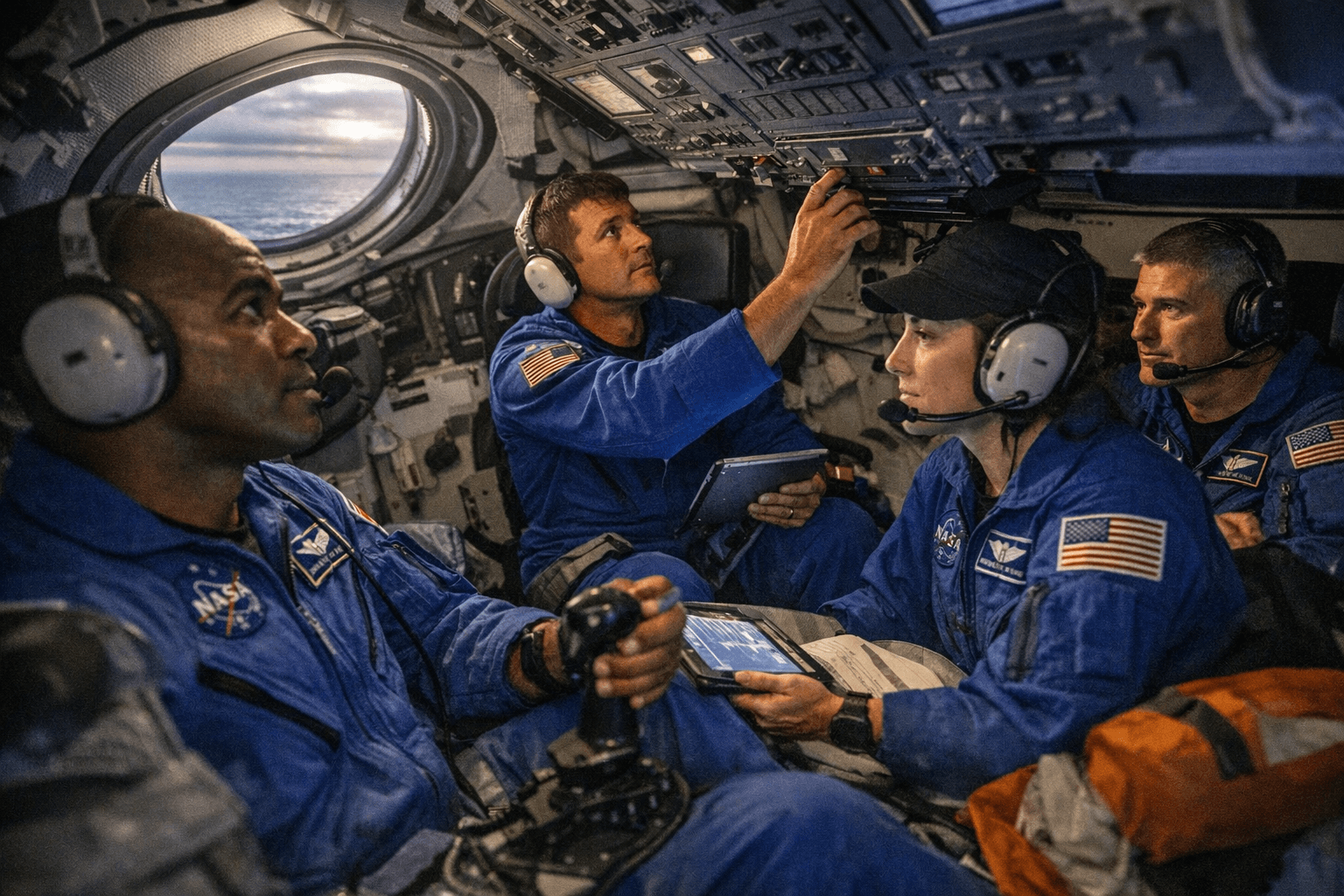
Flight day 8 centered on two key tests. The crew assessed their ability to protect themselves from high-radiation events such as solar flares, practicing the construction of a radiation shelter inside Orion's cabin. They also conducted manual piloting demonstrations, adding to a mission-long checklist designed to stress-test the spacecraft's systems in deep space conditions before NASA commits Orion to landing astronauts on the Moon.
Commander Reid Wiseman, Pilot Victor Glover, and Mission Specialists Christina Koch and Jeremy Hansen, a Canadian Space Agency astronaut, lifted off from Kennedy Space Center's Launch Pad 39B on April 1 at 6:35 p.m. EDT. Over the following days, the crew flew Integrity through a planned flyby of the Moon's far side on April 6, during which they surpassed the record for the farthest distance humans have ever traveled from Earth, reaching 252,756 miles, breaking the mark set by Apollo 13 in 1970. The mission is designed to cover 695,081 miles total from launch to splashdown.
The day before Wednesday's tests, Koch and Hansen reviewed procedures and monitored navigation data as Integrity completed its first return correction burn, a 15-second thruster firing at 8:03 p.m. EDT that produced a velocity change of 1.6 feet per second and nudged the spacecraft onto its final trajectory toward Earth. NASA confirmed that the USS John P. Murtha departed Naval Base San Diego that same day, heading to the midpoint of the recovery zone to be in position for crew retrieval.
Weather conditions for the splashdown looked cooperative. AccuWeather forecasts had the recovery area sitting near 63 degrees with winds between 7 and 15 mph, water temperatures around 64 degrees, and only a 20 percent chance of rain. Following splashdown, the crew will undergo medical evaluation before completing post-landing functional tests, including an obstacle course and a simulated spacewalk, designed to measure how quickly their bodies readapt to gravity after 10 days in deep space.
The reentry itself will be the fastest crewed atmospheric entry ever attempted, with Orion hitting the upper atmosphere at approximately 25,000 miles per hour. NASA modified the descent angle from the originally planned skip-reentry profile after heat shield erosion observed during the uncrewed Artemis I flight in 2022, opting instead for a steeper approach that reduces the time the capsule spends in peak thermal conditions.
The data Wiseman, Glover, Koch, and Hansen are generating about Orion's systems directly feeds NASA's planning for Artemis III, now targeted for mid-2027, and Artemis IV, the program's first planned lunar landing, slated for early 2028.
This article was produced by Prism’s automated news system from verified source data, official records, and press releases, then run through automated quality and moderation checks before publishing. The system is built and supervised by the people who set the standards it runs under. Read our full AI policy.
Did this article answer your question?