Artemis II live updates: NASA resolves flight termination issue, closes 2nd hatch
NASA cleared Artemis II for liftoff after engineers retrieved vintage Space Shuttle hardware to fix a flight termination system fault two hours before launch.

A last-minute technical fault with the rocket's flight termination system threatened to delay Artemis II just hours before liftoff, but engineers executed an improvised fix: retrieving a piece of legacy hardware from the Space Shuttle era stored inside the Vehicle Assembly Building at Kennedy Space Center.
The U.S. Space Force's Eastern Range identified the problem roughly two hours before the scheduled 6:24 p.m. EDT liftoff. The flight termination system, a critical safety mechanism designed to send a self-destruct signal to the rocket if it strays from its planned flight path, could not properly communicate with its ground hardware. The launch director authorized the FTS console operator to travel to the adjacent Vehicle Assembly Building to retrieve the heritage equipment. Once installed, the fault cleared. NASA spokesperson Derrol Nail confirmed: "The range is Go — that is no longer a constraint."
With the issue resolved, the closeout crew sealed the Orion capsule, closing both the Crew Module side hatch and the Launch Abort System hatch, locking all four astronauts inside. Technicians installed the crew module hatch service panel, which protects key connections and ensures the hatch area is secure for flight, and completed a hatch seal check to verify against air leaks.
The crew locked inside represents a string of historic firsts. Pilot Victor Glover, a naval test pilot who logged 168 days aboard the International Space Station during SpaceX Crew-1 in 2020 and 2021 and completed four spacewalks, became the first Black person and first person of color to travel to deep space. Mission Specialist Christina Koch became the first woman to venture to the vicinity of the moon. Mission Specialist Jeremy Hansen, flying for the Canadian Space Agency on his first spaceflight, became the first non-American and first non-NASA astronaut to fly on a lunar mission. Commander Reid Wiseman, a Navy test pilot, leads the crew. NASA Johnson Space Center Director Vanessa Wyche put the milestone plainly at the crew announcement: "Among the crew are the first woman, first person of color, and first Canadian on a lunar mission."
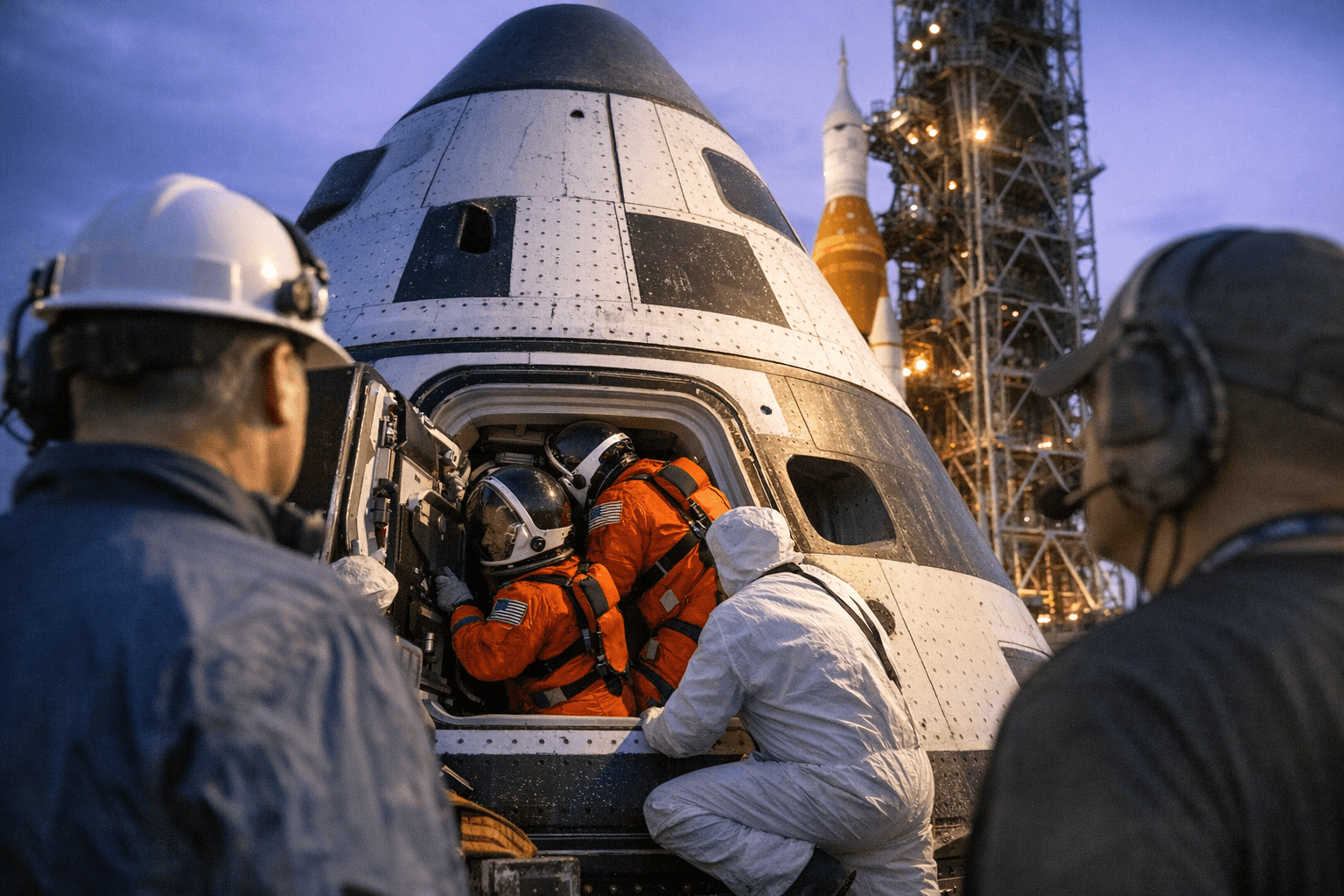
The Orion capsule launched atop NASA's 322-foot-tall Space Launch System rocket from Launch Complex 39B, the same pad used by the uncrewed Artemis I test mission in 2022 and its first crewed flight. The 10-day mission covers approximately 600,000 miles on a free-return trajectory, with the crew expected to come within about 6,000 miles of the lunar surface around April 6. The flight is projected to set a record for the farthest distance any human has traveled from Earth, approximately 252,000 miles, surpassing marks set during the Apollo program.
It was the first crewed lunar mission since Apollo 17 returned to Earth in December 1972, more than 53 years ago. Live coverage aired on NASA+, Amazon Prime Video, and YouTube.
This article was produced by Prism’s automated news system from verified source data, official records, and press releases, then run through automated quality and moderation checks before publishing. The system is built and supervised by the people who set the standards it runs under. Read our full AI policy.
Did this article answer your question?