Asian stocks mostly rise after Wall Street records, oil slips on Strait tensions
Wall Street’s record run lifted Asian stocks, while oil eased on Strait of Hormuz tensions. That mix could help retirement accounts, but it keeps inflation risks alive.

Asian stocks mostly climbed as Wall Street’s record-setting rally spilled into the region, but oil prices softened on signs that the next move in the Persian Gulf could shape inflation as much as investor sentiment. The U.S. benchmark crude fell 77 cents to $101.17 a barrel and Brent crude slipped 67 cents to $107.50, even after President Donald Trump said “Project Freedom” would begin Monday morning in the Middle East.
The U.S. stock market’s latest advance was powered by profits, not just momentum. The S&P 500 closed at 7,230.12, a record high, the Nasdaq composite finished at 25,114.44, also a record, and the Dow Jones Industrial Average ended at 49,499.27. Apple rose 3.3% after posting stronger-than-expected profit and emerged as the biggest force behind the S&P 500’s move. For households with 401(k)s, IRAs and index funds tied to the broad market, the rally has meant paper gains at a pace that can improve retirement balances quickly, though the latest leg higher has still leaned heavily on a handful of large companies.
The earnings backdrop has been strong enough to support the move. About a quarter of S&P 500 companies had reported results, and 84% beat analysts’ estimates. The index was on track for about 15% profit growth from a year earlier, and Friday’s advance gave the S&P 500 a fifth straight weekly gain, its longest such streak since 2024. That kind of run suggests more than a short-lived sentiment bounce, but it also leaves investors watching whether the gains broaden beyond mega-cap names such as Apple.
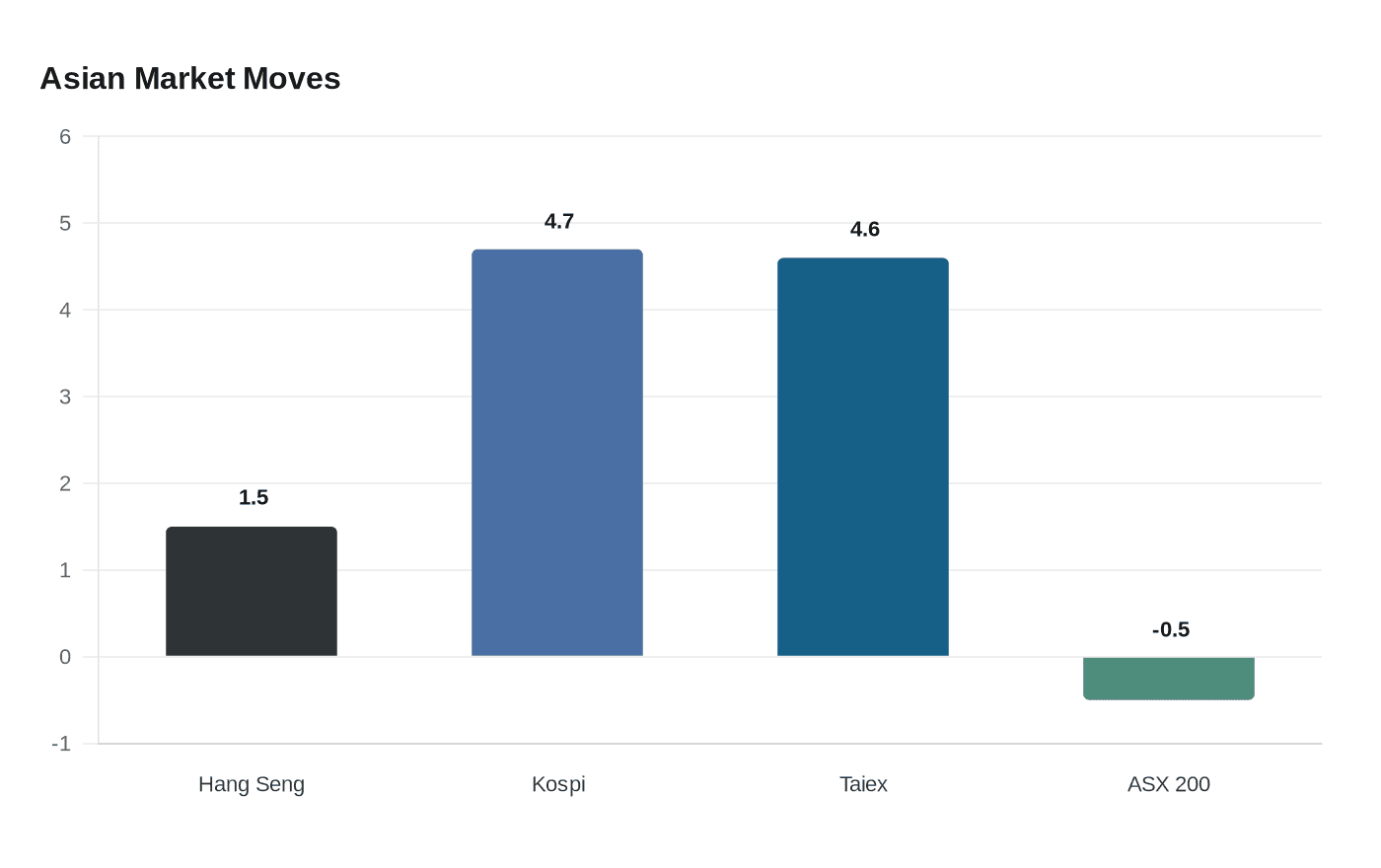
Across Asia, the reaction was mostly positive but uneven. Hong Kong’s Hang Seng rose 1.5% to 26,173.95, South Korea’s Kospi jumped 4.7% to 6,906.36 and Taiwan’s Taiex surged 4.6% as technology shares led the way. Samsung Electronics rose 4.8% and Taiwan Semiconductor Manufacturing Co. climbed 6.6%, underscoring how concentrated the regional rebound was in chipmakers. Australia’s S&P/ASX 200 slipped 0.5% to 8,690.60, while markets in Japan and mainland China were closed for Golden Week.
The oil market remains the key variable for inflation expectations. Trump said the U.S. would help ships leave the Strait of Hormuz, and U.S. Central Command said the operation would involve guided-missile destroyers, more than 100 aircraft and 15,000 service members. Iran rejected the plan. Stephen Innes of SPI Asset Management called oil the “fulcrum,” noting that hundreds of tankers, bulk carriers and cargo ships were still stranded across the Gulf as storage constraints forced producers to shut production. If oil stays elevated, gasoline, shipping and food costs could keep pressure on households even as stocks set fresh highs.
This article was produced by Prism’s automated news system from verified source data, official records, and press releases, then run through automated quality and moderation checks before publishing. The system is built and supervised by the people who set the standards it runs under. Read our full AI policy.
Did this article answer your question?

