Asian stocks slide again as bond yields and inflation fears rise
War-driven inflation fears pushed Treasury yields to 16-month highs, dragging Asian stocks lower as Nvidia’s earnings approached.

Asian stocks slipped again on Wednesday as investors faced a harsher mix of war-driven inflation fears, rising bond yields and a crucial earnings test from Nvidia, a combination that kept money moving out of risk assets and into safe havens.
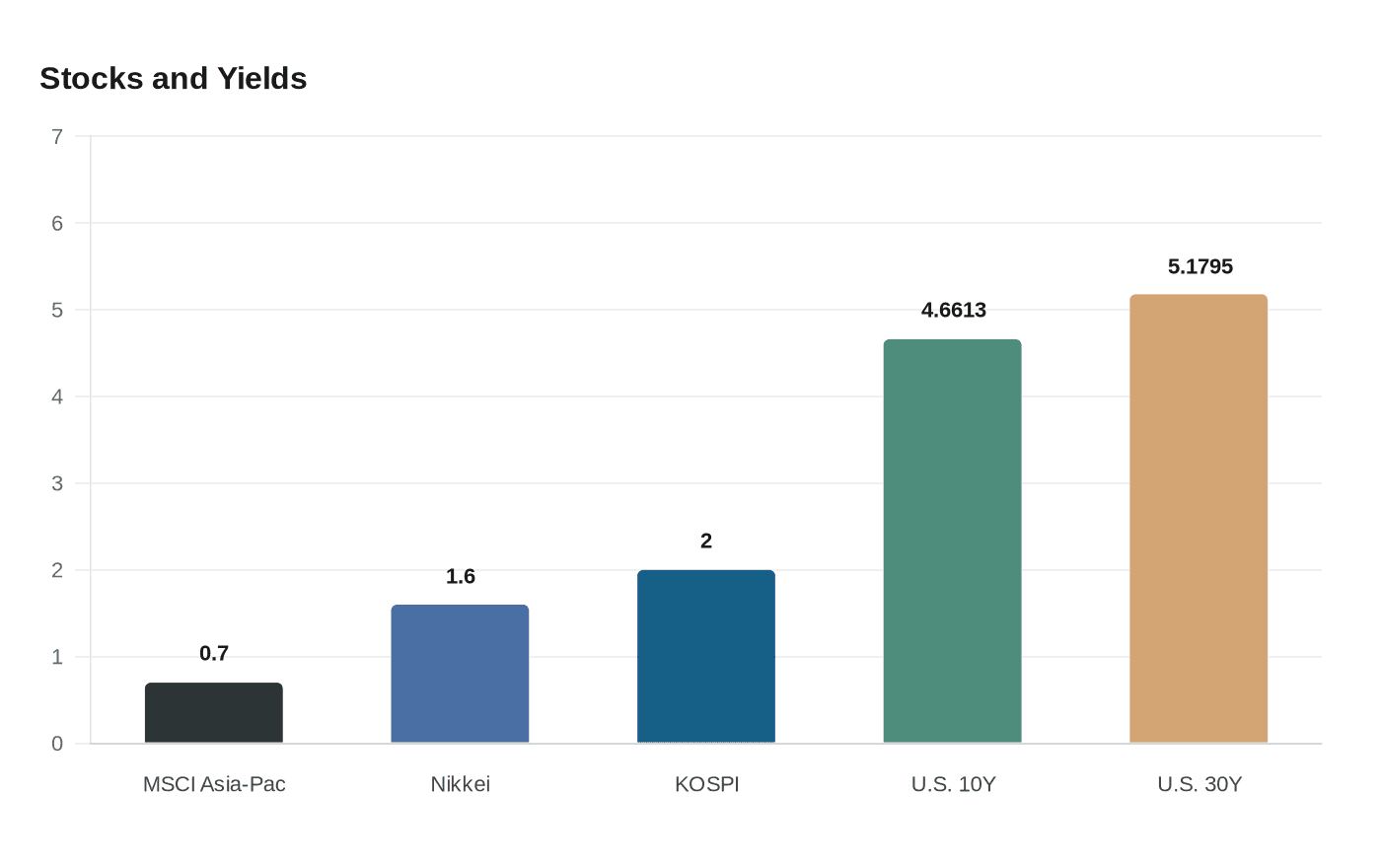
The MSCI Asia-Pacific index outside Japan fell 0.7%, marking a fourth straight decline. Japan’s Nikkei dropped 1.6% for a fifth consecutive session, while South Korea’s KOSPI slid 2% as the region’s technology-heavy markets came under renewed pressure. Treasuries stayed under strain in Asia, with the U.S. 10-year yield around 4.6613% after rising 21 basis points in three sessions and the 30-year yield near 5.1795% after a 17-basis-point climb since last Thursday. The benchmark 10-year touched a 16-month high, while the long bond moved to levels last seen in 2007.

The bond selloff has altered the market’s policy outlook as well. Traders are increasingly betting the Federal Reserve’s next move could be a rate increase rather than a cut, a sharp reversal from the easier policy hopes that supported equities earlier in the year. A Reuters poll published on May 19 found that most economists now expect the Fed to avoid cutting rates this year, with less than half still seeing a cut, down from just over two-thirds in the previous month.
That shift has collided with a geopolitical backdrop that continues to feed inflation anxiety. Oil prices stayed elevated as the Strait of Hormuz remained effectively closed, reinforcing fears that energy costs could stay high and complicate central-bank policy. The World Bank said the disruption triggered the largest oil market shock in history, while UNCTAD said the strait remained practically closed, leaving global trade and inflation under pressure.
The strain was visible in regional company news as well. Samsung Electronics fell after its union said a strike would go ahead, following failed talks over bonus payments. The company and its labor union did not reach a deal, setting the stage for 48,000 workers to walk off the job on Thursday, adding another supply-chain worry at a time when semiconductor demand remains central to global markets.
All of that has made Nvidia’s results unusually important. Investors are looking for another blowout report, but they also want proof that the company can still justify its extraordinary valuation in a world where borrowing costs are rising. Nvidia’s fiscal fourth quarter ended Jan. 25, 2026, with record revenue of $68.1 billion, up 73% from a year earlier, and full-year revenue of $215.9 billion, up 65%. For markets already rattled by war, oil and yields, those numbers now matter far beyond one stock.
Know something we missed? Have a correction or additional information?
Submit a Tip