Astronomers capture rare full view of massive star’s supernova death
Caught at shock breakout, SN 2026gzf was tracked from March 21 into April as its light brightened and shifted from blue to green.
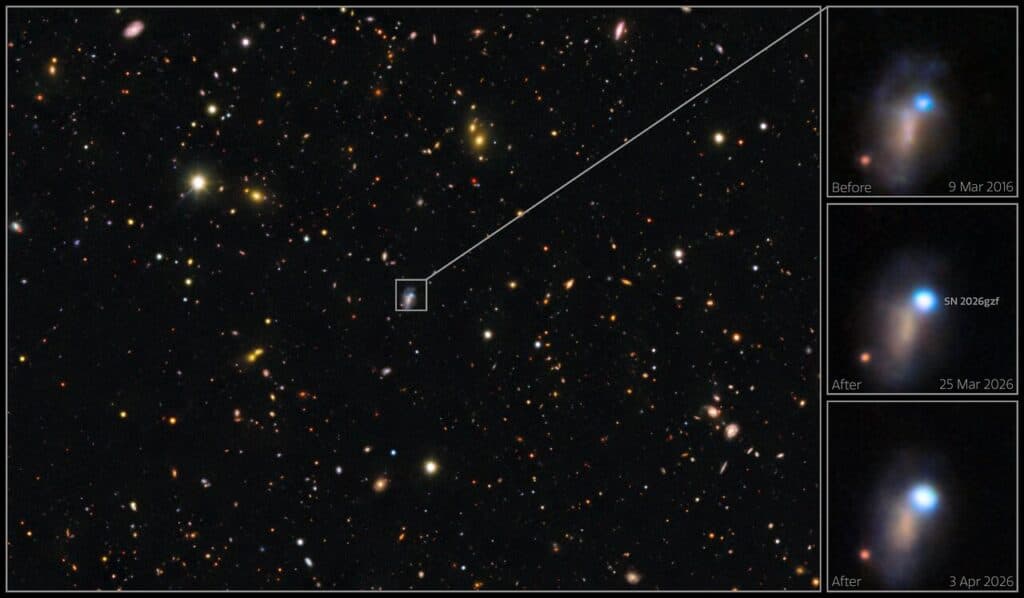
Astronomers caught SN 2026gzf on March 21 with the Einstein Probe and then watched it brighten again in images taken March 25 and April 3, a rare sequence that showed a massive star’s death from its first flash to its fade. The supernova, in a galaxy about 500 million light-years away, gave researchers a before-and-after view they usually do not get when studying stellar explosions.
The event was identified as a broad-lined Type Ic supernova and described in the paper as the faintest shock breakout tied to such a blast. That opening phase is the moment when the shock wave from the collapsing star breaks through the surface and emits ultraviolet and X-ray light. Supernovae are often discovered after that point has already passed, which leaves astronomers with only a fragment of the story instead of the full sequence of collapse, breakout, brightening and decline.
Follow-up observations with the 570-megapixel DOE-fabricated Dark Energy Camera helped trace the explosion as it unfolded. Radio observations from the National Radio Astronomy Observatory ruled out a relativistic jet, tightening the picture of how the blast was shaped. An abstract for the Einstein Probe transient EP260321a and SN 2026gzf placed the source at redshift 0.0344, the kind of distance that makes this kind of detailed coverage even more unusual.
The archival record made the discovery even more valuable. A March 9, 2016 image showed a bright blue source at the supernova site, and additional archival images from May 2025 through January 2026 showed the same blue light at that location. Astronomers said the source likely marked a compact, extreme star-forming region in the host galaxy, along with activity from the progenitor star before it died.
Over the following hours and days, the explosion briefly outshone the entire galaxy and shifted from blue to green before fading. Seeing that color change alongside the pre-explosion images gave scientists a rare way to connect the last stages of a massive star’s life with the material it hurled into space, sharpening models of core collapse and the heavy elements such explosions spread through galaxies.
This article was produced by Prism’s automated news system from verified source data, official records, and press releases, then run through automated quality and moderation checks before publishing. The system is built and supervised by the people who set the standards it runs under. Read our full AI policy.
Did this article answer your question?