Atlas V launches 29 Amazon satellites, sets heaviest payload record
Atlas V hauled 29 Amazon broadband satellites in one shot, the heaviest payload ULA has ever flown on the rocket.
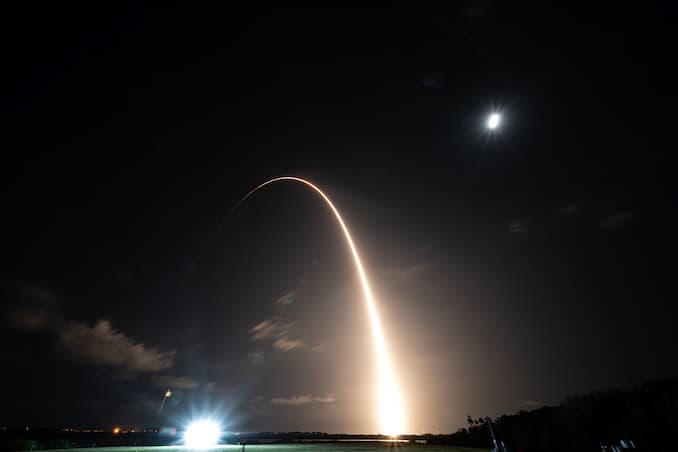
United Launch Alliance pushed Atlas V to a new threshold on April 4, when the rocket lifted off from Space Launch Complex-41 at Cape Canaveral Space Force Station, Florida, at 1:46 a.m. EDT carrying 29 Amazon Leo broadband satellites. ULA said the mission set two records at once: the most satellites ever flown on an Atlas V and the heaviest payload the rocket has ever launched.
The flight, called Amazon Leo 5, was more than a count of hardware headed for orbit. It marked another step in Amazon’s effort to build a low-Earth-orbit broadband network with more than 3,000 satellites, a system designed to compete in the same market that SpaceX’s Starlink has already turned into a global race. ULA said the launch brought the total number of satellites it had delivered for Amazon Leo to 139, and the company’s commercial launch agreement with Amazon will carry more than half of the initial constellation.
That matters because launch economics decide how fast a satellite network can scale. A heavier payload packed with 29 satellites spreads one rocket launch across more units in orbit, lowering the per-satellite cost of getting the constellation built. For Amazon, that is the difference between a long, expensive rollout and a network that can start approaching national and international broadband scale at a pace that makes it a credible rival.
ULA’s own launch cadence shows the size of the buildout still ahead. Spaceflight Now reported that a separate Atlas V mission for Amazon Leo was the 10th batch of production satellites sent to orbit and was scheduled for 8:53:30 p.m. EDT from pad 41 at Cape Canaveral Space Force Station. That broader deployment has also drawn public attention far beyond Florida. Florida Today reported that the Atlas V was visible in Charleston and Myrtle Beach, South Carolina, Asheville, North Carolina, and as far north as Howell, New Jersey.
For Amazon, the mission is less about a single launch than about proving that a private broadband network can be assembled at industrial scale. For ULA, it shows Atlas V can still carry unusually dense commercial loads into orbit. For the broadband market, it signals that Amazon is no longer simply entering the contest. It is building the launch pipeline needed to stay in it.
This article was produced by Prism’s automated news system from verified source data, official records, and press releases, then run through automated quality and moderation checks before publishing. The system is built and supervised by the people who set the standards it runs under. Read our full AI policy.
Did this article answer your question?