Auction houses engineer art market rebound after four-year slump
Auction houses helped turn a 27.3 percent collapse into an $11.7 billion rebound by curating supply and leaning on luxury. The comeback was strongest above $1 million.

Auction houses did not simply wait for buyers to return. They reset the terms of the market, managed seller expectations and leaned on luxury categories to turn a four-year slump into a carefully staged rebound.
The turnaround came after a brutal contraction. Total fine-art auction sales fell 27.3 percent in 2024 to $10.2 billion, then slid another 8.8 percent in the first half of 2025 to $4.72 billion. By the end of 2025, though, the market had clawed back to $11.7 billion, a 13.3 percent increase from 2024 and the first annual gain since 2021, when auction spending reached $16.6 billion.
Christie’s signaled the new playbook early in 2025, reporting first-half auction sales of $2.1 billion, flat from a year earlier, while luxury sales rose 29 percent and its 20th and 21st century category held steady at $1.3 billion. Sotheby’s and other houses pushed harder into luxury and private sales as the art side remained uneven. Charles F. Stewart described the market as “very resilient” and later said supply was “catching up with demand,” a telling admission that the recovery was being shaped as much by inventory management as by raw appetite.

The strongest price bands show where that appetite settled. Sales in the $1 million to $10 million range reached $3.5 billion in 2025, up 20.8 percent from 2024, while works priced above $10 million brought in $2.3 billion, up 36.1 percent. That concentration at the top suggests the rebound was narrow, not broad based, and that auction houses successfully steered collectors toward “known quantities” after the speculative boom in ultra-contemporary art lost steam.
That strategy was most visible in New York. In November 2025, the city’s major auction houses had at least $1.67 billion of art on offer, 54 percent more than the same cycle a year earlier, with a deeper bench of Impressionist and Modern estates helping support the season. By May 2026, the spring sales were estimated at between $1.8 billion and $2.6 billion across Christie’s, Sotheby’s, Phillips and Bonhams. Early reporting said roughly $2.1 billion sold across the Big Three’s evening auctions, more than double the comparable week in May 2025.
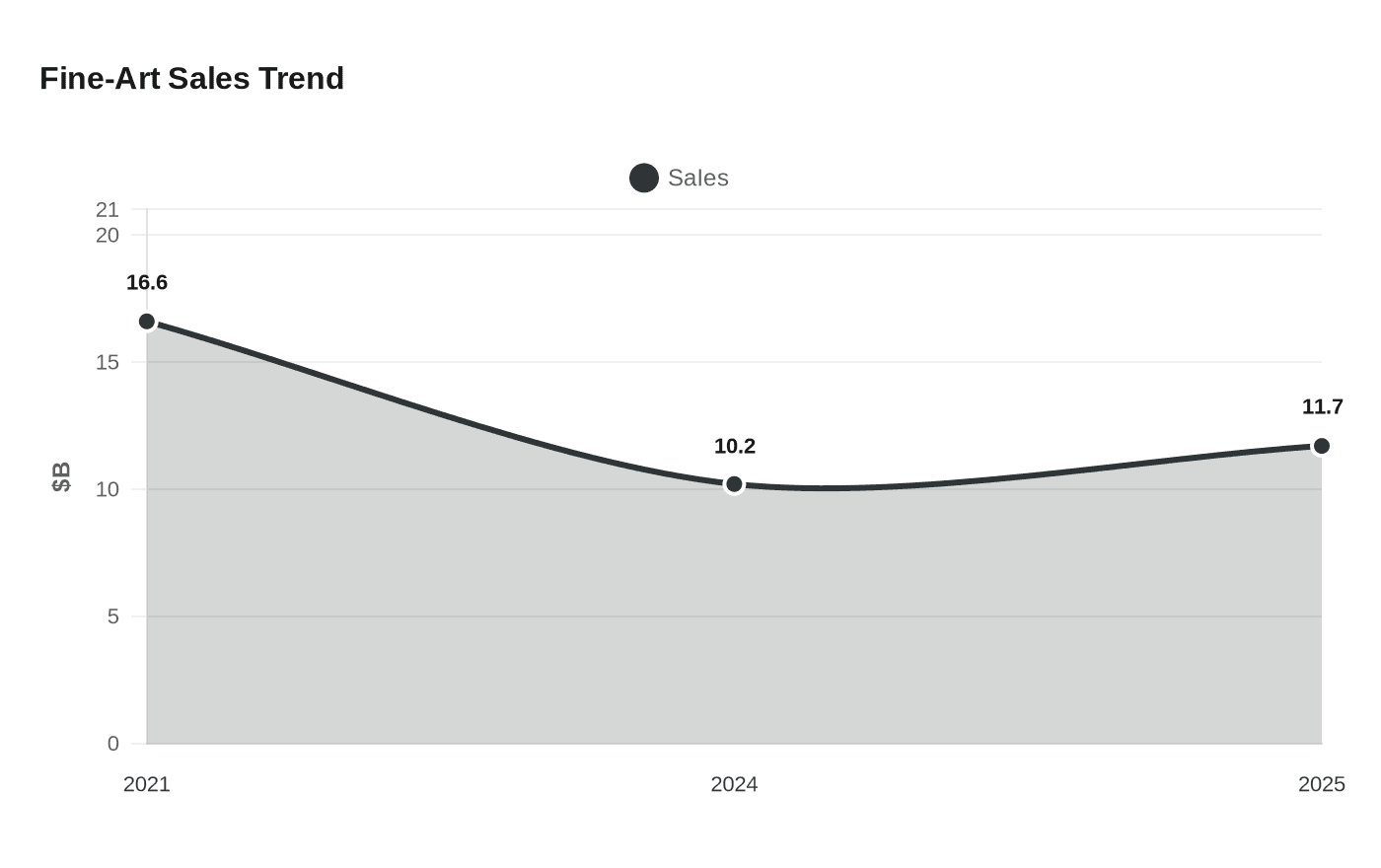
The numbers point to a market that has stabilized, but only on carefully managed terms. The houses engineered confidence by limiting risk, elevating premium lots and matching supply to a thinner, more cautious buyer pool. Whether that is a durable recovery or a polished version of resilience will depend on whether demand widens beyond the familiar names and familiar price bands that carried the rebound.
This article was produced by Prism’s automated news system from verified source data, official records, and press releases, then run through automated quality and moderation checks before publishing. The system is built and supervised by the people who set the standards it runs under. Read our full AI policy.
Did this article answer your question?

%3Amax_bytes(150000)%3Astrip_icc()%2FCertificate-of-deposit-2301f2164ceb4e91b100cb92aa6f868a.jpg&w=1920&q=75)
