Black unemployment stays elevated as White jobless rate remains lower
Black unemployment held at 6.6% in June while White jobless rate was 3.6%, as long-term unemployment rose and the labor market cooled unevenly.

Black unemployment stayed at 6.6 percent in June even as the White jobless rate held at 3.6 percent, leaving a wide gap in a labor market that barely moved overall. The U.S. unemployment rate was 4.2 percent, payroll employment rose by just 57,000, and the Black jobless rate remained the highest among major racial groups.
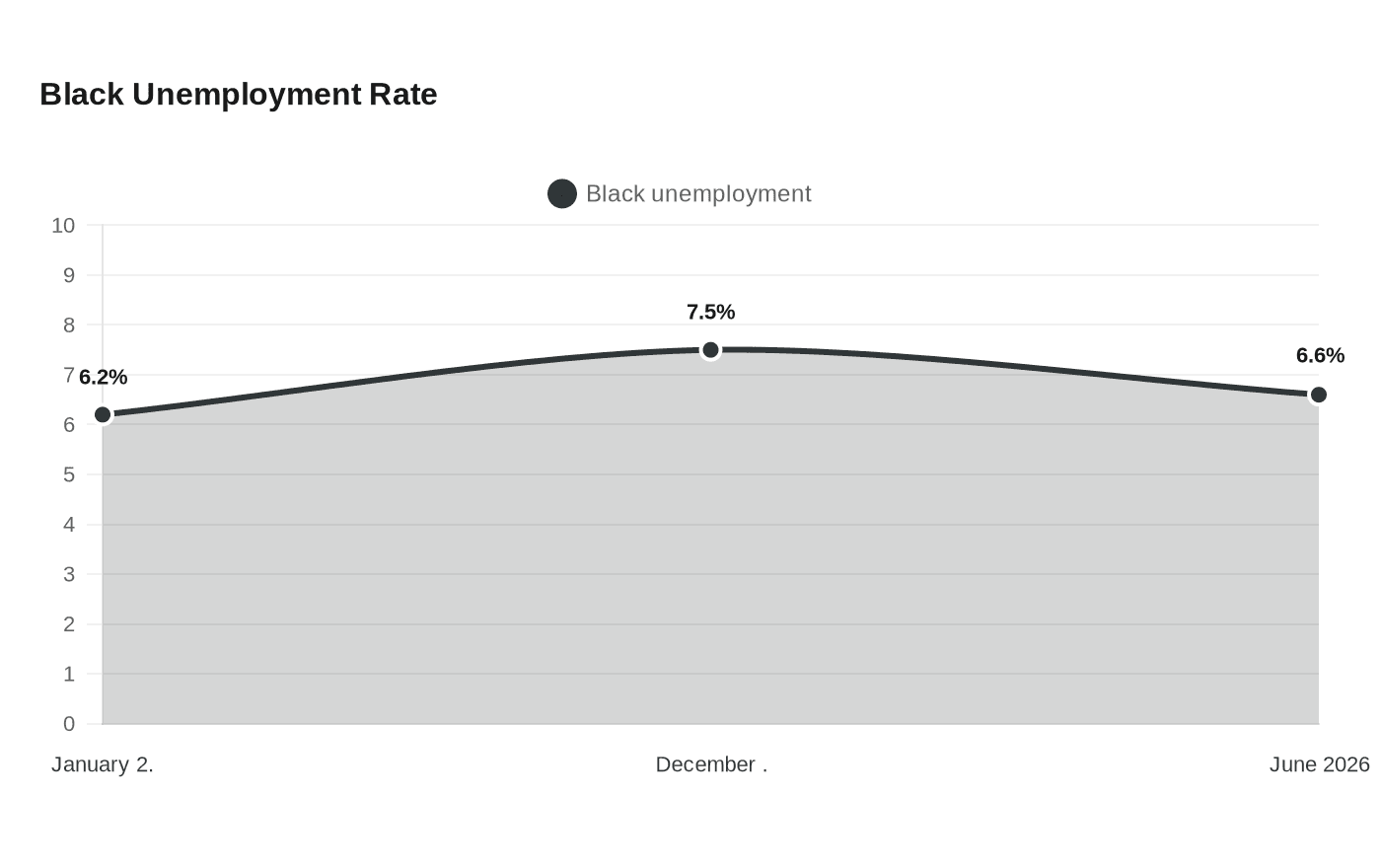
The June figures showed how unevenly the slowdown has landed. The Joint Center for Political and Economic Studies said Black unemployment was unchanged from May at 6.6 percent, still above the national average. The first half of 2026 has been worse on average, with Black unemployment running at 7 percent, about 0.6 percentage points higher than the same period a year earlier.
That strain built through 2025. The Joint Center’s State of the Dream 2026 report said Black unemployment rose to 7.5 percent in December 2025 from 6.2 percent in January 2025, a jump that it described as a year of economic regression for Black communities. The gap has also widened since Donald J. Trump took office last year, reinforcing a pattern that has persisted even when the broader economy appears stable.
The pressure has not been spread evenly across Black workers. The Economic Policy Institute said a softening labor market worsened unemployment for Black workers nationwide in the first quarter of 2026 and that unemployment and Black-white inequality rose across states. In separate commentary, the group said Black women bore especially large employment losses in 2025, including among college graduates and public-sector workers, showing how weakness in specific occupations can hit some groups faster than others.
Longer-running labor-market stress adds to the picture. The Bureau of Labor Statistics said long-term unemployment reached 1.9 million in June, up 286,000 from a year earlier. Federal Reserve Bank of St. Louis data series tracked by FRED show the Black unemployment rate across decades, while the Black-minus-White unemployment gap extends back to 1954, underscoring how durable the disparity has been.
The June numbers suggest the cooling is still being absorbed first by Black workers, while White unemployment remains lower and more stable. With the racial spread still at 2.4 percentage points in June, the labor market is sending the same signal it has for decades: when hiring weakens, Black households feel it sooner and more sharply.
This article was produced by Prism’s automated news system from verified source data, official records, and press releases, then run through automated quality and moderation checks before publishing. The system is built and supervised by the people who set the standards it runs under. Read our full AI policy.
Did this article answer your question?
%3Amax_bytes(150000)%3Astrip_icc()%2FCertificate-of-deposit-2301f2164ceb4e91b100cb92aa6f868a.jpg&w=1920&q=75)