Australia pledges new hate laws, large gun buyback after Bondi attack
Prime Minister Anthony Albanese and New South Wales leaders unveiled a package of immediate and longer term responses after a mass shooting at a Hanukkah event in Bondi Beach that killed 15 people. The measures seek to tighten hate crime and hate speech laws, review migration rules, step up policing, and remove firearms through a national buyback, a major shift in Australian public safety policy.
Fifteen people were killed at a Hanukkah gathering on Bondi Beach on December 20, 2025, a violence that has left Sydney and the nation in mourning. Funerals and community vigils continued as officials moved rapidly to shore up security around Jewish and other vulnerable sites, and to propose a suite of legal and operational reforms designed to prevent further attacks and address a rising tide of antisemitism.
Prime Minister Anthony Albanese convened emergency talks with state and federal leaders and announced a program of measures that he said would be pursued immediately and through the parliamentary process. He joined Sydney’s Jewish community at the Great Synagogue and posted on X that "All Australians stand together against antisemitism and hatred." The government also ordered stepped up patrols and protective policing nationwide while drafting legislative changes.
At the centre of the federal package are tougher hate crime and hate speech provisions. The government intends to broaden existing offences so they can capture preachers or community leaders who promote violence, designate some groups as hateful for legal purposes, and allow judges to treat bias as an aggravating factor in online threats and harassment. Officials framed the changes as both a criminal justice and social cohesion response to a surge in targeted hostility since the Gaza conflict.
The national government also announced a review of migration rules intended to bar people who openly hold antisemitic or racist views from entering Australia. The review will examine whether current character and security grounds are sufficient to exclude applicants and how to implement any new standards consistent with international law and non discriminatory obligations.
Perhaps the most politically fraught element is a new national gun buyback and tighter firearms oversight. The government described the buyback as the largest since 1996 and said it would be coupled with regular reviews of licence holders. Mr Albanese said the buyback would "help get guns off our streets." State leaders signalled parallel measures, including stricter licensing criteria and restrictions on large calibre weapons.
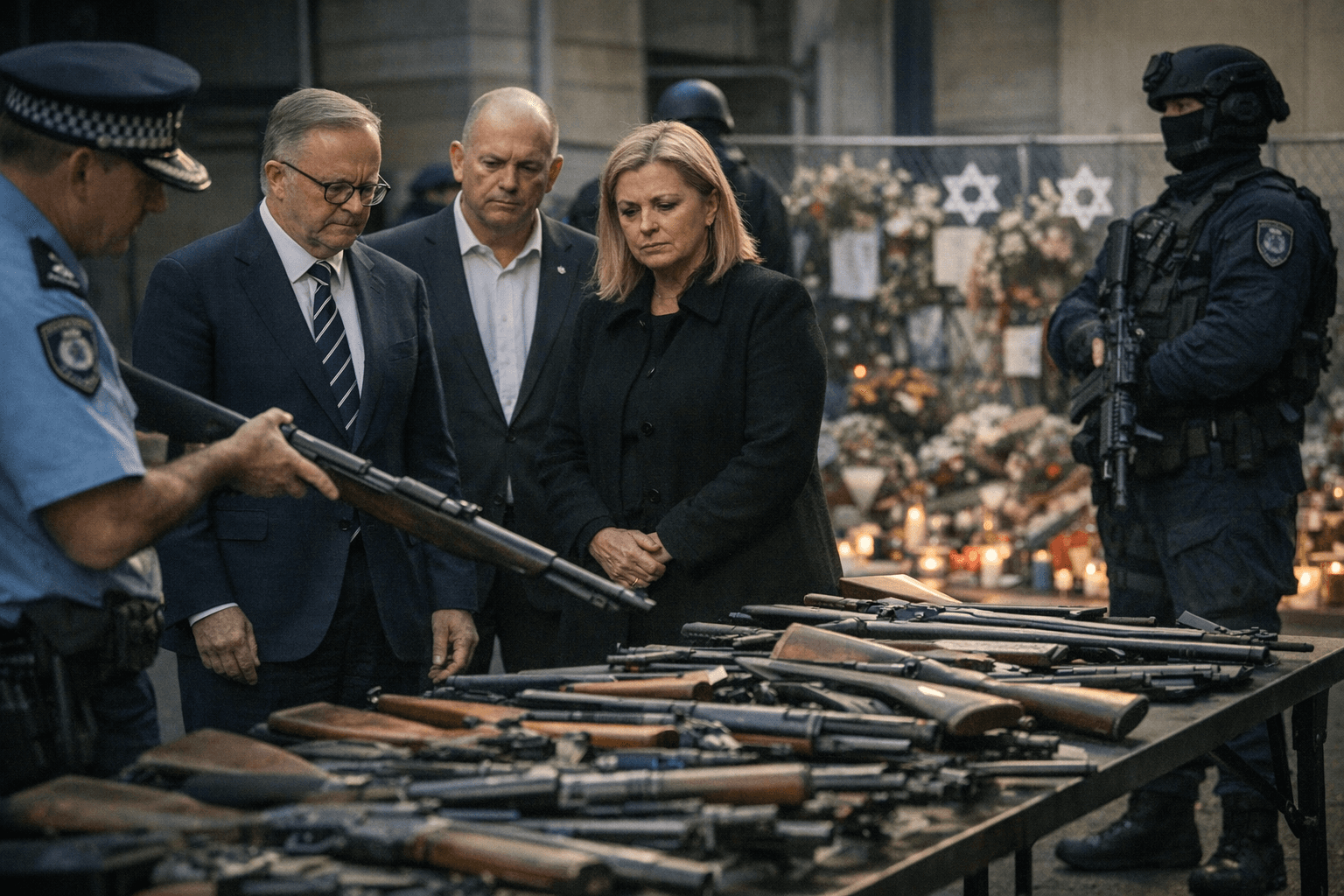
In New South Wales, Premier Chris Minns proposed draft legislation that would make public displays of Islamic State flags or symbols of other extremist groups an offence punishable by up to two years imprisonment and fines. Mr Minns also questioned the civilian need for heavy weaponry outside agriculture, asking "If you’re not a farmer, you’re not involved in agriculture, why do you need these massive weapons?" The state intends to present the draft law to parliament and is exploring additional controls on protests and public order to reduce the risk of copycat incidents.
The government faces immediate pressure from communities and opposition figures who say more should have been done earlier to address antisemitism. Officials note that Canberra had previously passed laws criminalising hate speech and expelled the Iranian ambassador after accusing Tehran of directing two antisemitic arson attacks.
Most of the measures announced are policy commitments rather than completed laws. The hate law amendments, migration changes, the detailed design and timetable of the buyback, and enforcement rules for the flag ban will require drafting, consultation, and parliamentary debate. For now, enhanced policing is the primary immediate deterrent while lawmakers seek to turn political resolve into enforceable law.
This article was produced by Prism’s automated news system from verified source data, official records, and press releases, then run through automated quality and moderation checks before publishing. The system is built and supervised by the people who set the standards it runs under. Read our full AI policy.
Did this article answer your question?


