Baker County, Fire Rescue Offer Wildfire Preparation Checklist and Free Inspections
Free home inspections and a detailed homeowner checklist aim to reduce wildfire risk across Baker County’s 503,000 acres of WUI and roughly 2,600 homes.

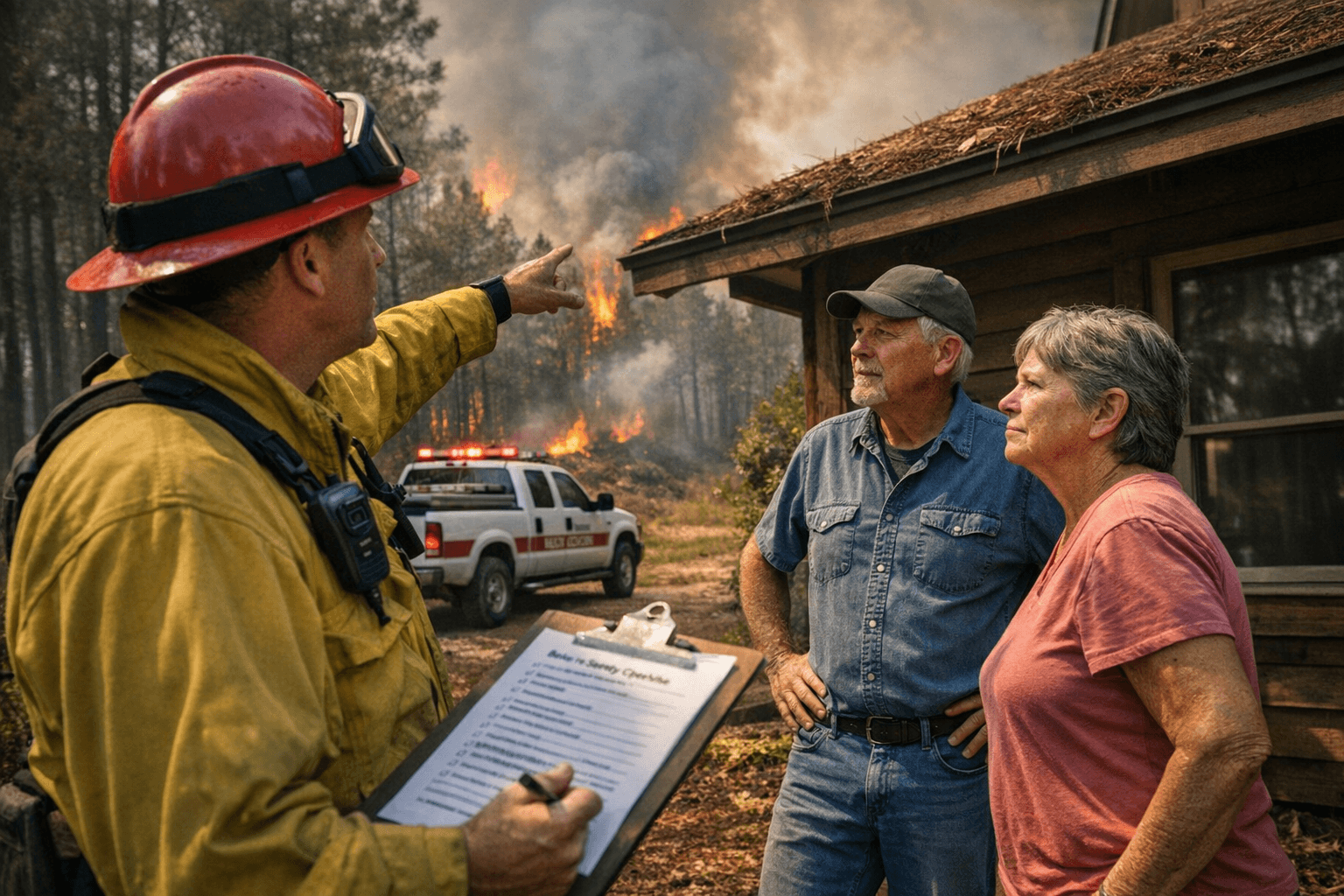
Baker County and Baker City Fire Rescue are promoting a practical wildfire-preparation checklist for homeowners, landowners and small-ranch operators and notifying residents about free home inspections cited in the county CWPP. The risk context is large and local: “503,000 acres of WUI land has been identified in 28 different WUI areas across the county,” and “Approximately 2600 homes are located within these WUI areas,” while “Within those areas, 42 communities would be directly threatened or affected by a large wildfire event.”
1. Free home inspections: what the county already promotes
Baker County’s Community Wildfire Protection Plan (CWPP) explicitly includes “notification of free home inspections for homeowners” and promotes “fire-resistant plants” as part of mitigation outreach. These inspections are listed among other mitigation programs intended to reduce structure ignitions; the CWPP also promotes equipment investments for firefighters and vehicles. The CWPP text indicates the county actively uses homeowner outreach as a primary mitigation tool, but the extracts provided do not include scheduling, eligibility rules, or which office conducts inspections—those operational details should be confirmed with Baker City Fire Rescue or the County Fire Marshal before relying on inspection availability.
2. Quick risk snapshot every homeowner should know
Baker County’s landscape and vegetation create broad exposure: “Densely forested Douglas fir forests and stands of ponderosa pine may highly vulnerable to wildfire because of natural aridity of the climate in Baker County and the frequency of lightning strikes.” In addition, “Grasslands, which naturally cover much of the region, also are potentially flammable.” Those vegetation patterns, combined with the WUI statistics above, underline why the checklist and inspections target both individual properties and neighborhood-level fuel issues.
3. Defensible space: the 30-foot guidance and key exceptions
The homeowner checklist repeatedly advises maintaining defensible space of 30 feet from structures—stated plainly as “30 feet from any structures.” Within that zone, follow the checklist’s pruning and spacing rules: remove tree branches less than 6 feet above the ground and maintain at least 10 feet between neighboring tree canopies. Shrub plantings should favor low-growing, fire-resistant species and be arranged in small groupings—no more than three shrubs or a maximum of 10 feet wide, spaced 10 feet apart—to create a discontinuous fuel profile that reduces fire spread toward buildings.
4. Storage and movable items: where to park and what to remove
The local homeowner guidance contains two related precautionary measures about vehicles and stored items: it warns not to “park or store any vehicles, boats, RVs, trailers, or ATVs within 5 feet of the home,” and it states the promotion: “Ideally, store these items in a closed garage or park them at least 30 feet away from the home.” The checklist also instructs homeowners to remove combustible items (firewood, potted plants, outdoor furniture, trash cans, pet houses, lawn tools, sheds, hot tubs, children’s playsets) from the immediate zone around the home. Because the documents include both 5-foot and 30-foot guidance, homeowners should verify the recommended separation for their property type with the County Fire Marshal or Baker City Fire Rescue.
5. Structure setbacks and accessory buildings: conflicting guidance to resolve
Checklist items address accessory structures such as sheds, hot tubs, pergolas and playsets; one segment directs homeowners to “Maintain structures within 30 feet of your home (i.e., sheds, hot tubs, pergolas, and playsets)” and another truncated line references placing structures “at least 10 feet away.” Elsewhere the numbered hardening checklist repeats that action to “Move structures 30 feet from your home.” The multiple explicit distances in the source materials (10 feet and 30 feet) should be treated as distinct recommendations in the record; verify which standard applies to your parcel before moving or removing structures.
6. Roofs and gutters: prioritized upgrades
The checklist gives specific material recommendations for reducing structure ignitability: “Replace a wood shake/shingle roof with a Class A fire-rated roof cover such as asphalt shingles, tile, slate, or metal roofs.” It also advises regularly clearing “all tree debris from your roof and gutters,” replacing plastic or vinyl gutters with metal gutters, and installing noncombustible gutter guards to keep debris out. For tile and some metal roofs, the guidance notes that they “must also include bird stops at the edges, to prevent intrusion under the tile by birds or other wildlife.” These measures are cited as discrete, actionable upgrades homeowners can schedule or prioritize during routine maintenance.
7. Building hardening: eaves, vents, dryer exhausts and windows
The checklist presents a short, actionable hardening list that homeowners can work through: enclose eaves with noncombustible or ignition-resistant soffit material (fiber-cement board or nominal 2-inch lumber) and, if vented, use ember-resistant vents or 1/8-inch or finer metal wire mesh; “Install noncombustible gutter guards to keep tree debris out”; “Install a noncombustible dryer vent. ☐ Install a metal dryer vent, which includes louvers or a flap.” It also recommends replacing exterior windows with tempered, multipaned glass—“Replace all exterior windows with tempered, multipaned glass (at least 2 panes tempered) or fire-resistant glass.” These items are presented as discrete checklist actions and align with reducing ember-ignition pathways on homes.
8. Vegetation and fuels work at the landscape scale
Baker County’s CWPP links fuel reduction to both wildfire mitigation and forest health, promoting thinning and prescribed burning and recognizing “re-treatment of forest stands.” The CWPP frames fuel reduction as a multi-benefit approach—resisting pests such as bark beetles and improving hydrological and wildlife outcomes—noting that “The effects of fire on ecosystem resources can include damages, benefits, or some combination of both. The benefits can include, depending upon location and other circumstances, reduced fuel load, disposal of slash and thinned tree stands, increased forage plant production, and improved wildlife habitats, hydrological processes, and aesthetic environments.” For landowners with larger parcels or adjacent forest stands, coordinate fuels projects with county programs and any permitted prescribed-burn processes.
9. Planning, permits and mitigation plans for new development
Local planning guidance informed by CPAW requires that a wildfire mitigation plan for development “shall address at a minimum” vegetation on lots, building construction methods and materials, utilities, fire protection (access, water supply, signage), public safety (areas of refuge, evacuation routes), site constraints (vacant lots, ditches, canals), and HOA/POA roles for implementation and maintenance. The CPAW extract explains the program: “CPAW (pronounced ‘SEE-PAW’)… a national program that provides professional land use planners, foresters, and fire behavior specialists to recommend improvements to local policies and codes.” CPAW worked with the Baker County Planning Department and Baker County Fire Rescue among others; mitigation plans are “subject to review and approval by the County Fire Marshal.”
10. Fire response, mutual aid and operational limits
Local fire governance includes mutual aid: “Mutual Aid Agreements exist among the fire authorities for mutual aid and support in the event of a wildfire incident; however, each fire authority operates under regulations that dictate their area of responsibility and specify limitations.” The CWPP extract also notes state and federal wildland firefighters can provide wildfire support, though the sentence is truncated in the source. Homeowners should understand that station equipment and mutual aid improve response capacity, but operational boundaries and resource limits can affect response times and tactics during large incidents.
- Verify whether free home inspections are currently scheduled, who performs them, and how notification is delivered.
- Confirm the county’s official setback standard for structures, stored vehicles and accessory buildings (10 ft vs 30 ft).
- Request the complete Baker County CWPP and full CPAW deliverables (the CPAW extract refers to three outputs).
- Ask Baker City Fire Rescue or the County Fire Marshal for the local list of recommended fire-resistant plants and any locally adopted construction/code standards referenced in mitigation plans.
11. What to confirm before you act: verification checklist for homeowners and reporters
The research notes include multiple truncated sentences and a few inconsistencies (notably setback distances and a CPAW collaborator list that names the “Florida Forest Service” in an extract). Confirm these items with county officials before implementing or publishing specifics:
Conclusion Baker County’s guidance combines household-scale building hardening and defensible-space actions with landscape-scale fuel-reduction strategies to protect the 28 WUI areas and roughly 2,600 homes within them. The CWPP makes clear mitigation is a mix of community programs—including “notification of free home inspections for homeowners”—and larger forest-health projects such as thinning and prescribed burning. Homeowners who follow the checklist items above and verify local setback and inspection details with Baker City Fire Rescue or the County Fire Marshal will be better positioned to reduce ignitions and limit damage if wildfires occur.
Know something we missed? Have a correction or additional information?
Submit a Tip