Balendra "Balen" Shah and RSP surge, toppling old guard in Nepal vote
Preliminary results show Balendra Shah leading a decisive win in Jhapa-5 and the centrist Rastriya Swatantra Party on track to upend established parties, reshaping Nepali politics.

Preliminary and partial results released on March 8, 2026 show Balendra Shah and the Rastriya Swatantra Party sweeping large portions of the vote in Nepal’s parliamentary elections, with Shah leading Jhapa-5 by a landslide. Ballot counts reported by France24 put Shah at more than 55,500 votes in Jhapa-5, while former prime minister KP Sharma Oli trailed with 15,409; with over 80 percent of votes counted, AFP calculations cited by France24 showed Shah had passed the winning threshold.
Early national trends in the lower house point to a stunning upset of Nepal’s political landscape. TheMountaineer reported that the centrist Rastriya Swatantra Party was on track, in initial counts, to win a majority in the 275-member House of Representatives, though counting was still under way. Reuters noted Shah’s party was far outpacing rivals in early tallies, including the former prime minister who was forced to resign after a youth-led uprising last year.
The result in Jhapa was emphatic and highly visible. Local reporting captured Shah touring the streets of his constituency in a victory parade, wearing his signature dark sunglasses and waving from the sunroof of a car as cheering crowds chanted "Balen." TheMountaineer published a photograph of Shah posing after collecting a certificate for his victory while electoral officials sorted ballots at a counting centre in Damak, Jhapa district.
Shah, 35, is a structural engineer and former rapper who used music fame and a strong social media following to build a political profile. He became Kathmandu’s first independent mayor in 2022 and resigned that office on January 18, 2026 to run nationally as the RSP’s prime ministerial candidate. The party campaigned in the wake of mass protests that toppled the previous elected government last year and in many places competed directly with long-established parties.
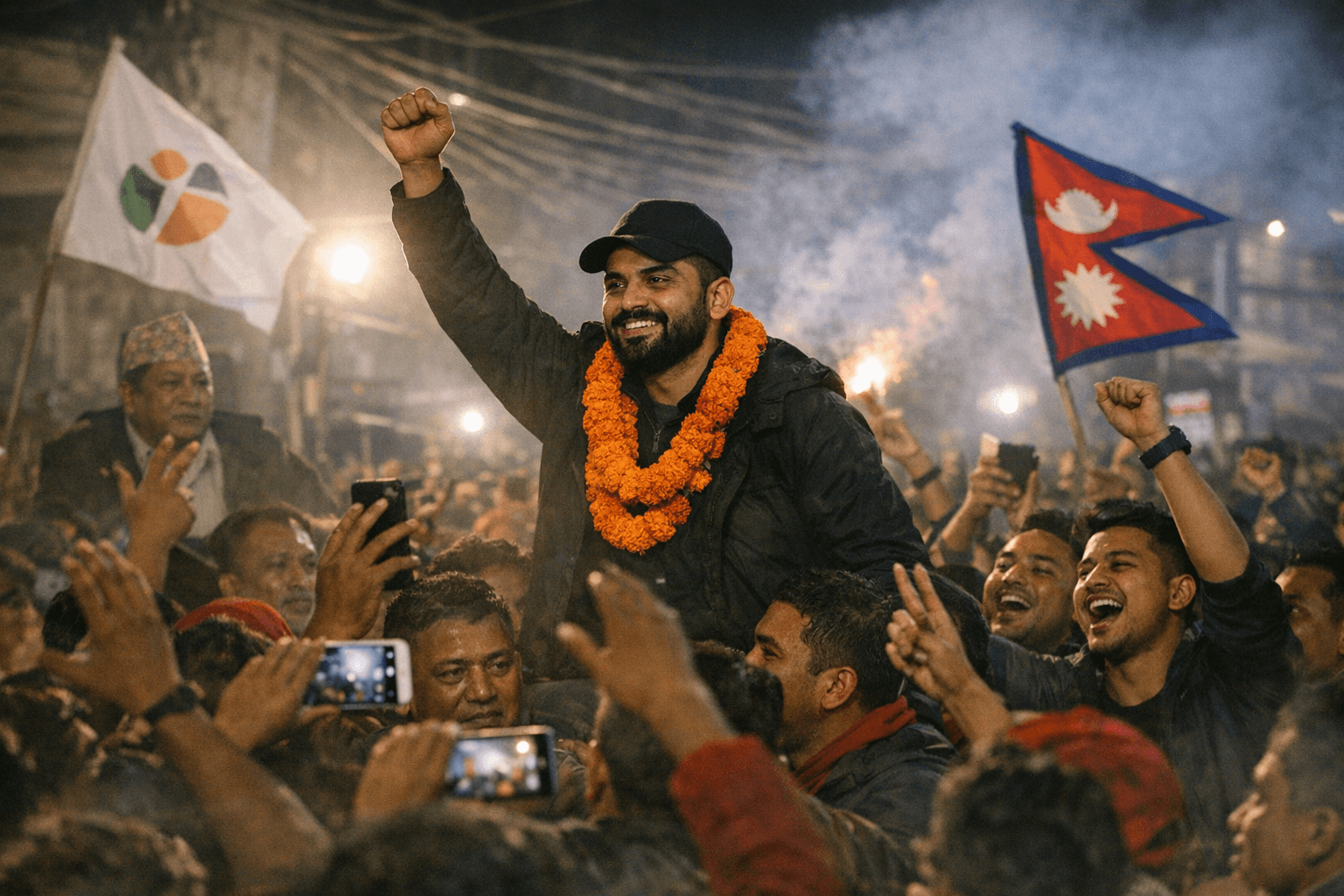
Analysts and observers framed the vote as a generational rebuke. Chandra Dev Bhatta said, "This is heading to a landslide victory this reflects the frustration that has been building up. It is actually the people's revolt against the established political parties. The people understand that the new do not really have strong agendas, but it is a punishment to the parties for their decades-long poor governance." Journalistic commentary captured the youth dimension more pointedly: "Young Nepalis see him as a decisive actor, who is not beholden to traditional political or business interests," Pranaya Rana told Al Jazeera, as cited in Firstpost.
Rabi Lamichhane, the RSP president, campaigned alongside Shah at rallies late in February, illustrating the party’s consolidation of a movement that began on the streets. If early trends hold, the RSP will face the immediate test of translating protest energy into governing capacity, coalition building and concrete policy, even as final, certified tallies from the Election Commission remain pending. The scale of the early upset signals a sharp realignment in Kathmandu and a challenge to parties that have dominated Nepali politics for decades.
Sources:
Know something we missed? Have a correction or additional information?
Submit a Tip