Banksy unveils faceless flag-carrying statue near Buckingham Palace
A faceless Banksy statue appeared overnight in Waterloo Place, steps from Buckingham Palace, and drew crowds to one of Westminster’s most tightly watched ceremonial streets.
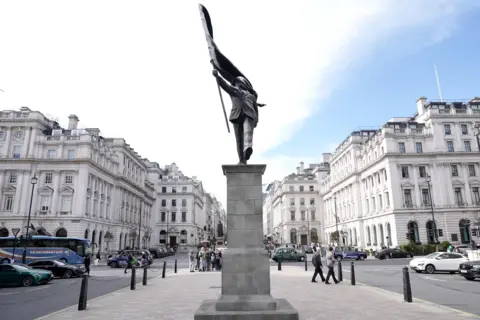
A new Banksy statue has appeared in Waterloo Place, a polished stretch of central London where the Mall, Buckingham Palace and the monuments of St James’s meet the machinery of state. The sculpture shows a suited man stepping forward off a plinth while carrying a large flag that hides his face, a stark image that turned a formal public square into a live debate about power, anonymity and who gets to mark Britain’s most controlled spaces.
The work surfaced in the early hours of Wednesday 29 April 2026 and was still drawing attention from passers-by and photographers as crowds gathered around it. Banksy later confirmed on Instagram that it was his, sharing footage of the nighttime installation that showed a large crane being used to place the piece. The plinth bears Banksy’s signature, making authorship part of the artwork itself even as the figure’s face is erased behind the flag.
Its placement gives the statue much of its force. Waterloo Place sits in St James’s, close to government buildings and foreign embassies in Westminster, and the new figure stands among some of the area’s most visible monuments, including statues of Edward VII and Florence Nightingale, the Guards Crimean War memorial and the Duke of York Column. Nearby, the Athenaeum Club’s gilded Athena adds another layer of imperial and civic symbolism to the setting. The location has invited readings of the piece as a comment on nationalism, authority and blind patriotism, delivered not through a gallery but in open public space under the gaze of the state.
The appearance also fits a broader run of London interventions from Banksy over the past two years. In summer 2024, a series of animal silhouettes appeared across the city and on a London Zoo building, drawing the kind of attention that often follows his work into the street. In September 2025, an unauthorised mural at the Royal Courts of Justice prompted a fast official response from the HM Courts and Tribunals Service, underscoring how quickly public art can turn into a contest over order, ownership and removal.
Banksy has installed statues before. In 2004, The Drinker, a parody of Rodin’s The Thinker, appeared in London’s West End before being removed shortly afterward. The new figure near Buckingham Palace suggests the same central tension that has defined his most visible works: the city can fence itself with protocol and security, but an unexpected object, installed overnight, can still force one of Britain’s most protected civic landscapes to explain itself.
This article was produced by Prism’s automated news system from verified source data, official records, and press releases, then run through automated quality and moderation checks before publishing. The system is built and supervised by the people who set the standards it runs under. Read our full AI policy.
Did this article answer your question?