Bausch Health posts sales growth, reports $1.4 billion goodwill charge
Sales climbed 12% to $2.52 billion, but a $1.426 billion goodwill charge pushed Bausch Health to a $1.423 billion loss.

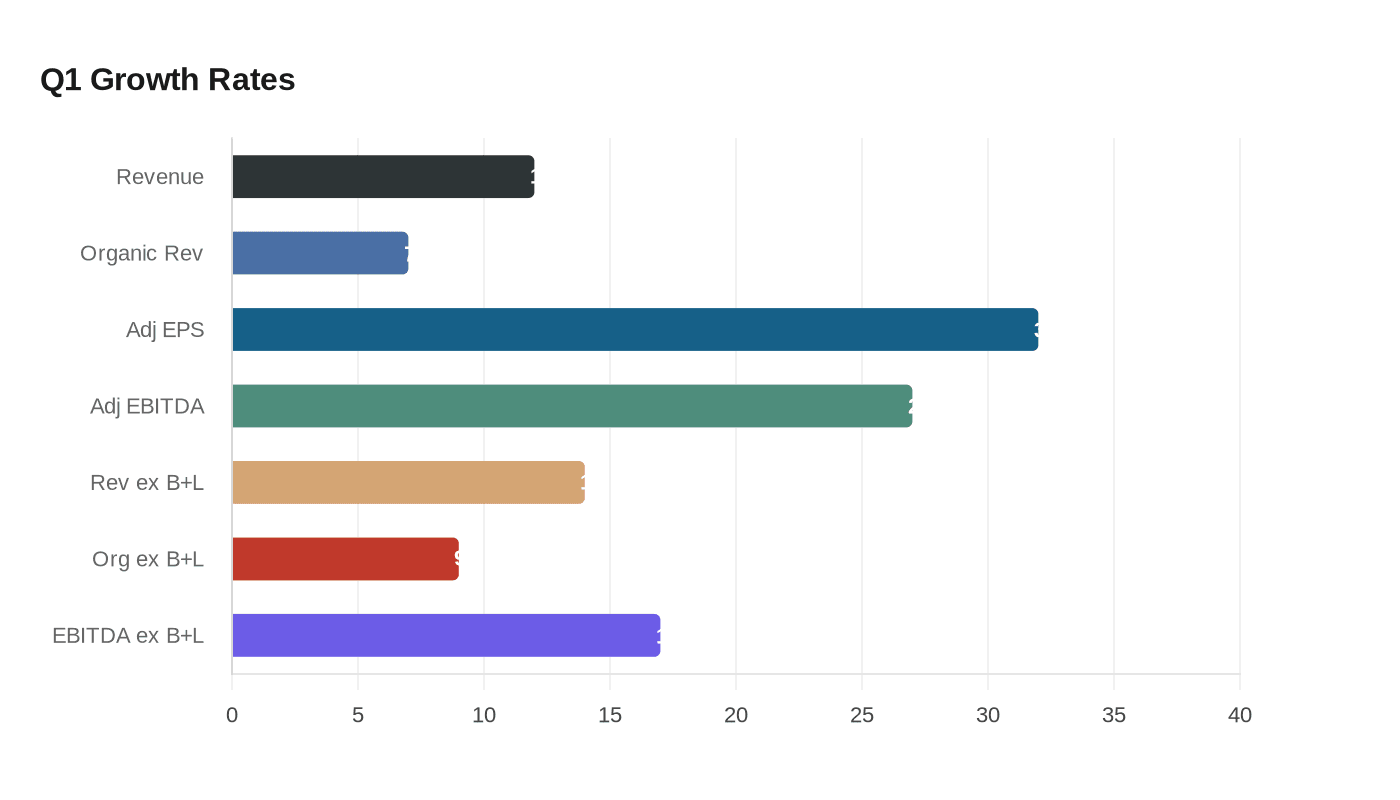
Bausch Health posted solid first-quarter sales and earnings growth, but a $1.426 billion goodwill impairment turned the period into a steep GAAP loss and underscored how far the company’s accounting results can diverge from its operating performance. Revenue rose to $2.52 billion, up 12% from a year earlier on a reported basis and 7% organically, while adjusted earnings per diluted share climbed 32% to $0.78 and consolidated adjusted EBITDA attributable to Bausch Health increased 27% to $837 million.
The top line was helped by more than simple volume growth. Bausch Health said the reported revenue gain included a $71 million foreign-exchange benefit, $33 million from acquisitions and a $4 million benefit from divestitures and discontinuations. Excluding Bausch + Lomb, the company said it delivered a 12th consecutive quarter of year-over-year revenue and adjusted EBITDA growth, with revenue up 14% reported and 9% organic, and adjusted EBITDA up 17%.
The bottom line told a much harsher story. Bausch Health reported a GAAP net loss attributable to the company of $1.423 billion, or $3.82 per share, almost entirely because of the goodwill charge. That kind of impairment does not affect cash in the quarter, but it does signal that an acquired asset is now valued far below what was once booked on the balance sheet. For investors, lenders and management, the distinction matters: the operating business is generating better results, yet the accounting damage still reflects the strain of past deal-making and the pressure to prove those assets were worth the price.
Management leaned on the parts of the report that point to durability. Adjusted cash flow from operations totaled $319 million, and Bausch Health reaffirmed full-year 2026 guidance for revenue of $5.25 billion to $5.4 billion, adjusted EBITDA of $2.875 billion to $2.95 billion, and adjusted cash flow from operations of $1.2 billion to $1.275 billion. That outlook incorporates the effect of new tariffs effective Sept. 29, 2026. Chief Executive Thomas J. Appio said, “We continue to invest in our pipeline, including the advancement of larsucosterol to treat alcohol-associated hepatitis, while pursuing business development opportunities aligned with our strategic priorities.”
The company’s longer-term message is that it is still rebuilding. Bausch Health acquired DURECT Corporation in 2025 to add larsucosterol to its hepatology pipeline, and DURECT had described the drug as an FDA Breakthrough Therapy with a registrational Phase 3 trial in development. Bausch Health also completed the acquisition of Shibo’s full-service aesthetics distribution business in China on Dec. 1, 2025, and in February it said full-year 2025 revenue reached $10.27 billion after $1.7 billion of debt exchange activity and $9.6 billion in total refinancing during 2025. Based in Laval, Quebec, and listed on the NYSE and TSX under BHC, the company is asking the market to focus on execution, not the impairment charge.
This article was produced by Prism’s automated news system from verified source data, official records, and press releases, then run through automated quality and moderation checks before publishing. The system is built and supervised by the people who set the standards it runs under. Read our full AI policy.
Did this article answer your question?
%3Amax_bytes(150000)%3Astrip_icc()%2FCertificate-of-deposit-2301f2164ceb4e91b100cb92aa6f868a.jpg&w=1920&q=75)