Baykar Demonstrates Autonomous Two-Drone Close-Formation Flight of Jets
Turkish defence company Baykar announced that two prototypes of its Bayraktar KIZILELMA unmanned combat aircraft completed a fully autonomous close-formation flight on December 28, 2025. If verified, the demonstration marks a notable advance in AI-driven, networked air operations with implications for future tactics, command structures and airspace regulation.
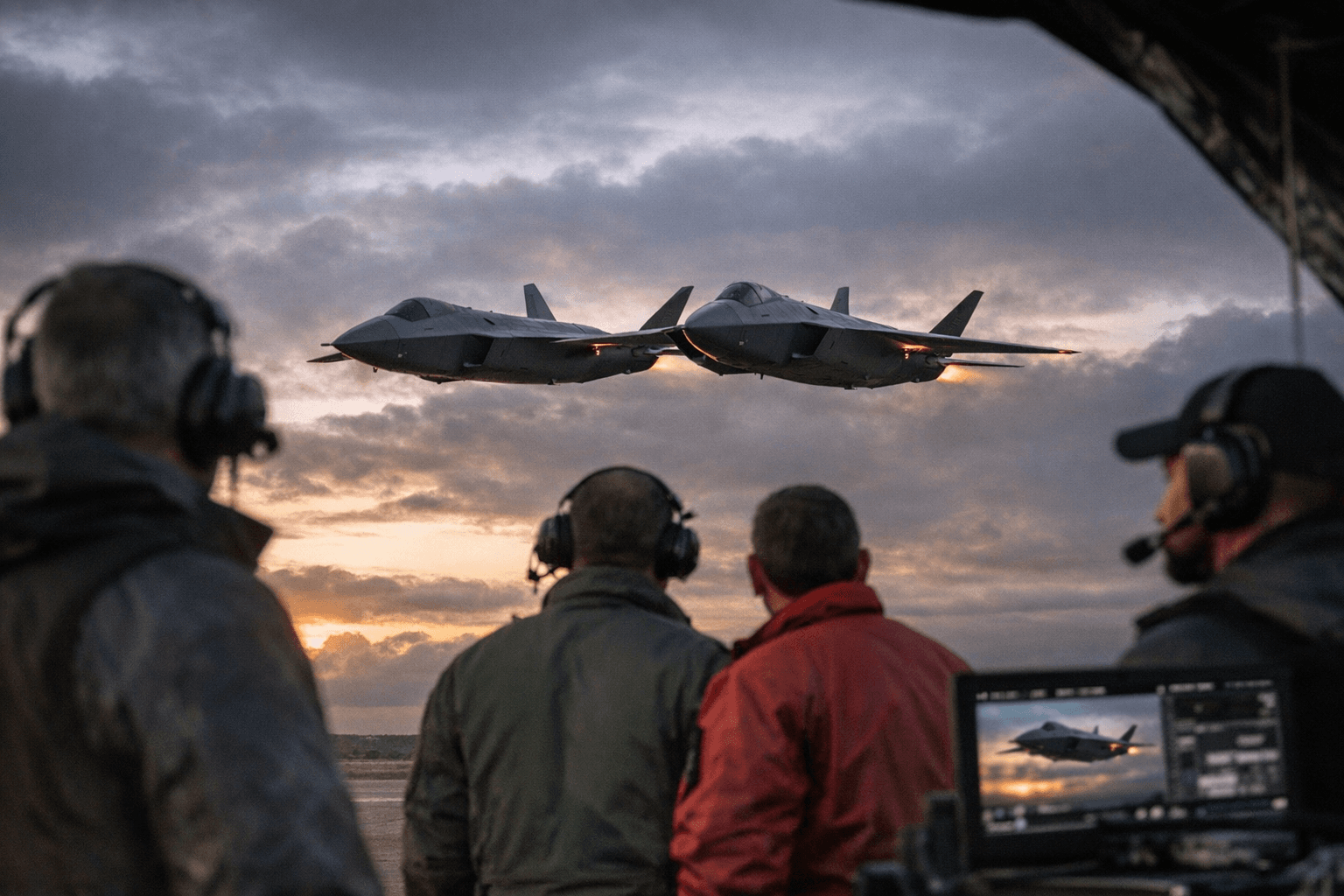
Baykar said two prototypes of its Bayraktar KIZILELMA unmanned combat aircraft, identified as PT3 and PT5, executed a fully autonomous close-formation flight at the Akıncı Flight Training and Test Center in the Çorlu district of Tekirdağ province on December 28, 2025. The company released statements and imagery showing the jet-powered platforms taking off consecutively, performing synchronized manoeuvres and maintaining tight formation at high subsonic speeds, and characterized the test as a milestone in “smart fleet autonomy.”
According to Baykar, the KIZILELMA prototypes relied on onboard artificial intelligence, sensors and real-time data exchange to coordinate positioning and avoid obstacles without human intervention or remote piloting during the manoeuvres. The firm attributed the capability to its own smart fleet autonomy algorithms that enable collaborative action logic, instant platform-to-platform communication and AI-driven flight management. Baykar described the KIZILELMA as a combat-capable, armed unmanned combat aerial vehicle in development to perform missions including autonomous patrol and interception.
The demonstration is significant because it showcases autonomous coordination between jet-powered, fighter-class unmanned platforms rather than slower, rotary-wing or small tactical drones that have dominated previous autonomy experiments. Military analysts have long argued that the transition from single autonomous systems to coordinated groups could alter the tempo and geometry of air combat by enabling swarming tactics, distributed sensing, mutual support and networked decision-making among unmanned assets.
Important technical and operational details were not disclosed in Baykar’s announcements. The company and accompanying imagery did not publish independent verification by military aviation authorities, nor did they release exact performance metrics such as separation distances, altitude, duration of sustained formation, specific speeds, software architecture, communications protocols or redundancy and failsafe measures. Reports also did not specify whether the prototypes carried live ordnance or whether weapons were present but inert for the test.
The lack of third-party corroboration and missing performance data leave key questions about reproducibility, reliability and safety unanswered. Independent confirmation could come from Turkish military or civil aviation authorities, flight-test range notices, or tracking data from civilian aviation monitors. Technical scrutiny would need information on encryption and anti-jam measures for inter-platform links, how the autonomy handles degraded sensors or communications loss, and what human-in-the-loop override capabilities exist.
Beyond technical vetting, the demonstration raises regulatory and strategic issues. Jet-powered autonomous UCAV operations pose airspace management challenges and force planners to consider how autonomous group behaviours fit into existing rules of engagement, command-and-control hierarchies and international law. If validated and fielded, the capability would accelerate a global shift toward networked, AI-enabled air combat that could lower the cost of attritable operations while complicating escalation dynamics.
Baykar’s announcement marks a notable reported step on that path. To assess its operational impact, independent observers and defence authorities will need access to detailed test data, verification from neutral sources and clear disclosure of safety and control measures.
This article was produced by Prism’s automated news system from verified source data, official records, and press releases, then run through automated quality and moderation checks before publishing. The system is built and supervised by the people who set the standards it runs under. Read our full AI policy.
Did this article answer your question?


