Google Shifts reCAPTCHA Data Responsibility to Website Operators in 2026
Google formally handed reCAPTCHA's data compliance liability to website operators on April 2, switching from controller to processor under GDPR.
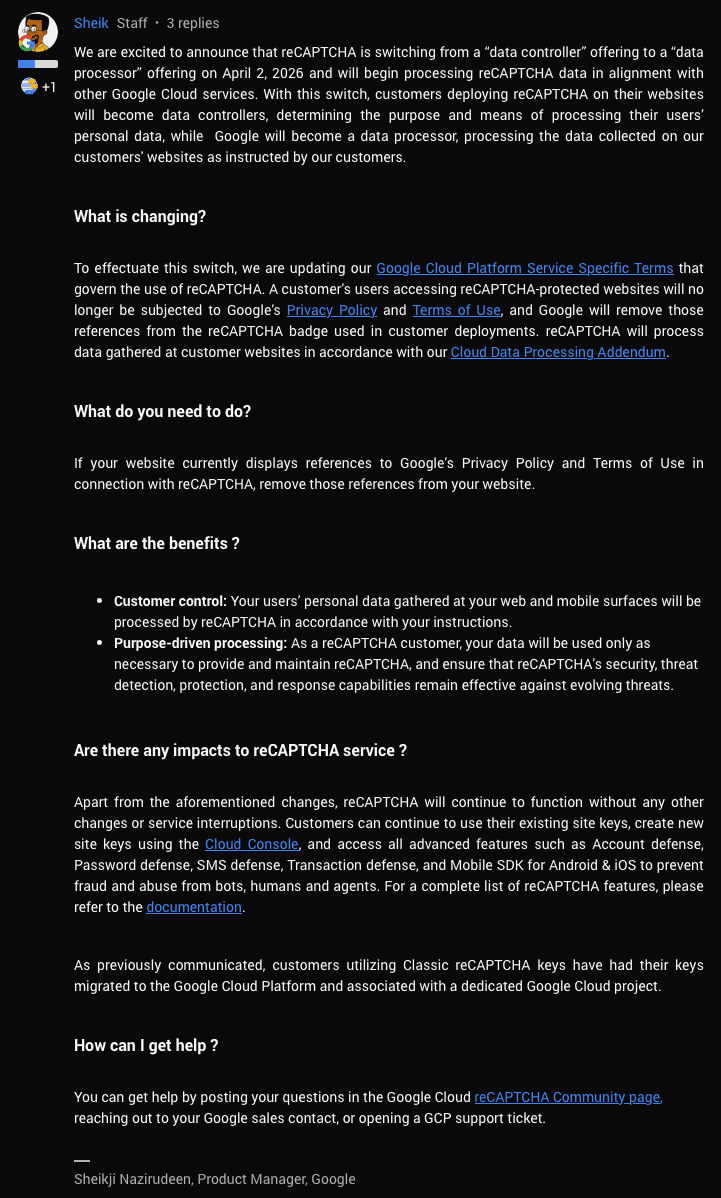
Google formally altered the legal architecture of its reCAPTCHA service on April 2, 2026, reclassifying itself from "data controller" to "data processor" and transferring the primary weight of data-protection compliance onto the millions of websites that embed the anti-bot tool. The practical effect is immediate: any site using reCAPTCHA is now the data controller responsible for determining the purpose and legal basis for processing visitors' personal data.
The distinction matters enormously under the EU General Data Protection Regulation. A data controller decides why and how personal data is collected; a processor simply acts on the controller's instructions. By assuming the controller role, Google had previously borne responsibility for reCAPTCHA's behavioral and device-level data collection, with the latitude to use that information for its own purposes. Although website operators technically integrated reCAPTCHA, they had only limited influence over how Google processed the user data collected in the process. As of April 2, that liability landed squarely with site operators.
The mechanics of the shift are spelled out in Google's Cloud Data Processing Addendum, which now governs all reCAPTCHA data flows. Google also removed references to its own Privacy Policy and Terms of Use from the reCAPTCHA badge that appears on protected pages. Existing site keys remain functional, and operators can create new ones through the Google Cloud Console. The bot-detection functionality is unaffected; the change is legal and structural, not operational.
For site owners, the compliance to-do list is concrete. Privacy policy language must be updated to remove any reference to Google's Privacy Policy as the governing framework for reCAPTCHA data collection, and a Data Processing Agreement with Google must be executed under the Cloud framework. Consent flows and cookie banners need to be reviewed to correctly identify the site operator as the controller and disclose reCAPTCHA's data collection to end users. Vendor management records should reclassify Google from a joint controller to a data processor for this service, and any Article 30 records of processing activities must reflect the new controller status.

Under the UK GDPR, which mirrors the EU regulation, the same controller obligations apply to sites with UK users. The CCPA and CPRA introduce a parallel set of requirements for operators handling California residents' data: reCAPTCHA must now be disclosed as a service provider relationship in privacy notices, and operators must be prepared to honor deletion requests covering data Google processes on their behalf.
The risks are unevenly distributed. Publishers, e-commerce operators, and enterprises with dedicated privacy teams can absorb this shift through routine legal updates. The website operator now carries the compliance case more visibly: lawful basis, transparency, contractual setup, transfer assessment, and proportionality all sit more clearly with the controller. Small businesses operating without in-house counsel face the most exposure. reCAPTCHA often protects core revenue and account flows such as sign-up, sign-in, checkout, lead generation, and password recovery, and many operators running off-the-shelf platforms may not immediately recognize that the change has made them responsible for data they never consciously chose to collect.
Data still flows to U.S. servers, and there remains no EU-only option. European regulators who scrutinized the service under GDPR's data-transfer provisions will likely watch closely to see whether the processor reclassification produces genuine compliance improvements or simply redistributes legal risk downward onto smaller operators with the fewest resources to manage it.
This article was produced by Prism’s automated news system from verified source data, official records, and press releases, then run through automated quality and moderation checks before publishing. The system is built and supervised by the people who set the standards it runs under. Read our full AI policy.
Did this article answer your question?