Beyond Lehengas: India's 2000+ Communities and 100+ Bridal Traditions
With 15+ million weddings a year and a ₹10 lakh crore industry, Indian brides choose from 100+ regional traditions that map 2,000+ communities, not just lehengas.
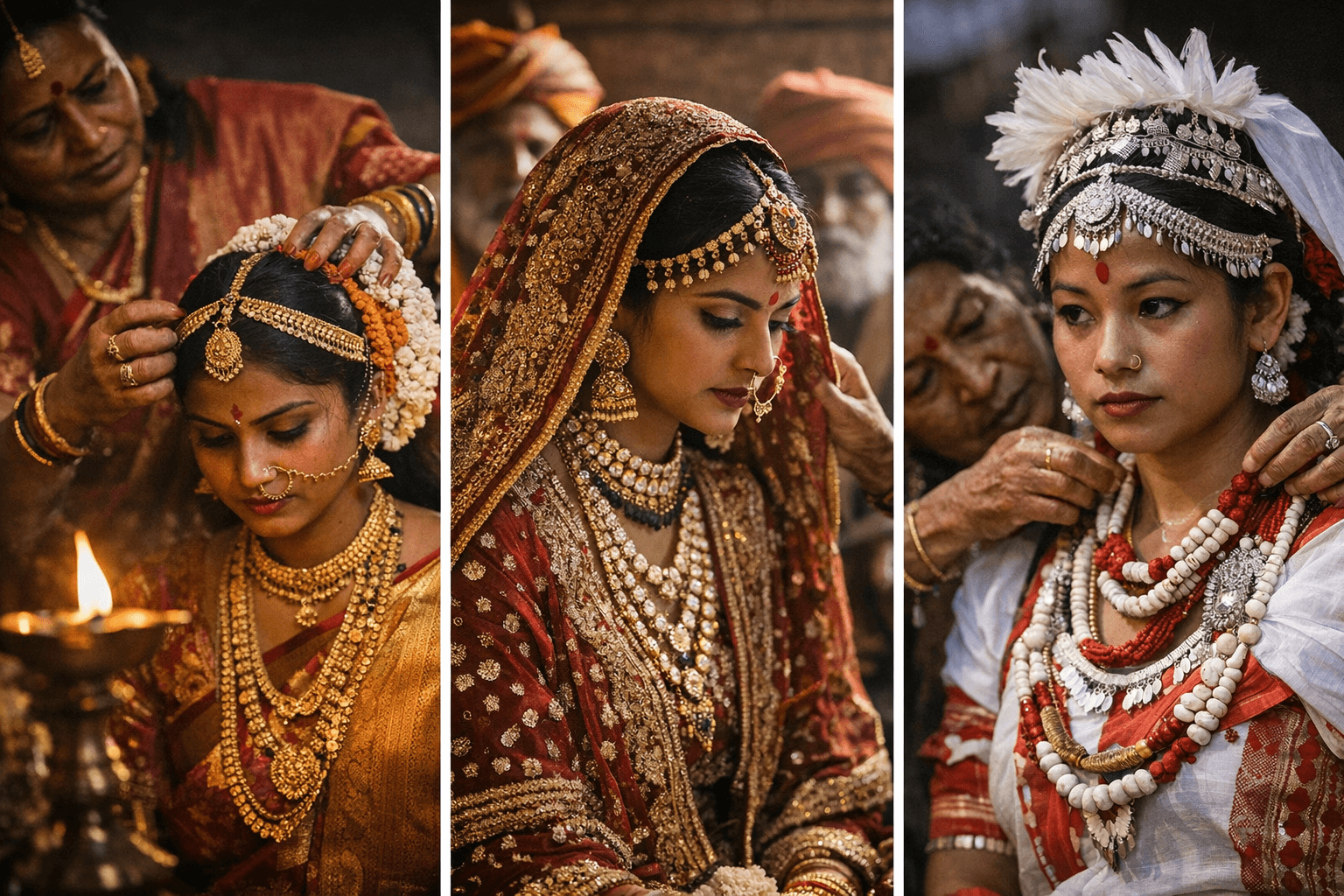
With 15+ million weddings annually and a ₹10 lakh crore industry, India’s bridal wardrobe reads like a national archive of craft and ritual rather than a single fashion moment. “Because in India, a bride doesn’t just dress for a wedding, she wears her heritage. 💍” That line captures why regional dress matters: each outfit is a repository of color, technique, and ceremony that links the bride to family, faith, and place.
Scale and ritual Across 28 states and more than 2,000 communities, the country produces 100+ regional bridal variations and a dizzying range of ceremonial meanings. Indialegacy catalogs the scale: 28 states celebrate 15+ million weddings annually, Hindu weddings dominate (80%), followed by Muslim nikah, Christian church ceremonies, and Sikh anand karaj. Ritual language is woven into clothing: “weddings function as spiritual initiations aligning 7 chakras through 7 pheras, invoking 33 crore deities via mantras, creating karmic bonds spanning 7 lifetimes.” Symbols like sindoor and the mangalsutra are described as marital seals, with the groom applying sindoor in the hair parting for kundalini activation and the mangalsutra representing a seven-lifetime bond. Vidaai and grihapravesh complete the arc, each ritual carrying textile- and color-based meanings as the bride moves between homes.
Why sarees still matter Fashion editors and bridal stylists are increasingly insisting that bridal sarees are viable, contemporary options rather than fallback antiques. Rimpleandharpreet presses the case: “As brides embark on their journey to find the perfect attire for their special day, embracing the versatility of sarees opens up a world of possibilities to redefine bridal fashion, celebrate individuality, and pay homage to the diverse heritage of India.” The Kanjivaram or Kanchipuram exemplifies that crossover: Rimpleandharpreet notes it hails from Tamil Nadu with vibrant colors, broad borders and rich silk, while Wed In observes that Telangana brides also embrace Kanchipuram or Pattu sarees, woven from pure silk and gold zari and paired with temple jewellery and fresh flowers.
Northeast: Potloi, Mekhela, Bakhu The northeast stages some of India’s most sculptural bridal silhouettes. Manipur’s ornate Potloi appears on lists as a signature ceremonial dress, its circular structure and layered look marking it as formally bridal. Assam’s Mekhela Chador is presented as a cultural emblem: the mekhela saree bride’s connection to Assamese culture “elevates her beauty by embracing simplicity and heritage,” allowing her to “exude a unique charm that speaks of tradition and grace on her special day.” Sikkim’s Bakhu and other named garments like Kinnauri wool drapes are invoked as regional identifiers even when source detail is sparse; their placement in national lists signals how dress operates as cultural shorthand across the northeast.
North and Punjab: Phulkari, pheran, Punjabi pageantry Punjab’s Phulkari is defined by hand-embroidered floral motifs and vibrant colorways that “uniquely enhance the Punjabi bride's appearance,” and Mohifashion underscores Phulkari’s exuberant cultural symbolism. The Better India evokes the “iconic Punjabi bridal look seen on Anushka Sharma in Phillauri,” a pop-cultural shorthand for the region’s celebratory costume. Kashmir supplies the graceful pheran, named for its flowing lines and warmth, while northern ceremonies—processions, singing and region-specific jewellery—make clothing a moving tableau rather than a singular silhouette.
East and Bengal: Banarasi and Boula Patta Bengali brides are described as stunning in classic red and gold Banarasi sarees, “adorned with intricate zari work. Red symbolizes fertility and prosperity, while gold reflects wealth and grandeur, together creating a timeless, regal bridal look that’s hard to miss.” Odisha contributes the Boula Patta, a yellow saree with red borders whose palette is explicitly symbolic: yellow for positivity and happiness, red for tradition and auspiciousness, and the overall ensemble representing purity, prosperity and the beginning of a new chapter.
Central and tribal traditions: Jharkhand and Arunachal Jharkhand’s bridal favorites include lustrous Tussar silk sarees, prized for their “rich texture” and “intricate embroidery.” Tribal garments like Panchi (upper garment) and Parhan (lower garment) are named alongside sarees as expressions of local identity and craftsmanship. Arunachal’s bridal outfit is described as a sleeveless kameez paired with a long, embroidered jacket featuring full-length sleeves, a silhouette that reflects tribal richness and cultural identity while blending heritage with grace.
Tripura and small-state weaves: Rignai-Risa-Rikutu Tripura’s Rignai forms a three-piece system—Rignai, Risa and Rikutu—with the Rignai itself described as a knee-length cloth wrapped around the waist. The colorful, handwoven patterns and tightly held cultural meanings are explicit: each element carries deep significance and showcases the state’s textile traditions, turning the bride into a living map of local weaving practice.
South India: Kasuti, Pochampally, Kanchipuram South India presents some of the country’s most celebrated weave-architectures. Mohifashion calls the Kasuti sarees of Karnataka “a masterpiece that enhances a bride's beauty with artistic splendor,” crafted in cotton or silk and decorated with hand-embroidered geometric patterns, celebrated for striking black-and-red combinations, image courtesy Facebook. Pochampally from Telangana is explicitly noted for its Ikat dyeing technique and geometric designs, handmade in silk or cotton, its patterning described as a way to turn the bride into “a living work of art and tradition,” image courtesy Pinterest. Kanchipuram or Pattu sarees surface again here as pure silk with gold zari, the classic temple-bride aesthetic completed with jasmine and temple jewellery.
Rajasthan and ceremony While specific garments are not always named in every region, the Indialegacy list points to Rajasthan’s royal processions and ghoomar dances as context where dress meets choreography: the state’s sartorial vocabulary is as much about movement, procession and pageantry as it is about textiles.
- Kasuti embroidery: hand-embroidered geometric patterns in cotton or silk, often black-and-red combinations, noted as Karnataka’s craft, image courtesy Facebook.
- Pochampally Ikat: an intricate dyeing technique producing geometric designs on silk or cotton, a Telangana hallmark, image courtesy Pinterest.
- Tussar silk: prized for rich texture and intricate embroidery, a Jharkhand bridal favourite.
- Banarasi zari: gold and silver threadwork that gives the Banarasi saree its signature splendor.
- Phulkari embroidery: hand-embroidered floral motifs, vibrant color palettes and Punjabi exuberance, image courtesy Pinterest.
Weaves and techniques
Ceremony, meaning and movement Clothing in Indian weddings is inseparable from ritual. Indialegacy’s ritual phrasing ties garment actions to metaphysics and lifecycle: bridal acts—from sindoor and mangalsutra rites to the vidaai’s backward rice-throwing—are coded gestures that confer blessing, ward off evil, and stitch one household into another. Grihapravesh customs like kicking a rice pot and circumambulating a tulsi plant are described as threshold rites where textile, ritual and household symbolism meet.
A modern bride’s choices Contemporary brides and stylists are taking these texts and reworking them. Wed In notes Telangana brides embracing Kanchipuram sarees even when the weave originates elsewhere, showing cross-regional adoption. Rimpleandharpreet’s editorial voice urges brides to see sarees as alternatives to lehengas and to celebrate individuality through regional drapes and weaves. The result is not a nostalgia act but a living practice: fabrics travel, techniques are reinterpreted, and bridal fashion becomes terrain for both personal taste and cultural continuity.
Social pulse and imagery Pieces cataloging this diversity often land on social feeds with tags and shareable lines: The Better India framed its round-up with hashtags such as #IndianCulture and #BridalTraditions, and image credits in Mohifashion are explicit, noting “Image Courtesy: Facebook” for Kasuti and “Image Courtesy: Pinterest” for Pochampally and Phulkari. If reproducing photographs, secure permissions: these platforms supply helpful leads but image rights must be cleared.
Conclusion From Manipuri Potloi to the Boula Patta and Kanjivaram’s gleaming borders, India’s bridal sartorial map is vast and specific. The country’s 100+ regional variations and 2,000+ communities make bridal dressing an act of inheritance as much as style. The modern bride who chooses a regional weave is making a double claim: to look beautiful on her wedding day and to carry a community’s story forward into the next life of the garment.
Know something we missed? Have a correction or additional information?
Submit a Tip