Bipartisan Senate Bill Would Ban Sports Betting on CFTC Prediction Markets
Senators Schiff and Curtis introduced a bill to ban sports bets on CFTC prediction markets, days after Arizona filed criminal charges against Kalshi and a Nevada judge blocked it entirely.
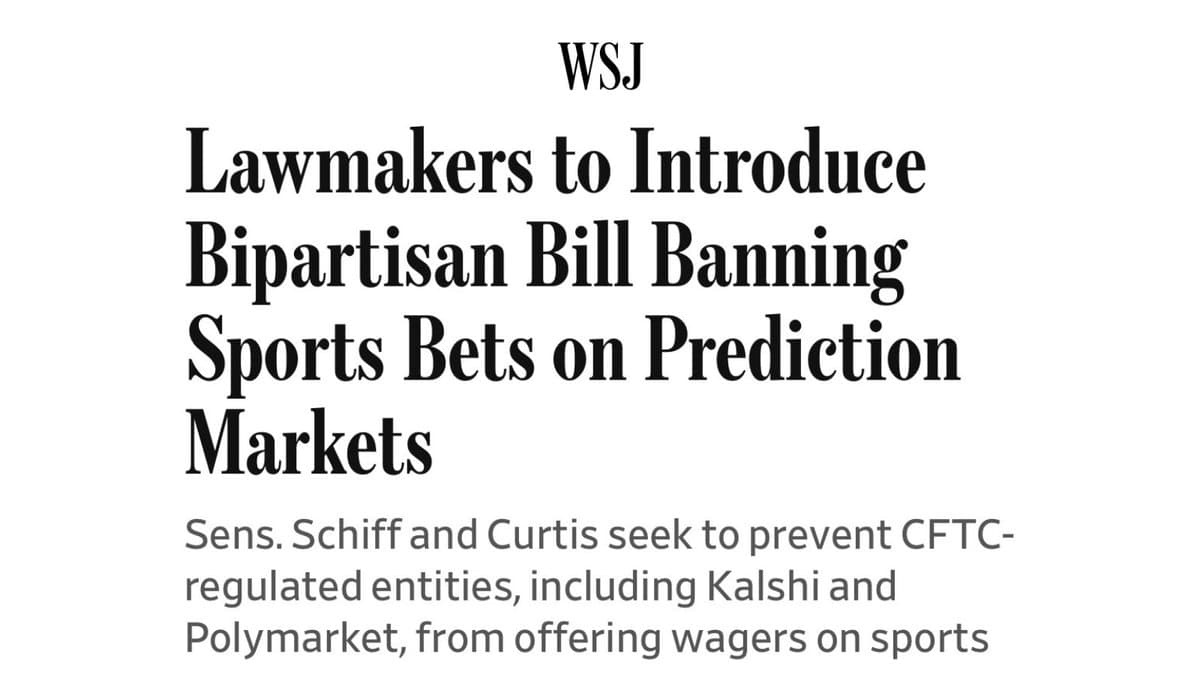
Arizona had just filed 20 criminal charges against prediction market giant Kalshi on March 17, and a Nevada judge had blocked the company from operating in that state three days later. Into that accelerating legal crisis, Senators Adam Schiff (D-Calif.) and John Curtis (R-Utah) introduced bipartisan federal legislation Monday that would resolve the underlying dispute by a simpler method: banning sports and casino-style contracts from CFTC-regulated prediction markets altogether.
The Prediction Markets Are Gambling Act, the first bipartisan bill introduced in the Senate seeking to regulate prediction markets, would prohibit CFTC-registered entities from listing any prediction contract that resembles a sports bet or casino-style game. Super Bowl trading volume on prediction markets surpassed $1 billion in 2026, and a March Madness winner contract already has more than $100 million in trading volume.
"Sports prediction contracts are sports bets — just with a different name," Schiff said. "These contracts are currently offered in all fifty states in clear violation of state and federal law." He added that rather than enforcing the law, the CFTC is "greenlighting these markets and even promoting their growth," and that it is "time for Congress to step in and eliminate this backdoor, which violates state consumer protections, intrudes upon tribal sovereignty and offers no public revenue."
Curtis framed the bill as a consumer protection measure. "Too many young people in Utah are getting exposed to addictive sports betting and casino-style gaming contracts that belong under state control, not under federal regulators," he said. "The Prediction Markets Are Gambling Act is about respecting states' authority, protecting families, and keeping speculative financial products out of spaces where they don't belong."
While traditional sports gambling is regulated by states, prediction markets use a different technical trading mechanism, via futures or commodity contracts, that falls under federal oversight. The bill would explicitly close that gap. It would ban any entity registered with the CFTC from "listing a contract that closely resembles a sports bet or a casino-style game" and would reinforce Congress' "original intent" that the Commodity Exchange Act "does not permit sports gambling," removing any ambiguity that prediction markets have used to sidestep betting bans. Specific products barred would include slot machine games, video poker, blackjack and bingo.
The bill arrives as Kalshi faces mounting legal pressure from multiple directions. Arizona Attorney General Kris Mayes filed 20 criminal charges against Kalshi on March 17, accusing it of operating an unlicensed gambling business, marking the first criminal case against a prediction market platform in the U.S. "Kalshi may brand itself as a 'prediction market,'" Mayes said, "but what it's actually doing is running an illegal gambling operation and taking bets on Arizona elections, both of which violate Arizona law." Three days later, District Court Judge Jason D. Woodbury in Carson City signed a temporary restraining order blocking Kalshi event contracts for sports, elections and entertainment for as long as two weeks.
The Trump administration has defended prediction market companies, which argue that their products are similar to trading stocks or commodities, putting them under CFTC jurisdiction. Chairman Mike Selig has repeatedly defended the CFTC's sole regulatory authority over prediction markets. Kalshi co-founder Tarek Mansour reacted to the Senate bill on social media, writing that it was the "casino lobby hard at work. Banning just pushes this offshore, where no regulation exists. This bill isn't about protecting consumers; it's about protecting monopolies."
The American Gaming Association took the opposite view. "The introduction of the Prediction Markets Are Gambling Act is a critical step in reaffirming Congressional intent that all gaming, including sports betting, is not a federal commodity, and is governed by state and tribal law," the AGA said, adding that it "strongly supports this bipartisan effort" to "uphold state and tribal sovereignty and protect consumers."
The bill has split Republicans, with several continuing to back state regulation over the Trump administration's preferred federal framework. The bill also drew support from the Indian Gaming Association and the California Nations Gaming Association. IGA Chair David Bean said it "will reaffirm existing tribal and state government authority to regulate sports betting, limit online gambling, or in some cases continue to prohibit all forms of gambling."
The Schiff-Curtis bill is one of at least six pieces of federal legislation targeting prediction markets introduced since February. Last week, Sen. Chris Murphy and Rep. Greg Casar introduced the Banning Event Trading on Sensitive Operations and Federal Functions (BETS OFF) Act, which aims to ban prediction markets from offering event contracts on government actions, terrorism, assassinations and wars. On March 11, Sen. Richard Blumenthal introduced the Prediction Markets Security and Integrity Act, which would prevent online prediction markets from operating in states unless subject to a state-approved wagering program and would set a minimum age of 21. In February, Rep. Dina Titus, whose district includes Las Vegas, introduced the Fair Markets and Sports Integrity Act targeting the same sports and casino-style contracts. On March 5, Sens. Jeff Merkley and Amy Klobuchar introduced a bill to ban federal elected officials from trading on prediction markets, the same day Reps. Blake Moore of Utah and Salud Carbajal of California filed legislation that would make event contracts on assassination, war, terrorism, gambling and politics illegal.
Hours after the Schiff-Curtis bill was introduced, Kalshi announced it would launch new efforts to bar politicians from trading on their own campaigns and ban athletes from placing bets on their own sports. The company said the changes were aligned with recent congressional proposals and CFTC guidance and had been in development for months. None of the congressional prediction market bills introduced so far have advanced beyond a committee assignment, and their paths to the floor remain unclear.
This article was produced by Prism’s automated news system from verified source data, official records, and press releases, then run through automated quality and moderation checks before publishing. The system is built and supervised by the people who set the standards it runs under. Read our full AI policy.
Did this article answer your question?

