Birmingham braces for all-out council election after financial crisis
All 101 council seats will be contested after Birmingham’s section 114 crisis, as low turnout, bin strikes and party fragmentation reshape the race.

Birmingham’s entire political map will be reopened in a single contest, with all 101 council seats going before voters on Thursday 7 May 2026. The city has 69 wards, each electing one or two councillors, and 51 seats will be needed for a majority. Alongside the council race, voters in Sutton Coldfield will also choose town councillors, and Frankley in Birmingham will hold parish council elections.
The scale of the vote reflects the scale of the strain that has built up inside the city. Birmingham City Council issued two Section 114 notices in September 2023, then came under commissioners appointed by Michael Gove. Council documents say the authority had to catch up after a long period of non-delivery of savings and over-optimistic budget assumptions. The intervention has remained politically radioactive, with some academics and experts publicly questioning whether the section 114 process rested on unaudited or materially incorrect figures.
The 2026 contest is unfolding against that backdrop of anger and uncertainty. Labour leader John Cotton has framed the race as a choice between Labour’s “unity” and “the politics of division” offered by Reform UK and independent candidates. That argument lands in a city where old loyalties have already been tested by financial distress, bin strikes and complaints about local services. Independents are presenting themselves as the vehicle for a shake-up, while the Green Party says it is fielding candidates in every single Birmingham seat for the first time ever.
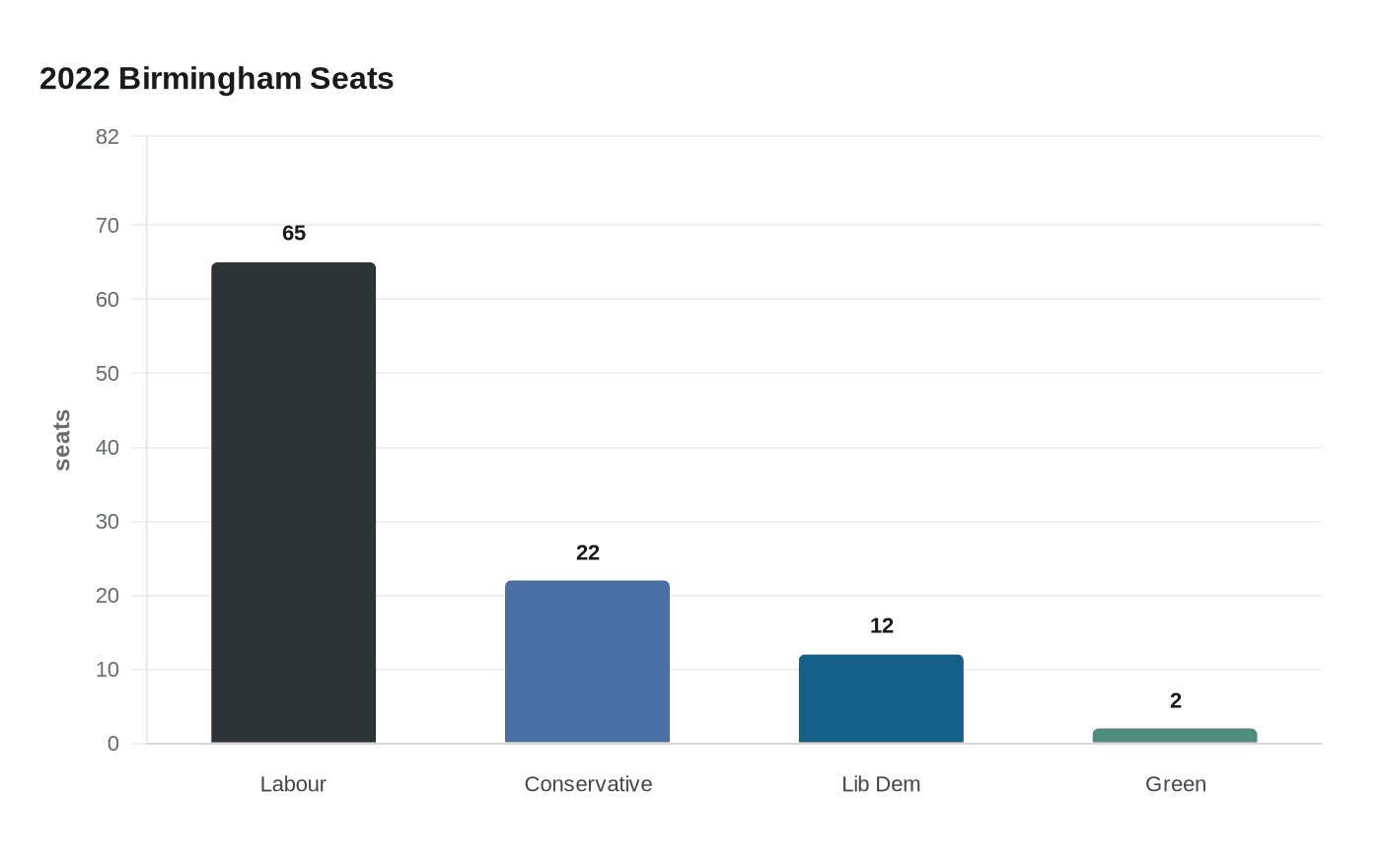
The last all-out election in 2022 left Labour with 65 of the 101 seats, well clear of the Conservatives on 22, the Liberal Democrats on 12 and the Greens on 2. Labour had won 67 seats in the 2018 all-out election, so the party’s grip on the council has loosened only gradually. Yet Birmingham’s turnout figures show how uneven local engagement can be. In 2022, participation ranged from 17% in Ladywood to 41.1% in Brandwood and Kings Heath, a spread that captures the city’s mix of anger, apathy and stubborn civic hope.
That is what makes Birmingham such a sharp test of local democracy. The contest will not only decide who governs city hall; it will show whether voters still believe the council can recover credibility after financial collapse, or whether exhaustion has become the dominant political force in the UK’s second city.
This article was produced by Prism’s automated news system from verified source data, official records, and press releases, then run through automated quality and moderation checks before publishing. The system is built and supervised by the people who set the standards it runs under. Read our full AI policy.
Did this article answer your question?

