Bombay Framed Exhibition Charts Mumbai's History Through Art and Memory
A Princeton historian's free exhibition at Mumbai's Taj Mahal Palace traces the city from a 10,000-person colonial outpost to a megacity shaped by reclamation and migration.
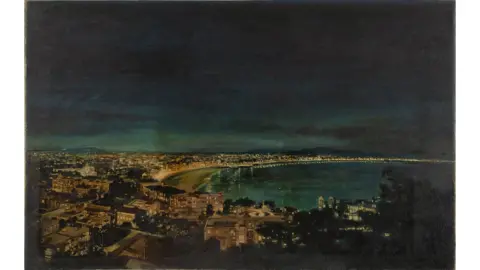
A chromolithograph painted in 1860 shows Malabar Hill the way no Mumbai resident would recognize it today: a tranquil shoreline where figures picnic beneath palm fronds and fishing boats float in still water, with only a faint church-like silhouette breaking the horizon. That image, created by French artist Isidore Laurent Deroy, now anchors "Bombay Framed: People, Memory, Metropolis," an exhibition at DAG's space inside Mumbai's Taj Mahal Palace Hotel running through April 2026, with free admission to the public.
The Deroy piece carries particular weight because of what was happening just years before it was made. By the time Deroy rendered that quiet shoreline, Governor William Hornby's 1782 Vellard project had already permanently sealed the tidal breach at Worli Creek, reclaiming the marshy northern flats and locking together what had been seven separate islands. The Sion Causeway, completed by 1803, gave carts and pedestrians their first continuous land crossing. Bombay Fort, the British settlement's administrative heart, was demolished in the same decade Deroy made his picture. The city he painted was already erasing itself.
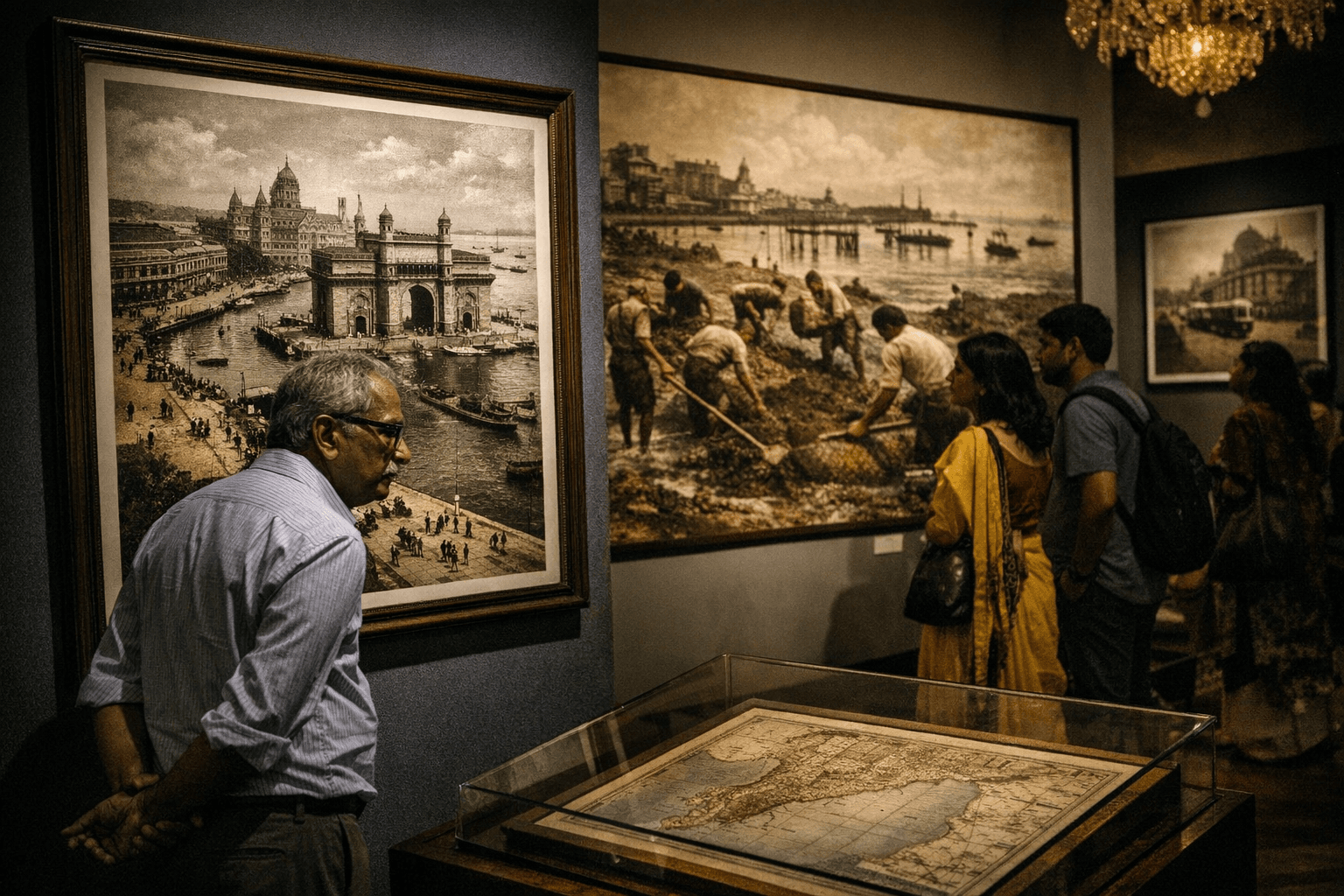
Curated by Gyan Prakash, Dayton-Stockton Professor of History at Princeton University and author of the 2010 nonfiction work "Mumbai Fables," the exhibition grew from a conversation between Prakash and Ritu Vajpeyi-Mohan, Senior Vice President at DAG, who sought his guidance on a vast collection of Mumbai-related artworks and images the gallery had acquired. Beyond paintings and photographs, the show brings together prints, archival material, and film memorabilia, tracing the city from a seven-island colonial acquisition to one of the world's most densely contested urban environments.
The historical spine of that story is compressed and stark. In 1661, Bombay passed to the English Crown as part of Infanta Catherine of Braganza's dowry upon her marriage to King Charles II. Seven years later, a Royal Charter transferred the islands to the English East India Company for an annual rent of £10, with Sir George Oxenden installed as the first Company governor. Population surged from approximately 10,000 in 1661 to roughly 60,000 by 1675, driven by deliberate pro-immigration policy designed to build a trade and military hub.
That arc, from engineered land to engineered population growth, resonates well beyond the subcontinent. Cities from Phoenix to Miami are currently managing rapid demographic expansion through infrastructure investment, zoning battles, and aggressive land development, raising the same questions Bombay confronted in the 18th century: who reclaims land, who lives on it, and who gets displaced in the process.
Chittaprosad Bhattacharya's painting "The Tram Way Workers' Strike" appears in the exhibition as a counterweight to the colonial infrastructure narrative, foregrounding the labor that built the city's systems. Vintage film posters and J. H. Thakkar's luminous studio photographs place Bollywood at the center of the city's self-image, a parallel to how Los Angeles has long defined itself through its entertainment industry's lens.
Prakash, who grew up in Bihar and came to Bombay first through images rather than experience, has framed the exhibition's central premise precisely: "Before I started working on Bombay, Bombay only existed in certain images that I had." The show, which also serves as a prelude to the second edition of "The City as a Museum, Mumbai," argues that those images are not simply records but the architecture through which cities are built in the imagination before they are built in concrete.
This article was produced by Prism’s automated news system from verified source data, official records, and press releases, then run through automated quality and moderation checks before publishing. The system is built and supervised by the people who set the standards it runs under. Read our full AI policy.
Did this article answer your question?