Bondi's Missteps Turn Epstein Files Into a Justice Department Crisis
Bondi arrived at a February House hearing with a lawmaker's personal search history in hand, crystallizing how the DOJ's Epstein rollout became its own worst enemy.
What began as a legal obligation became a cascading institutional embarrassment. Attorney General Pam Bondi's handling of the Justice Department's Epstein file disclosures has generated something rare in Washington: a bipartisan revolt that originated not with Democrats but with Republicans who helped write the law she was supposed to enforce.
The Epstein Files Transparency Act, signed by President Trump in November 2025, imposed a December 19 deadline on the DOJ to release all documents related to Jeffrey Epstein and his convicted accomplice Ghislaine Maxwell. The agency missed that deadline by more than a month. After making more than 3 million documents public in late January 2026, the DOJ announced it would not release the remainder, totaling more than 2.5 million documents. Media outlets subsequently reported the department had removed previously released files from public view.
Rep. Thomas Massie, a Kentucky Republican and co-sponsor of the Epstein Files Transparency Act, was the first GOP lawmaker to publicly hold Bondi accountable at the February 11 House Judiciary Committee hearing. Massie documented that victims' names had not been shielded in the releases, calling it a "massive failure" to comply with the law Trump had signed. He noted the contrast: the name of businessman Leslie Wexner, a co-conspirator, had been blacked out while survivors were exposed. "Who's responsible?" Massie demanded, asking whether Bondi could identify who in the organization made the error that released the victims' names.
The hearing produced a second, more explosive misstep. Photos taken during the hearing showed Bondi holding a document in a black binder labeled "Jayapal Pramila Search History," a printout of the queries Rep. Pramila Jayapal of Washington had entered into the DOJ's database of unredacted Epstein files. The document list numbers matched the Epstein files' own numbering system. Jayapal called the monitoring "totally inappropriate and against the separation of powers." House Speaker Mike Johnson, one of Trump's closest congressional allies, said the tracking was inappropriate and told reporters he would "echo that to anybody involved with DOJ." Rep. Jamie Raskin, the top Democrat on the House Judiciary Committee, accused Bondi of "spying on Members of Congress conducting oversight in yet another blatant attempt to intrude into Congress's oversight processes."
Bondi's posture toward survivors added to the damage. When Rep. Jayapal asked survivors seated in the gallery to raise their hands if they had been unable to secure a meeting with the DOJ, every survivor present raised their hand, contradicting Bondi's claim that the department had been working in close contact with Epstein's victims. When Jayapal then asked Bondi to turn and apologize to the survivors, Bondi declined, characterizing the request as "theatrics."
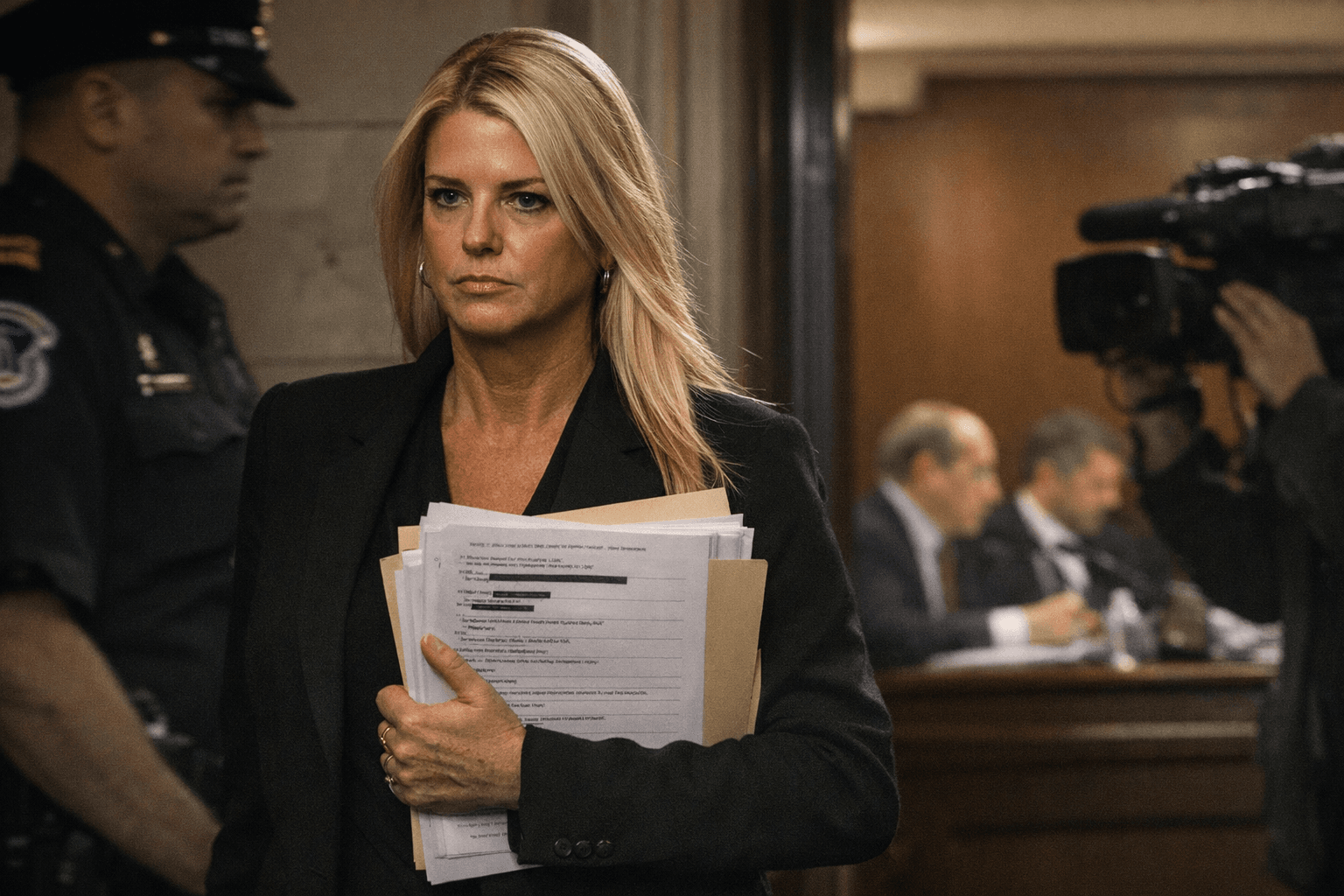
On March 4, the House Oversight Committee voted 24-19 to subpoena Bondi to testify about the DOJ's management of the Epstein files. In a rare bipartisan rebuke, the motion was introduced by Republican Rep. Nancy Mace and passed with five Republicans joining Democrats: Lauren Boebert, Scott Perry, Tim Burchett, and Michael Cloud. House Oversight Chair James Comer formally issued the subpoena on March 17, scheduling a sworn deposition for April 14.
Democrats walked out of a March 19 closed-door briefing with Bondi and Deputy Attorney General Todd Blanche after Bondi repeatedly declined to say whether she would comply with the deposition subpoena. Comer, despite having personally said he did not see the need for the deposition, said he would move forward given the five Republicans on his committee had supported it.
Raskin demanded that the DOJ's inspector general investigate what he described as a "clandestine congressional surveillance operation" by the department's Office of Legislative Affairs. Meanwhile, a bipartisan group of House lawmakers began drafting legislation to hold the DOJ and FBI accountable for improper redactions and compel release of remaining documents, with language specifically designed to be enforceable, unlike gaps they identified in the current law.
Each of these errors, taken alone, might have been manageable. Together, they handed critics inside and outside the Republican Party a concrete case that the DOJ's commitment to transparency was performative. With the deposition deadline set for April 14 and inherent contempt proceedings still on the table, the question is no longer whether Bondi damaged the department's credibility on the Epstein files, but how much further that damage spreads as the administration heads deeper into an election year.
This article was produced by Prism’s automated news system from verified source data, official records, and press releases, then run through automated quality and moderation checks before publishing. The system is built and supervised by the people who set the standards it runs under. Read our full AI policy.
Did this article answer your question?

