Bonsai Potting Mixes by Species and Climate with Exact Ratios
Pick mixes by species and climate: use akadama+pumice+lava as a backbone, 100% kanuma for azaleas, 100% pumice for collected trees, and cap akadama at 30% (conifers) or 50% (deciduous) for pre-bonsai.

Why the right soil saves you hours and a sick tree: match component function (water retention vs drainage) to species, health and climate, and you’ll avoid the common mistakes, regular potting mix, Miracle-Gro, or succulent soil.
1. Don’t use regular potting soil, Miracle-Gro, or succulent mix
Regular potting soil is “far too dense” and “may retain too much moisture and lack proper aeration,” a recipe for root rot. My Perfect Plants warns “Miracle Gro contains a high amount of fertilizer, which can be damaging to delicate bonsai roots,” and succulent mixes are formulated for water-storing plants, not trees. If you’re buying ready mixes, check ingredient lists rather than trusting packaging.
2. Core backbone: akadama + pumice + lava rock
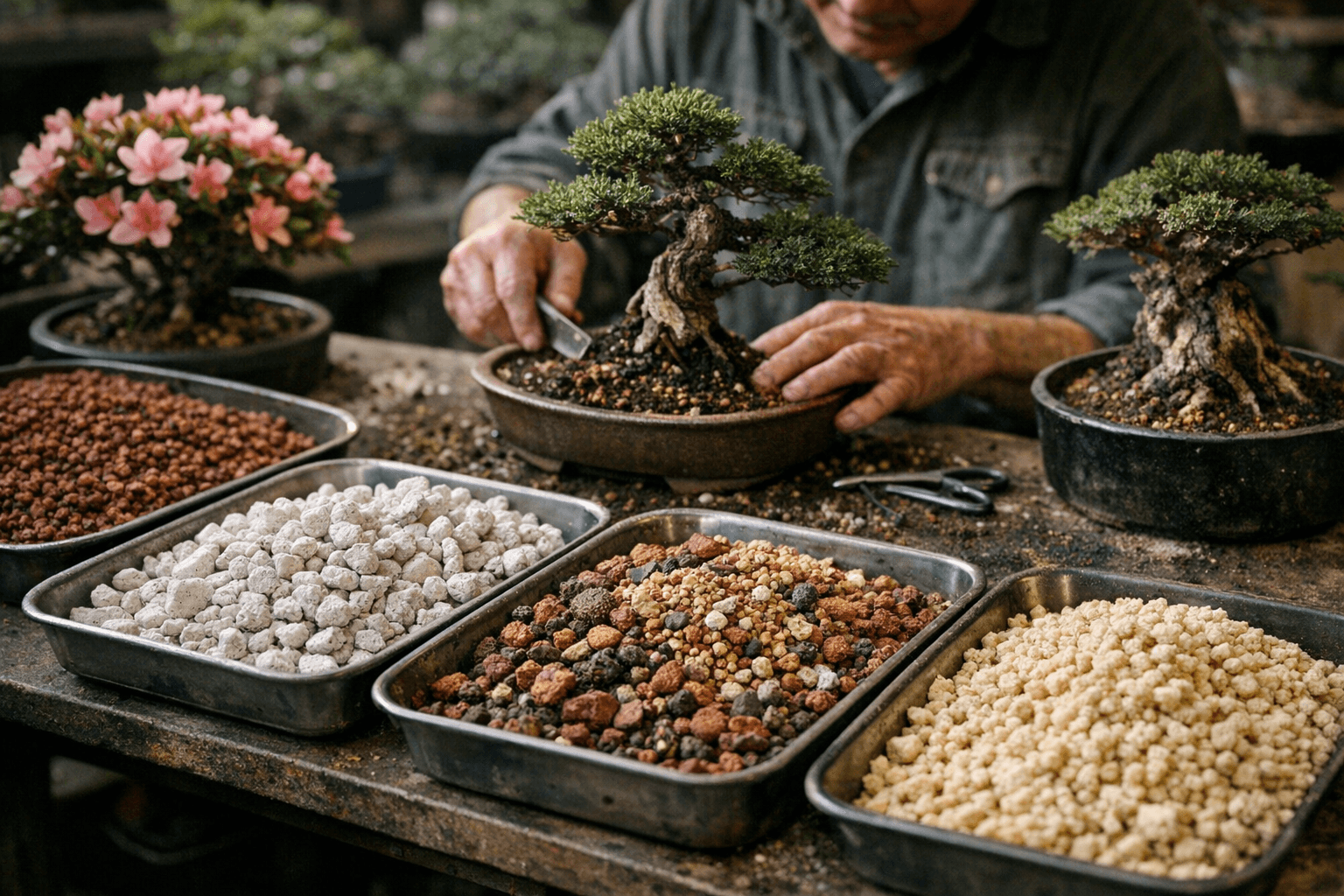
Specialist sources repeatedly recommend the triad of Akadama, Pumice, and Lava rock as the backbone for both deciduous and conifer mixes. Bonsai Empire states these three components provide water retention (Akadama), substrate structure and root ramification (Pumice), and aeration/drainage (Lava rock). Most modern practitioners have moved away from using fine gravel/grit as a primary ingredient and instead keep this three-way balance.
3. Component functions and practical notes
Akadama: a hard-baked Japanese clay that holds water and structure but breaks down slowly; it’s “by far the most common component” but can be pricey. Pumice: “a soft volcanic rock…absorbs water and nutrients…helps to retain water and allows the roots to ramify very well.” Lava rock: gives structure and drainage but “roots can't grow into the Lava rock.” Organic potting compost (peat/perlite/sand) retains moisture and should be used sparingly when extra retention is needed. Fine gravel/grit is still useful as a bottom drainage layer, though “most experts have stopped using it” as a main ingredient.
4. Azalea (including satsuki azaleas): exact ratio, 100% kanuma
For azalea bonsai, cuttings, young plants, and finished specimens, use 100% kanuma. Bonsai Tonight is explicit: “The soil mix for azalea bonsai, including satsuki azaleas, is simple: 100% kanuma.” Don’t substitute akadama or pumice for azaleas; kanuma is the species-specific exception.
5. Collected trees / mountain or garden-sourced pre-bonsai: exact ratio, 100% pumice
When you collect trees or lift specimens from gardens/mountains, Bonsai Tonight favors “100% pumice” for pre-bonsai because it’s lightweight and particle size allows you to control moisture (smaller particles hold more water). Use 100% pumice for initial recovery and training where you need low weight and good control over moisture.
6. Conifers (pre-bonsai and refined): keep akadama at or below 30%
For conifers the practical upper limit for akadama in pre-bonsai is explicit: Bonsai Tonight says “I rarely use more than 30% akadama for conifers.” The author also notes examples like a black pine pre-bonsai shown in a “30% akadama mix.” For the non-akadama portion, use straight pumice or a pumice+lava combination to maximize drainage, conifers and pines “need soil that is very well draining.”
7. Deciduous (pre-bonsai and refined): keep akadama at or below 50%
For deciduous pre-bonsai the same source recommends “rarely use more than 50% akadama.” That upper limit reflects the trade-off Bonsai Tonight observes: “more akadama slows growth and I often want faster growth in these early stages of development.” Use the remainder as pumice/lava to balance aeration and drainage.
8. Species needing extreme drainage or retention: jumpers, pines, wisterias, willows
Bonsai2u calls out species differences: “Jumpers and pines need soil that is very well draining,” while “Wisterias and Willows on the other hand, require soil that can retain moisture for longer.” Translate that by minimizing akadama/pumice particle fineness and increasing lava/grit for pines; increase akadama or add a controlled amount of organic potting compost for wisterias and willows when moisture retention is desired.
9. Health-based adjustments: example, live oak
When a tree is stressed, alter the mix to suit recovery. Bonsai Tonight gives a clear example: “Unhealthy live oaks, for example, benefit from drier mixes with high percentages of pumice. Once these trees are healthy again, I’ll increase the percentage of akadama.” In practice that means switching to a pumice-dominant mix for recovery, then gradually moving toward your long-term akadama ratio once vigor returns.
10. Climate and schedule adjustments (wet climates and infrequent checks)
Match your mix to how often you can tend and to local rainfall. Bonsai Empire: “If you know you won’t have enough time to check on your trees twice a day, then add more Akadama or organic potting compost to your mix for increased water retention.” And: “If you live somewhere with a wet climate, add more lava rock or grit to enhance the draining qualities of your mixture.” Those are direct, actionable rules: increase retention for infrequent watering; increase drainage for wet environments.
- Azalea: 100% kanuma (Bonsai Tonight).
- Collected/pre-bonsai from gardens/mountains: 100% pumice (Bonsai Tonight).
- Conifer pre-bonsai example: 30% akadama + 70% pumice or pumice/lava (Bonsai Tonight’s 30% akadama example for black pine).
- Deciduous pre-bonsai example: 50% akadama + 50% pumice/lava (reflects “rarely use more than 50% akadama” guidance).
11. Practical mix templates you can use (based on explicit limits and examples)
Use only proportions that are supported by the sources:
These templates reflect explicit percentages and the documented non-akadama choices (straight pumice or pumice+lava) used by practitioners.
12. Ready mixes and shopping notes (retailer specifics)
If you don’t want to mix your own, retailers offer sifted premixes. Bonsai Outlet promotes sifted Akadama mixes and claims its blends are “carefully blended and sifted to remove dust,” noting products like Tinyroots All-Purpose (over 80 reviews) and Premium Blend Bonsai Soil (over 30 reviews). If you buy premixed Akadama, remember Akadama can be “quite pricey” per Bonsai2u, so reserve 100% or high-akadama mixes for special trees if budget matters.
- Never use standard potting soil; it’s “far too dense.”
- Don’t use Miracle-Gro for bonsai, high fertilizer loads can harm roots.
- Use kanuma for azaleas and pumice for initial recovery/collected trees.
- Cap akadama at ~30% for conifers and ~50% for deciduous pre-bonsai; adjust higher only for refined specimens when growth control matters.
- For wet climates or heavy rain, increase lava rock/grit; if you can’t check often, increase akadama or add a small percentage of organic compost to retain moisture.
13. Final rules of thumb and troubleshooting checklist
Conclusion, pick by species, climate and objective There’s no universal soil, but there are clear, species-specific absolutes in the sources: 100% kanuma for azaleas and 100% pumice for many collected trees, with bounded akadama percentages for pre-bonsai (≤30% for conifers, ≤50% for deciduous). Use akadama+pumice+lava as your backbone, tune with the climate and the tree’s health, and you’ll spend less time rescuing trees and more time shaping them.
Know something we missed? Have a correction or additional information?
Submit a Tip