Bright Meteor Flashes Across Washington Captured at NAS Whidbey; Oak Harbor Fireball
A bright meteor flashed across Washington on March 4, 2026, captured by the Skunk Bay weather camera at Naval Air Station Whidbey Island; eyewitness reports stretched 220+ miles to Kamloops, B.C.
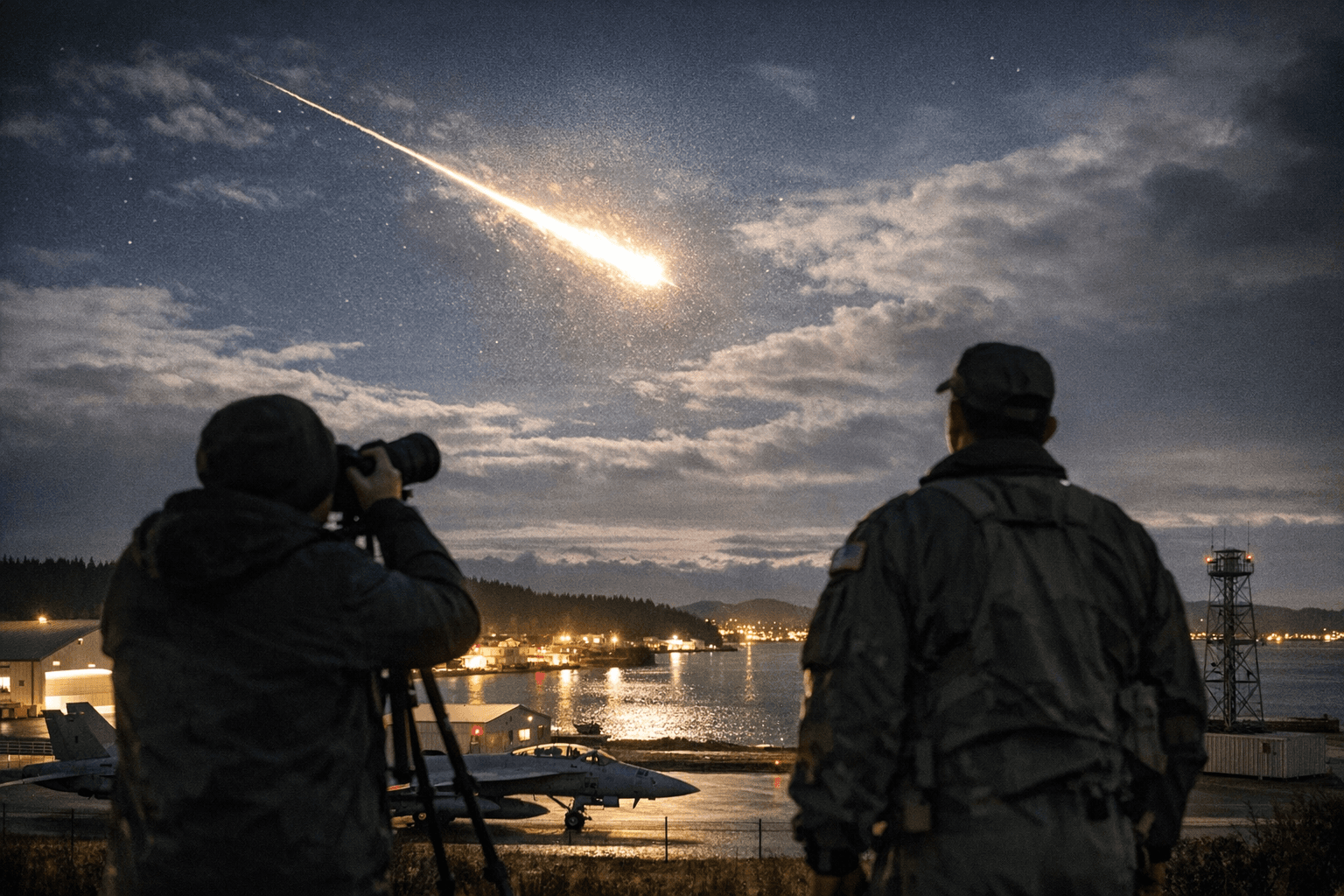
A bright meteor flashed across Washington and was caught on the Skunk Bay weather camera at Naval Air Station Whidbey Island, with the report saying the flash was seen across the state and a boom was heard in southern British Columbia as eyewitness reports spanned more than 220 miles from Quilcene, Washington, to Kamloops, British Columbia.
The capture on the Skunk Bay weather cam occurred early March 4, 2026, according to the original report of the sighting. That same account places the sonic report in southern B.C., and lists the wide eyewitness footprint from Quilcene on the Olympic Peninsula eastward into interior British Columbia, underscoring the geographic reach of the atmospheric event.
Separately, a mid-October 2022 fireball over Oak Harbor was recorded on multiple doorbell and security cameras, including a front-door camera belonging to Oak Harbor resident Sarah Peace. The Oak Harbor footage shows the meteor exploding in the upper atmosphere above Whidbey Island and was accompanied by local reaction to the bright burst seen in the security clips.
Tony Edwards, vice president of the Island County Astronomical Society and an astrophotographer, described the Oak Harbor flash as a "fire ball" and said he thinks the event was likely from the Orionids meteor shower, noting that the Orionids peak every year from Oct. 21-22 and that Halley’s Comet is associated with the Orionids. Edwards framed the Oak Harbor capture in wider context, saying, "They estimate that the earth is hit with about 44 tons of meteor material on a daily basis."
Edwards also offered practical perspective for observers and investigators, advising, "If people are interested in viewing shooting stars, they should simply go out on a clear, moonless night in a dark location." He added that his own long-exposure astrophotography often catches streaks of light but that, "Because of the long exposure time, he normally has no idea if they are satellites or shooting stars."
On the question of fragments and aftermath, Edwards cautioned uncertainty: "He didn't know the size of the meteor in question. Small fragments may have survived and fallen to the earth." He described the final burst in the Oak Harbor footage as likely a denouement: "That last flash was probably its last hurrah," and reminded readers that "most meteors are about the size of a grain of sand so they burn up pretty quickly."
Together, the March 4, 2026 Skunk Bay cam capture and the October 2022 Oak Harbor doorbell footage highlight how fixed cameras at Naval Air Station Whidbey Island and household security systems can document bolides across Island County and beyond. Local investigators, astrophotographers such as Tony Edwards, and camera owners like Sarah Peace provide the on-the-ground—and on-camera—evidence that helps scientists and authorities corroborate sonic reports, map trajectories, and determine whether any fragments might have reached the surface.
Sources:
Know something we missed? Have a correction or additional information?
Submit a Tip