Britain's tax gap hits £59.2 billion, small businesses drive shortfall
Britain collected 93.6% of taxes due, but small firms drove a £59.2 billion gap that now tests Rachel Reeves’s fiscal plans.
Britain’s £59.2 billion tax gap is more than a compliance statistic. It is a measure of how much state capacity the government still lacks, and how unevenly the burden of paying for public services is being enforced. HM Revenue and Customs said the shortfall in 2024/25 amounted to 6.4% of theoretical tax liabilities, meaning the state collected 93.6% of what it was owed.
The pressure point is clear: small businesses accounted for 62% of the gap, even though they make up about 5.1 million firms, roughly 93% of UK businesses. By tax type, Corporation Tax and Income Tax, NICs and capital gains tax each made up 35% of the total gap, with VAT accounting for 20%. That mix points to a problem concentrated in the parts of the tax system that rely most heavily on self-assessment, record-keeping and enforcement.

Corporation Tax is the sharpest risk. HMRC estimated the Corporation Tax gap at 18.1% of theoretical liability in 2024/25, or £18.6 billion in cash terms. For small businesses alone, the Corporation Tax gap was £14.7 billion, equal to 40.1% of their theoretical Corporation Tax liability. That scale matters because it shows the gap is not evenly spread across the economy. It is concentrated among smaller firms, where compliance can be weaker and enforcement more difficult.
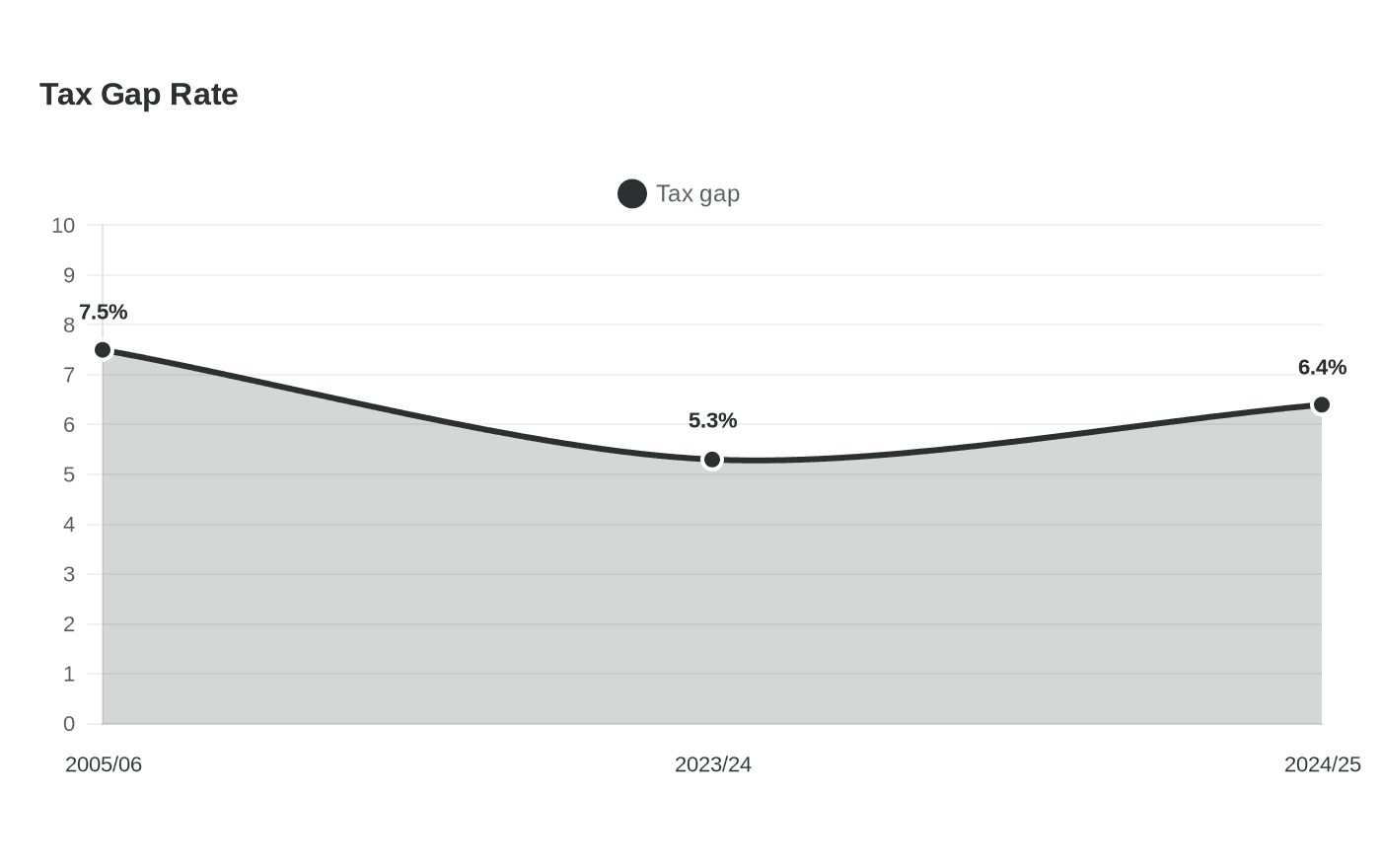
The latest figures also underline how stubborn the problem has been. HMRC said the tax gap was 7.5% in 2005/06 and 6.4% in 2024/25, a decline of only 1.1 percentage points over two decades. Earlier HMRC data put the 2023/24 tax gap at £46.8 billion, or 5.3%, so the latest estimate is both larger in cash terms and higher as a share of liabilities.
The fiscal stakes are severe. The UK ran a budget deficit of £128 billion, equal to 4.2% of GDP, in the last financial year, while public-sector net debt stood at £2.805 trillion, or 93% of GDP, at the end of 2024/25. The House of Commons Library says the UK last posted a budget surplus in 2000/01. Against that backdrop, the Treasury’s pledge to raise £10 billion from anti-gap measures by 2029/30, and HMRC’s claim that it brought in £48.0 billion that would otherwise have gone unpaid, show why enforcement is now central to Rachel Reeves’s fiscal arithmetic. Recent Office for Budget Responsibility work on welfare fraud and error, especially around Universal Credit and the pandemic, reinforces the same lesson: Britain’s public finances depend not just on tax rates, but on whether the system can collect what is already due.
This article was produced by Prism’s automated news system from verified source data, official records, and press releases, then run through automated quality and moderation checks before publishing. The system is built and supervised by the people who set the standards it runs under. Read our full AI policy.
Know something we missed? Have a correction or additional information?
Submit a Tip