Britons now say Brexit was a mistake, polls find
Most Britons now say Brexit was a mistake, but Labour and the Conservatives still rule out a rerun. The political taboo has outlasted the public verdict.
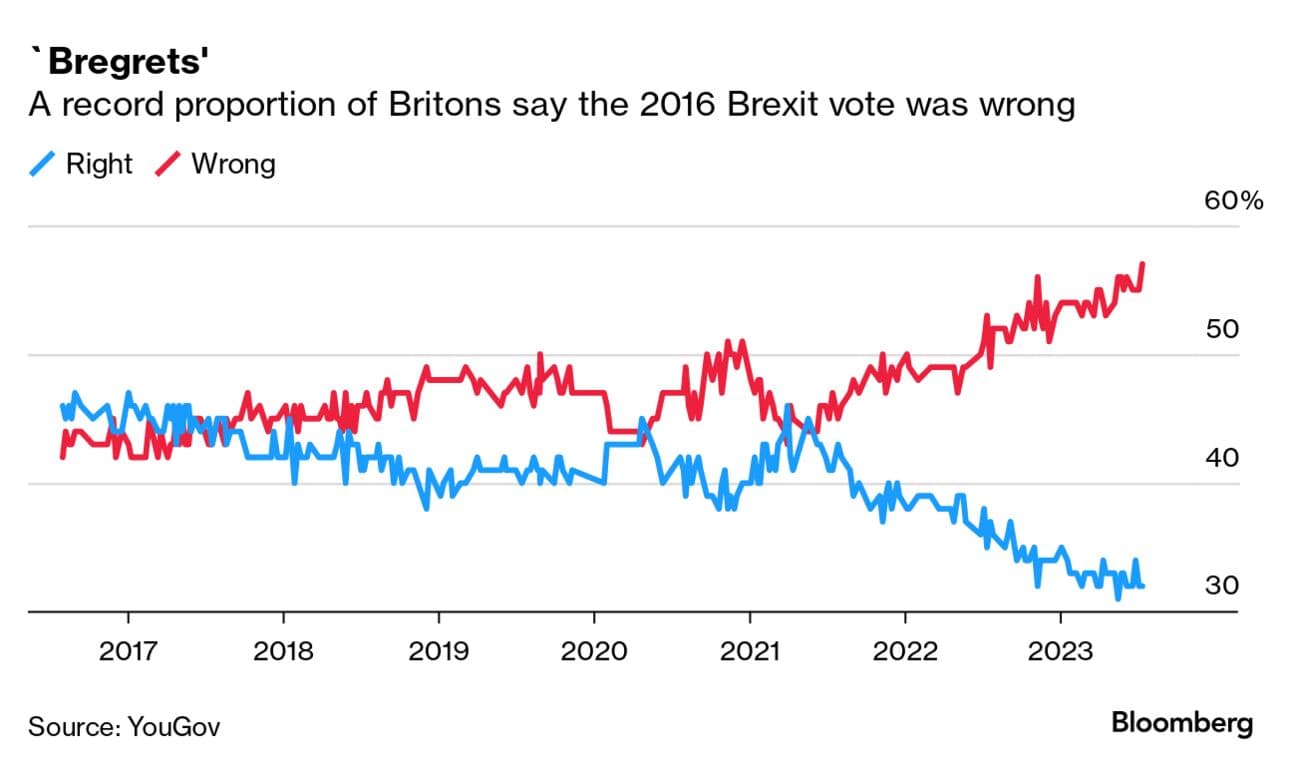
A decade after Britain voted to leave the European Union, public opinion has shifted decisively against Brexit, but the political class still treats the question as settled. New YouGov polling found 57% of Britons think the UK was wrong to vote to leave, 55% support rejoining the EU and 59% want a closer relationship without going back into the single market, customs union or full membership.
That reversal matters because the 23 June 2016 referendum was close but decisive enough to redraw British politics for years. Leave won 51.9% to 48.1% on turnout of 72.2%, and the UK formally left the EU on 31 January 2020 after years of negotiations, legal wrangling and political upheaval. The latest polling suggests many voters now judge Brexit less as a question of sovereignty than as a policy that failed to deliver on economics, competence and stability.

Six in 10 Britons now say Brexit has been a failure. In the same YouGov polling, the Conservatives and Boris Johnson were seen as most responsible for it not being a success, while only 31% of respondents said rejoining the EU would improve their household finances. That split helps explain why the word “mistake” has become so common in the debate: it can mean weaker growth, more friction for trade, less certainty for business and a country that feels more isolated, but it does not automatically translate into a belief that the answer is a simple return to the status quo.
Labour ministers have made that distinction explicit. Keir Starmer has said Brexit caused deep damage to the economy, but his government has ruled out reopening the argument over EU membership. The line from ministers is to seek a closer relationship with Brussels while rejecting a return to the single market, customs union or freedom of movement. That leaves the government trying to capture the benefits of warmer ties without reviving the fight that split the country in 2016.

Separate polling backed by the European Council on Foreign Relations found the same broad mood. Conducted by YouGov and Mandate from 7 to 14 May 2026, in four rounds with more than 2,000 respondents, it found about two-thirds of Britons believed Brexit had hurt the country, roughly three-quarters wanted closer ties with the EU and 52% said they would vote to rejoin in another referendum. Among people too young to vote in 2016, support for rejoining was reported at about 70%, underlining how generational the shift has become.

The old regional fault lines still hang over the issue. England and Wales voted Leave, while Scotland, Northern Ireland and London backed Remain, and those divisions have not disappeared just because the mood has changed. A decade on, Britons may have grown more willing to call Brexit a mistake, but neither major party sees advantage in trying to undo it.
This article was produced by Prism’s automated news system from verified source data, official records, and press releases, then run through automated quality and moderation checks before publishing. The system is built and supervised by the people who set the standards it runs under. Read our full AI policy.
Did this article answer your question?