Broad index funds beat politically tied stocks, experts say
Political bets can feel urgent, but the record still favors broad index funds. Morningstar and Investopedia say election winners are hard to time and diversification wins.
Morningstar has been blunt: “politics are not a winning technique for selecting investment themes.” Its election-season coverage has repeatedly argued that investors tend to come out ahead no matter who wins in November.
Why election logic breaks down in the market
The temptation to buy stocks tied to one party or one administration is understandable, especially when big business and the Trump administration appear closely intertwined. But the market does not reward loyalty, it rewards exposure to earnings, valuation, and time in the market, and political outcomes are too blunt a tool to predict those forces.
A presidential result can affect portfolios through policy shifts, but not in a way that makes betting on one candidate’s favored stocks a reliable long-term strategy, Investopedia wrote in a 2024 explainer published on November 5. Policy can move sectors, yet the timing, magnitude, and market reaction are far harder to forecast than the campaign rhetoric suggests.
Morningstar has made the same point in different forms. One election-cycle article was titled “Investors Tend to Win No Matter Who Prevails In November,” and another on oil and energy stocks argued that those shares were confounding political expectations under both Biden and Trump.
What past election cycles show
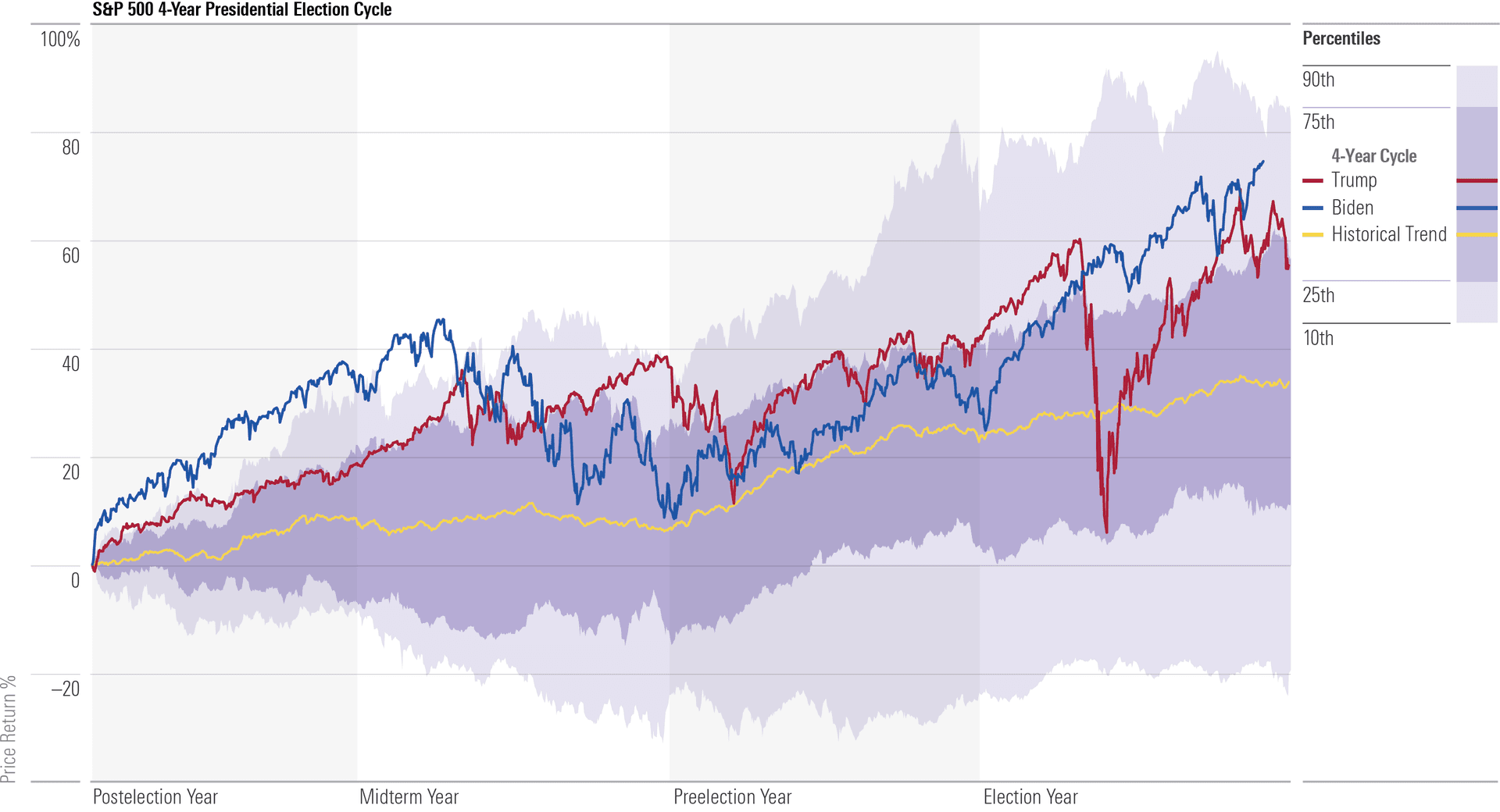
Markets can rise under very different administrations, as Morningstar’s election-season retrospectives on the 2016 and 2020 elections showed. That alone undercuts the idea that an ordinary investor can reliably time a portfolio around who occupies the White House.
In Morningstar’s “13 Charts on Q4’s Big Postelection Rally and Late Stumble,” stocks set record after record in 2024, even though the year ended on a weak note. That kind of backdrop makes it hard to claim that a single election outcome explains returns in a durable way, especially when the broader market is already driven by profit growth, rates, inflation, and concentration in a few megacap names.
Morningstar published “What Investors Should Focus on After Election Day” on August 19, 2024, with the core message that who wins the election is not the most important question.
Why broad index funds usually hold up better
Broad index funds beat politically tied stocks because they spread risk across many companies instead of tethering returns to a small set of names that happen to be close to power. That diversification matters when election outcomes, policy shifts, and market concentration all raise the odds that one favored sector or company will disappoint.
Investors are better served focusing on what they can control. In practice, that means the structure of the portfolio, the level of diversification, and the discipline to avoid making a big bet on a political narrative that can be wrong for months or years.
ETFs trade on stock exchanges such as the New York Stock Exchange, unlike mutual funds, which are priced and processed once a day. That accessibility has helped make broad index exposure the default choice for many investors who want a simple way to own a wide market rather than a politically themed slice of it.
Why 2025 policy uncertainty strengthens the case for diversification
Policy uncertainty does not justify concentration, it argues for the opposite. In late 2024, Russell Investments published “Potential U.S. Policy Changes in 2025,” and Paul Eitelman, CFA, the firm’s global chief investment strategist, framed the year as one that could bring major U.S. policy changes. When tax, trade, regulation, or industrial policy can shift quickly, a portfolio built around one political thesis can be vulnerable to abrupt reversals.
That is where broad index funds have an edge over politically tied stocks. A diversified fund can absorb policy surprises across sectors and industries, while a concentrated bet on a few administration-linked winners can magnify losses if expectations prove wrong.
The real test for ordinary investors
Politics can move individual stocks. But Morningstar’s election coverage, Investopedia’s 2024 election explainer, and Russell Investments’ 2025 policy outlook point in the same direction: no reliable edge appears from choosing stocks by partisan affiliation.
This article was produced by Prism’s automated news system from verified source data, official records, and press releases, then run through automated quality and moderation checks before publishing. The system is built and supervised by the people who set the standards it runs under. Read our full AI policy.
Did this article answer your question?