Broadcom posts record $19.3B quarter, raises guidance and OKs $10B buyback
Broadcom reported $19.311 billion in Q1 revenue, driven by AI demand, raised near-term guidance and approved a $10 billion buyback, reshaping data center and community impacts.

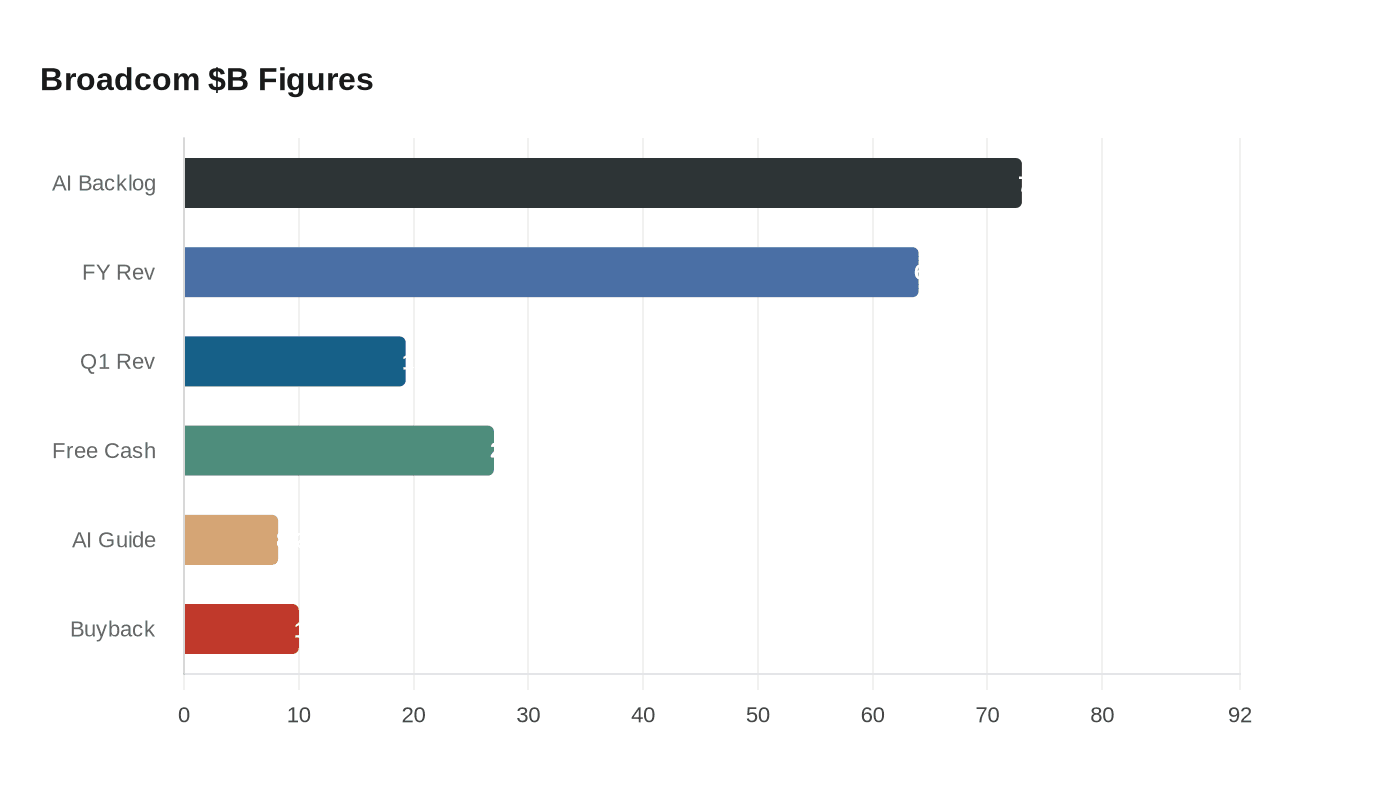
Broadcom reported record fiscal first-quarter revenue of $19.311 billion, up 29 percent year over year, and said it raised near-term guidance while approving a $10 billion share buyback as demand for custom AI chips and high-speed networking surged. The company announced the results after the market close on March 4 and held an investor call to outline heavy bookings, multiyear order visibility and plans to return cash to shareholders.
AI products and networking were the dominant drivers. Management guided AI semiconductor revenue for the next quarter at $8.2 billion, “representing a near doubling YoY,” and said the company’s AI pipeline has deepened. “Total AI backlog now stands at $73 billion, expected to be delivered over the next 18 months,” executives told investors, while the AI switch backlog alone exceeded $10 billion at the end of Q4. Broadcom’s Tomahawk 6 Ethernet switch, capable of 102 terabits per second, and custom accelerators known as XPUs have become central to hyperscale cloud builds.
Broadcom highlighted traction with hyperscale customers. Company remarks confirmed Anthropic as one of the large XPU customers and that Anthropic “had placed an additional $11 billion order for delivery in late 2026, following a $10 billion order received in Q3.” Executives also said a fifth XPU customer had been secured with an initial $1 billion order. Management told investors that the XPU business “accelerated to 65% of our AI revenue this quarter,” underscoring the shift in Broadcom’s semiconductor mix toward bespoke AI silicon.

The surge in orders has translated into substantial cash generation. For the prior fiscal year, Broadcom posted roughly $64.0 billion in revenue and free cash flow approaching $27 billion, supporting higher dividends and buybacks. Investors will note the company recently increased its quarterly dividend and now plans to deploy $10 billion more on repurchases, signaling an aggressive capital return posture alongside ongoing investment in data center components.
Company remarks also stressed how networking has become a strategic bottleneck for large-scale models, noting that “the network is the computer” as customers scale clusters beyond 100,000 compute nodes. That convergence of compute and networking hardware has widened Broadcom’s role in the AI supply chain, positioning the firm alongside chip-foundry partners as hyperscalers design and deploy custom accelerators.
The growth trajectory carries broader public health, environmental and equity implications. Rapid data center expansion to absorb hundreds of billions of dollars in AI orders will increase electricity demand in host communities, magnify local air and noise impacts from construction, and raise questions about who benefits from the value generated. Policymakers and regulators face near-term decisions on grid upgrades, emissions mitigation and community benefit agreements to ensure that neighborhoods near new facilities do not shoulder disproportionate harms. Healthcare systems, which increasingly rely on AI tools, will also confront access and equity challenges if compute capacity and model deployment concentrate in a handful of well capitalized companies.
Broadcom said it now expects fiscal 2026 AI revenue outlook to improve significantly from prior guidance, reflecting the backlog and production ramps. With multi‑billion dollar orders and a decade of capital flow back to investors, the company’s growth will continue to reshape data center capacity, industrial policy and the local communities that host the physical infrastructure of AI.
This article was produced by Prism’s automated news system from verified source data, official records, and press releases, then run through automated quality and moderation checks before publishing. The system is built and supervised by the people who set the standards it runs under. Read our full AI policy.
Know something we missed? Have a correction or additional information?
Submit a Tip