BYD first-quarter profit plunges 55%, Chinese EV price war bites harder
BYD’s quarterly profit fell 55.4% to 4.1 billion yuan as China’s EV price war and weaker subsidies squeezed the industry’s biggest seller.
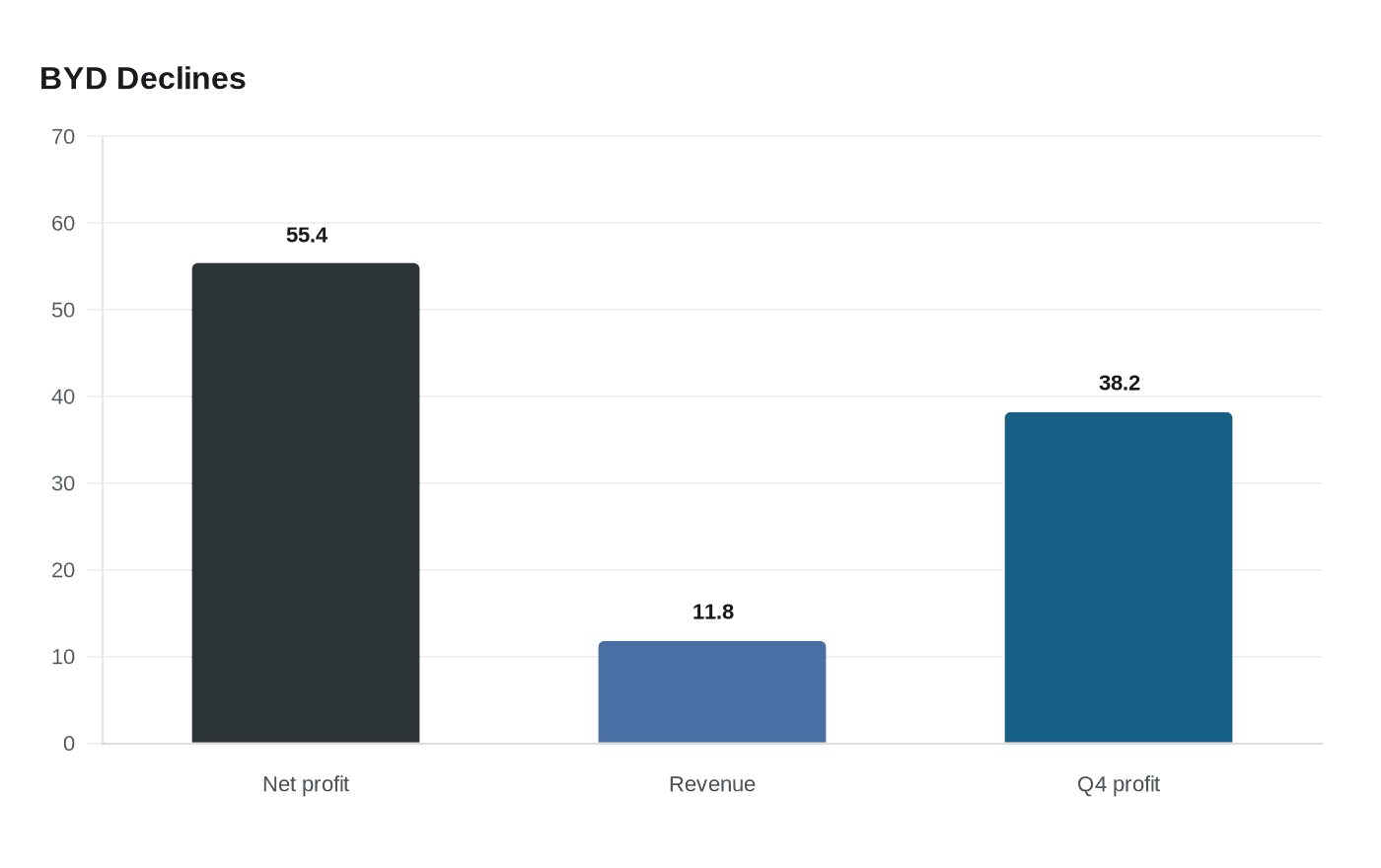
BYD’s first-quarter earnings showed how far China’s electric-vehicle price war has moved beyond smaller rivals and into the heart of the market leader’s business. Net profit fell 55.4% from a year earlier to 4.1 billion yuan, about $600 million, while revenue slipped 11.8% to 150.2 billion yuan, the weakest quarterly profit BYD has posted in more than three years.
The drop marked BYD’s fastest pace of profit decline since 2020 and came after a 38.2% fall in the fourth quarter, a sequence that points to a sustained deterioration rather than a one-off setback. For a company that remains the world’s biggest EV seller by volume, the numbers suggest the domestic market that powered its rise is becoming much less forgiving.
Pressure has built in China as trade-in subsidies for entry-level electric cars and plug-in hybrids were scaled back, removing one support for demand just as competition intensified. BYD, known for budget models priced under 150,000 yuan, has been squeezed by rivals including Geely and Leapmotor, which have pushed harder into the same high-volume segments. BYD’s overall sales also fell for a seventh straight month in March, underscoring how persistent the slowdown has become.
The result matters well beyond Shenzhen. BYD has long been treated as a bellwether for Chinese EV demand and, by extension, for consumer sentiment and industrial activity in the country. A sharp profit decline at the sector’s largest player can ripple through suppliers, battery makers, dealers and export planning, especially when the market is already crowded and inventories are under pressure.
The company has tried to offset the domestic slump by leaning more heavily on overseas markets. Some reports put exports at roughly 45% to 46% of first-quarter deliveries, and BYD has said it is confident of reaching 1.5 million overseas vehicle sales in 2026. That international push gives the company another growth engine, but it also highlights the broader problem in China: the industry’s breakneck expansion is increasingly dependent on lower prices, thinner margins and more aggressive volume growth.
BYD’s latest numbers suggest that model is becoming harder to sustain. Even the strongest producer in China’s EV market is now feeling the cost of a price war that is testing whether growth alone can still be enough.
This article was produced by Prism’s automated news system from verified source data, official records, and press releases, then run through automated quality and moderation checks before publishing. The system is built and supervised by the people who set the standards it runs under. Read our full AI policy.
Did this article answer your question?

