California Governor Candidates Clash Over State's Record-High Gas Prices
California's gas averaged $5.29/gallon in March while the national average sat at $3.54, as two major refinery shutdowns and the Iran war collision transformed fuel costs into the defining fight of the 2026 governor's race.

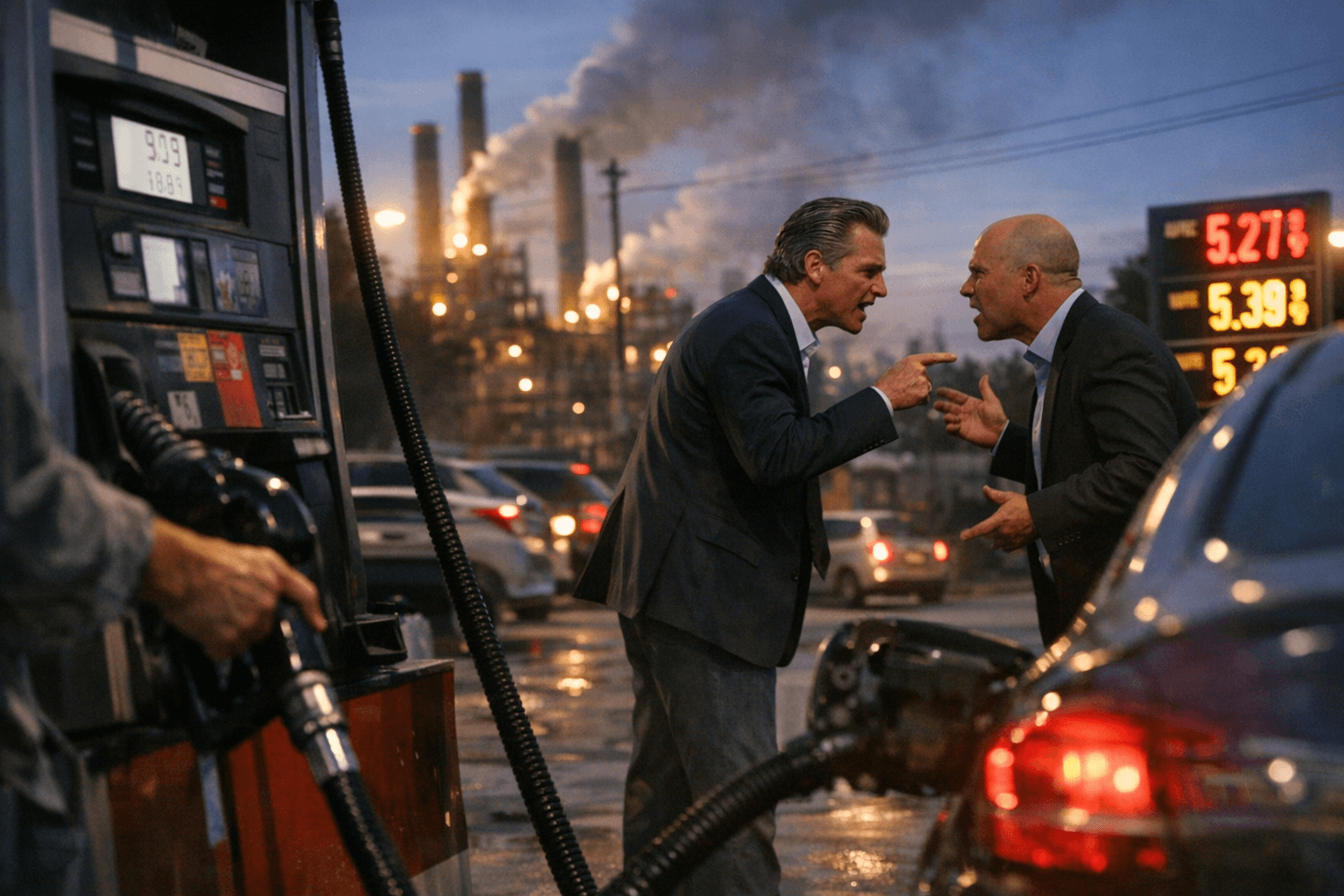
When California's average gas price hit $5.29 per gallon against a national average of $3.54 in mid-March, the gap was impossible for candidates running for governor to ignore. The pressure behind the numbers was a compounding one: experts say the latest price spike is driven by global oil markets and the U.S. conflict with Iran, while California's persistently higher baseline stems from refinery closures, the state's market structure, and environmental rules.
Both forces are now colliding in real time. Phillips 66 closed its 139,000-barrel-per-day Wilmington refinery in the Los Angeles area, and Valero submitted notice to end operations at its 145,000-barrel-per-day Benicia refinery in the Bay Area by the end of April 2026. Together, the two closures account for 17 percent of California's refinery capacity and 11 percent of total West Coast capacity. Valero attributed its decision to "costs and uncertainty imposed on the company by California state regulations." State taxes and fees contribute over $1.28 per gallon, far exceeding national levels.
That regulatory backdrop has given every major candidate in the 2026 governor's race a policy target, even if the remedies diverge sharply. "We're going to end these insane regulations. My goal is to get to $3 per gallon gas in California," said Republican Steve Hilton of Atherton. Among the specific policies Hilton discussed were reducing vehicle registration fees to a flat $71 and opening offshore oil drilling. Riverside Sheriff Chad Bianco proposed going further, calling to do away with the state gas tax altogether.
On the Democratic side, former Los Angeles Mayor Antonio Villaraigosa positioned himself closest to the Republican framing on regulatory culpability. Villaraigosa called for an "immediate moratorium" on regulations he said are "overburdening" California refineries and working families. At the April 1 Fresno State debate, he raised the stakes explicitly: "If we continue to over-regulate refineries, one more goes down, gas prices are going to $8.75 a gallon. I've got a plan," Villaraigosa said. That plan includes relief payments, sending rebates to low-income families if gas prices stay above $5.50 per gallon for more than a month. He also said he would reform and overhaul the California Air Resources Board, which administers many of the state's environmental rules.
San Jose Mayor Matt Mahan offered a narrower but faster-acting lever. He called for a temporary suspension of California's 61-cent-per-gallon gas tax during the war with Iran, a move that would cut roughly 61 cents at the pump. "Gas prices are punishingly high and harming working families," Mahan said. He would not rule out also curbing some of the state's refinery regulations.
Former Health and Human Services Secretary Xavier Becerra took a different approach, proposing broader consumer cost freezes rather than targeting fuel policy directly. "I'm going to freeze your property insurance costs. I'm going to freeze your utility rates so we can look behind the curtain and figure out why they're charging us so much and making so much profit at our expense," Becerra said.
The political debate, however, is running ahead of what any state executive can actually deliver quickly. "California is certainly already strained and the war could not come at a worse time for California gas prices," said Alex Jacquez, chief of policy and advocacy for Groundwork Collaborative, noting that while the Iran conflict is lifting prices nationally, California faces compounding pressure as refinery capacity shrinks. The state's required switch to a more expensive summer fuel blend, which takes effect in April, is adding further upward pressure on already tight supplies.
A gas tax suspension would offer immediate relief at the pump but provides no structural answer to refinery attrition. Regulatory rollbacks could theoretically slow closures, but Valero and Phillips 66 both cited long-term business calculus, not a single rule, when they announced their exits. California's 2023 price-gouging law, signed by Governor Gavin Newsom, has yet to be used; the California Energy Commission voted in August 2025 to delay profit-cap rules for five years. That delay was framed as protecting investor confidence, which leaves Sacramento's most aggressive anti-price-gouging tool sitting on a shelf well past any plausible election mandate.
This article was produced by Prism’s automated news system from verified source data, official records, and press releases, then run through automated quality and moderation checks before publishing. The system is built and supervised by the people who set the standards it runs under. Read our full AI policy.
Did this article answer your question?

