Canva expands AI push with enterprise tools and conversational design platform
Canva is betting enterprise AI can turn design into workplace infrastructure, bundling layered content, security controls and workflow automation for large teams.

Canva is pushing beyond consumer design into enterprise AI, trying to make its platform the place where large organizations create, edit, govern and ship visual work. The company says it now empowers more than a quarter of a billion people across 190 countries, and it has been building a higher-margin business around Canva Enterprise, a subscription launched on May 23, 2024 for large organizations that need both scale and control.
That enterprise move has become more urgent as Canva’s AI strategy has expanded. At Canva Create 2025 on April 10, 2025, the company unveiled Visual Suite 2.0 and Canva AI. On April 15, 2026, it followed with Canva AI 2.0, which Canva describes as a major step toward a conversational, agentic platform for teams. The system is powered by the Canva Design Model, which Canva calls the world’s first foundation model built to understand the structure, hierarchy and complexity of real-world design. Canva says it can produce fully layered, editable output from a single prompt.

The product changes matter because they change the business model. Canva Enterprise is designed for large organizations and already includes AI-enabled features along with enterprise security controls such as SSO, 2FA, ISO 27001 certification and AI controls. In January 2026, Canva introduced Canva Shield, a collection of trust, safety, privacy and indemnification tools for enterprises, teams and individuals using Canva AI. Canva says customers with more than 100 seats get additional privacy and security tools and indemnification at no extra cost.
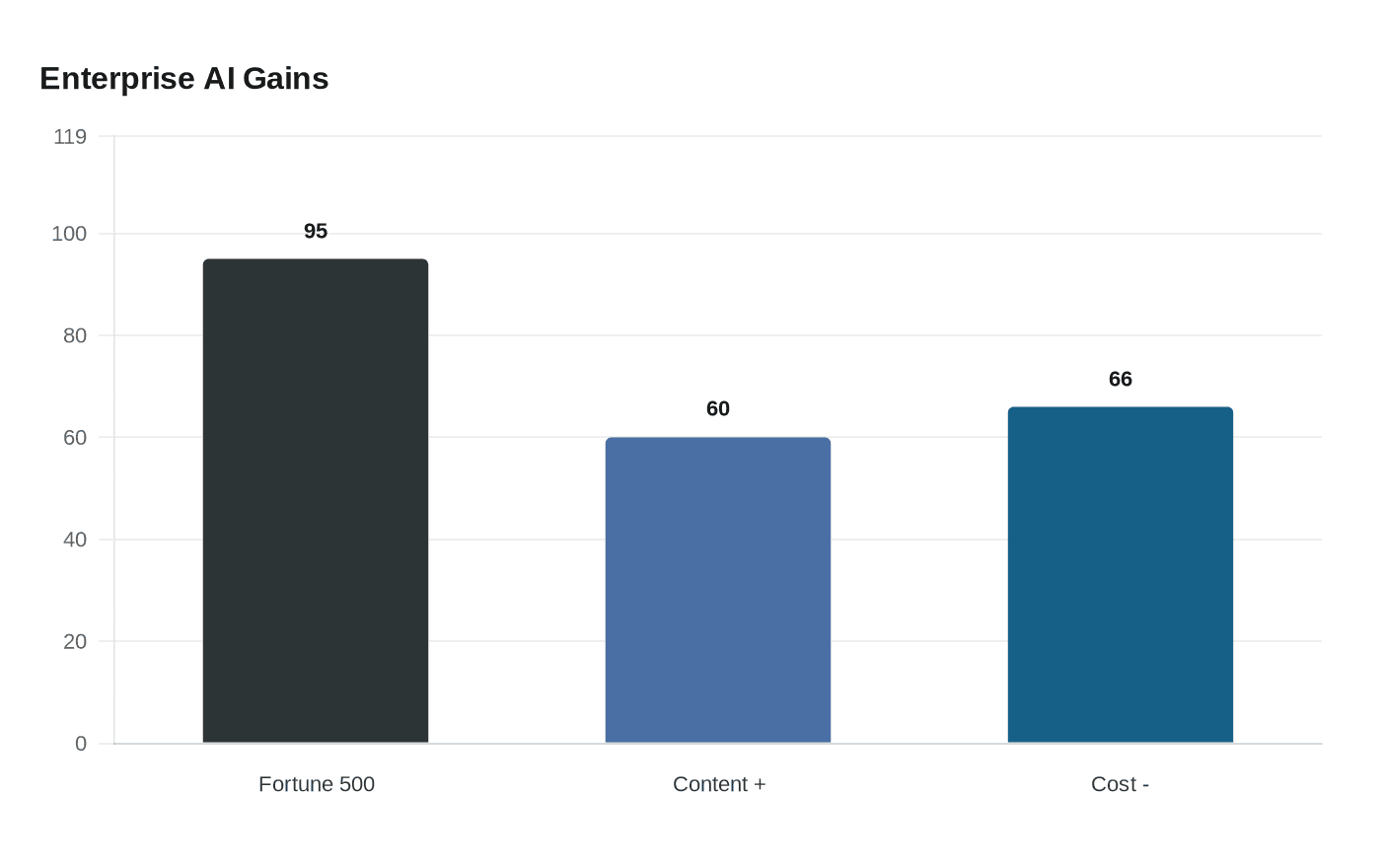
Canva is also trying to prove that the pitch translates into measurable operational gains. In its enterprise materials, the company has cited examples including 230 hours of design saved in three months, a 60% increase in content creation in one month, six months for a full global rebrand and a 66% reduction in design costs. Canva said in May 2025 that its enterprise product was transforming how global teams at companies including FedEx, Keller Williams and Docusign collaborate and communicate visually at scale, and it said the platform was trusted by 95% of the Fortune 500.
The wider strategy is to solve a problem that now sits at the center of enterprise AI adoption: fragmentation. Perkins said the old design bottleneck has reappeared in AI workflows, where people generate content in one tool, format it in another, collaborate in a third and publish through a fourth. Canva’s answer is to pull those steps into one workflow, adding connectors, scheduling, web research, brand intelligence, Sheets AI and Canva Code 2.0. With Daniela Amodei of Anthropic joining Canva Create 2025 and companies such as Coca-Cola and Dropbox building AI into daily work, Canva is making a clear bid to become more than a design app. It wants to be the software layer where teams create, govern and distribute content in the AI era.
This article was produced by Prism’s automated news system from verified source data, official records, and press releases, then run through automated quality and moderation checks before publishing. The system is built and supervised by the people who set the standards it runs under. Read our full AI policy.
Know something we missed? Have a correction or additional information?
Submit a Tip