Career experts urge workers to build AI skills on their own
Employers want practical AI fluency, not buzzwords. Job postings, training data and federal guidance all point to one message: self-train now or fall behind.
The market is already rewarding workers who can use AI, not just talk about it
The clearest signal in the labor market is that AI has moved from a résumé flourish to a workplace expectation. The World Economic Forum said businesses expect nearly half of workers’ core skills to be disrupted by AI by 2027, and that 42% of business tasks are expected to be automated by then. That is not a distant forecast for the next generation of workers, it is a near-term shift in how jobs are being organized and judged.

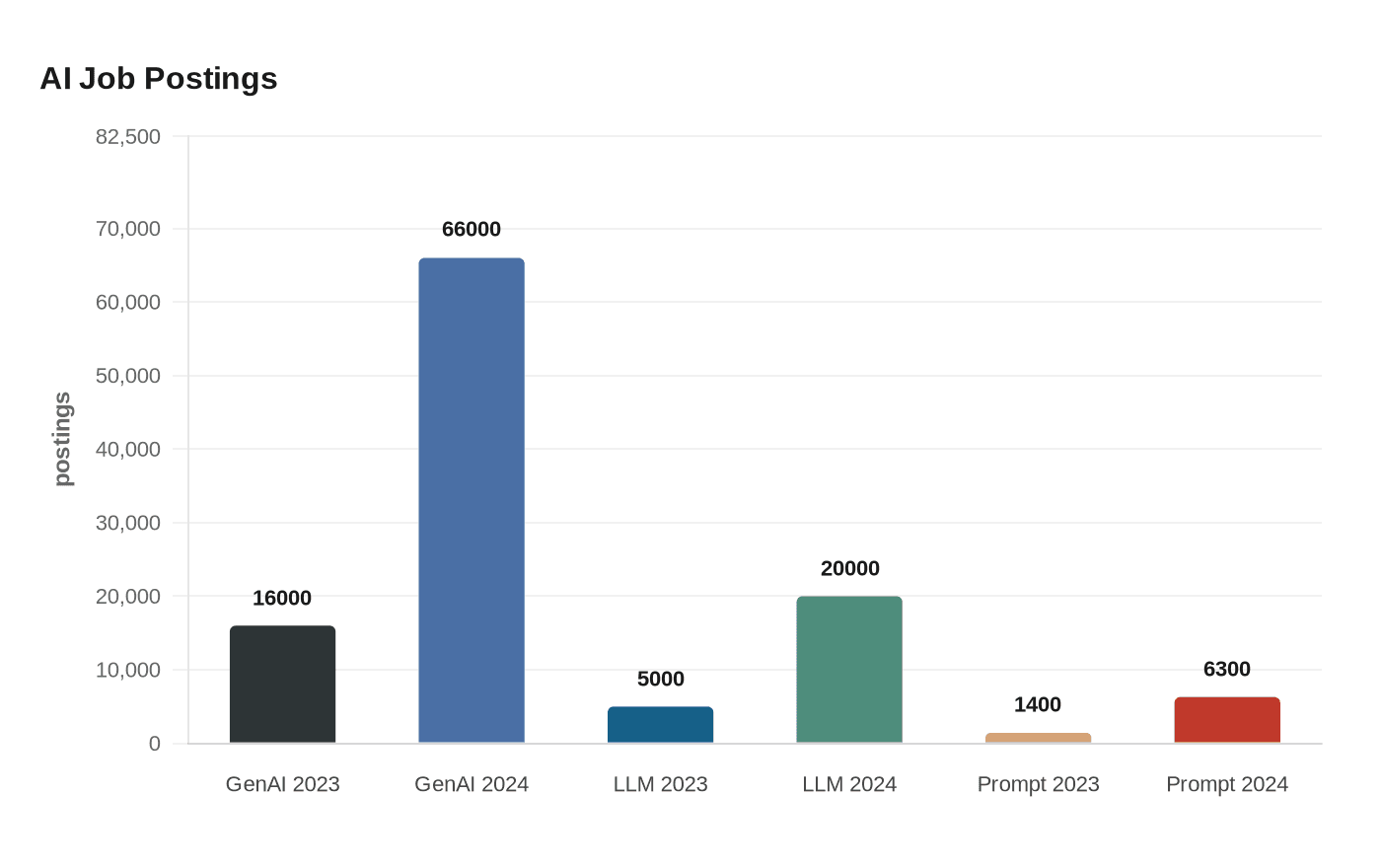
Employers are signaling this change in plain sight. A Stanford Human-Centered AI Institute and Lightcast analysis cited in 2025 found more than 66,000 job postings mentioning generative AI in 2024, up from 16,000 in 2023. Mentions of large language modeling rose from 5,000 to 20,000, while demand for prompt engineering climbed from 1,400 to nearly 6,300 postings. Coursera’s 2025 Job Skills Report showed the same pattern from the learning side: GenAI became the fastest-growing skill among enterprise learners, with enrollments up 866% year over year.
What employers are actually signaling
The fastest-growing AI terms in job ads are useful because they show where employers see immediate value. Generative AI, large language models and prompt engineering are not abstract research phrases anymore. They are shorthand for workers who can use AI tools to draft, summarize, search, compare, classify and accelerate repetitive work without turning every task into a technical project.
The practical reading is simple: employers are rewarding applied fluency more than performative familiarity. Listing AI on a résumé is weak if it stops at a buzzword. Much stronger is showing that you have used AI to cut research time, improve first drafts, organize information, or handle high-volume routine work with fewer errors. In other words, the market is asking for task-level productivity, not just tool awareness.
That is especially important because the WEF said people are now more than twice as likely to add AI skills than in 2018, and that recruiters, marketers, sellers and healthcare professionals are far more likely to add AI skills than six years ago. Those are jobs built around communication, judgment, coordination and information handling, exactly the kinds of work where AI can save time quickly if used well.
Why government agencies are treating AI literacy like baseline workforce training
The federal government is now framing AI as a workforce issue, not a niche tech issue. In February 2026, the U.S. Department of Labor published an Artificial Intelligence Literacy Framework for workers, employers, training providers, teachers, faculty and workforce agencies. The framework says every worker will need baseline AI literacy skills to succeed, regardless of industry or occupation, and it lays out five foundational content areas and seven delivery principles.
That follows earlier action from the same department. In August 2025, the Labor Department issued guidance encouraging states and local workforce boards to use Workforce Innovation and Opportunity Act grants to support AI literacy and training in the public workforce system. The message is that AI education should not depend entirely on whether an employer happens to offer a good internal program.
The Bureau of Labor Statistics added another reason workers are moving early. In March 2025, it said AI is expected to primarily affect occupations whose core tasks can be replicated by generative AI in its current form during the 2023 to 2033 projections period. It also said other jobs in computer, legal, business and financial, and architecture and engineering fields may be susceptible. That does not mean these occupations disappear. It means the work inside them changes, and workers who can use AI well will adapt faster than workers who wait to be trained.
A practical roadmap for building useful fluency without a computer science background
The cheapest path is usually the most direct one: learn AI by using it on real tasks you already do. Start with one recurring workflow, then measure whether AI helps you complete it faster, with fewer mistakes, or with a clearer first draft. The goal is not to become a model builder, but to become a better operator in a workplace where AI is increasingly part of the process.
If you work in recruiting, marketing, sales or healthcare
These roles are already showing strong AI adoption because they depend on sorting information and communicating quickly. A recruiter can use AI to draft job descriptions, summarize candidate notes, or organize interview feedback. A marketer can use it to generate campaign variants, outline content, or compare message angles. A seller can use it to prepare account research and follow-up drafts. In healthcare, the safest and most useful starting point is administrative and documentation support, not clinical judgment.
A low-cost path here is to practice on anonymized, low-risk material first. Use AI to rewrite an email, summarize a meeting, or produce a checklist, then compare the output to your own version. The point is to learn where it helps and where it needs close supervision.
If you work in business, finance, law, engineering or tech-adjacent roles
These jobs may be more exposed because many core tasks are text-heavy, rules-based or document-driven. BLS flagged these fields as potentially susceptible in the 2023 to 2033 window, which makes AI literacy a defensive skill as much as a productive one. The useful skill is not simply prompting a chatbot. It is knowing how to ask for a structured output, verify it, and spot where the model is overconfident or incomplete.
- use AI to build first drafts of memos, summaries and issue lists
- compare AI output against your own source materials
- create a personal library of prompts that reliably produce useful structures
- document where AI saved time and where it introduced risk
For these workers, the highest-return habits are often the cheapest:
That kind of evidence matters because it turns AI from a résumé claim into a work habit.
If you work in public-facing or administrative jobs
The DOL’s guidance around Workforce Innovation and Opportunity Act grants matters here because it points to community-level training, not just corporate upskilling. If an employer is not offering structured AI education, local workforce boards and public training programs may be the fastest route to baseline literacy. The federal framework is designed to help those providers build programs around practical use, not theory.
For administrative workers, the highest-value skills are often the least glamorous: sorting inboxes, summarizing long documents, drafting standard replies, building checklists, and turning messy information into usable formats. Those are the tasks where AI can create immediate time savings without requiring advanced technical knowledge.
What to learn first, and what to ignore
Workers do not need to chase every AI phrase that appears in a job ad. The market data suggests that generative AI, large language models and prompt engineering are real signals, but the bigger prize is broader fluency: knowing how AI fits into everyday work. A worker who can use AI to handle a recurring task, check the output and explain the result is more valuable than someone who can recite terminology.
That is why the smartest self-training strategy is narrow at first and practical throughout. Pick one role-relevant task, learn one or two tools, and keep a record of what changed in time, quality or output. The labor market is already moving, the training signals are already visible, and the jobs most likely to change are the ones that reward workers who adapt before the requirement appears in the job description.
This article was produced by Prism’s automated news system from verified source data, official records, and press releases, then run through automated quality and moderation checks before publishing. The system is built and supervised by the people who set the standards it runs under. Read our full AI policy.
Did this article answer your question?

