TSMC sees global chip sales topping $1.5 trillion by 2030
TSMC says AI could push the global chip market past $1.5 trillion by 2030, but that bet depends on data centers, power grids and factory buildouts keeping pace.

Taiwan Semiconductor Manufacturing Co. is putting a hard number on the scale of the AI boom: global chip sales could top $1.5 trillion by 2030, a sharp upgrade from its earlier $1 trillion forecast. The revision matters because TSMC is not just another chip company. As the world’s largest contract chipmaker, it is a bellwether for whether AI is becoming a full industrial cycle, not just a software surge.
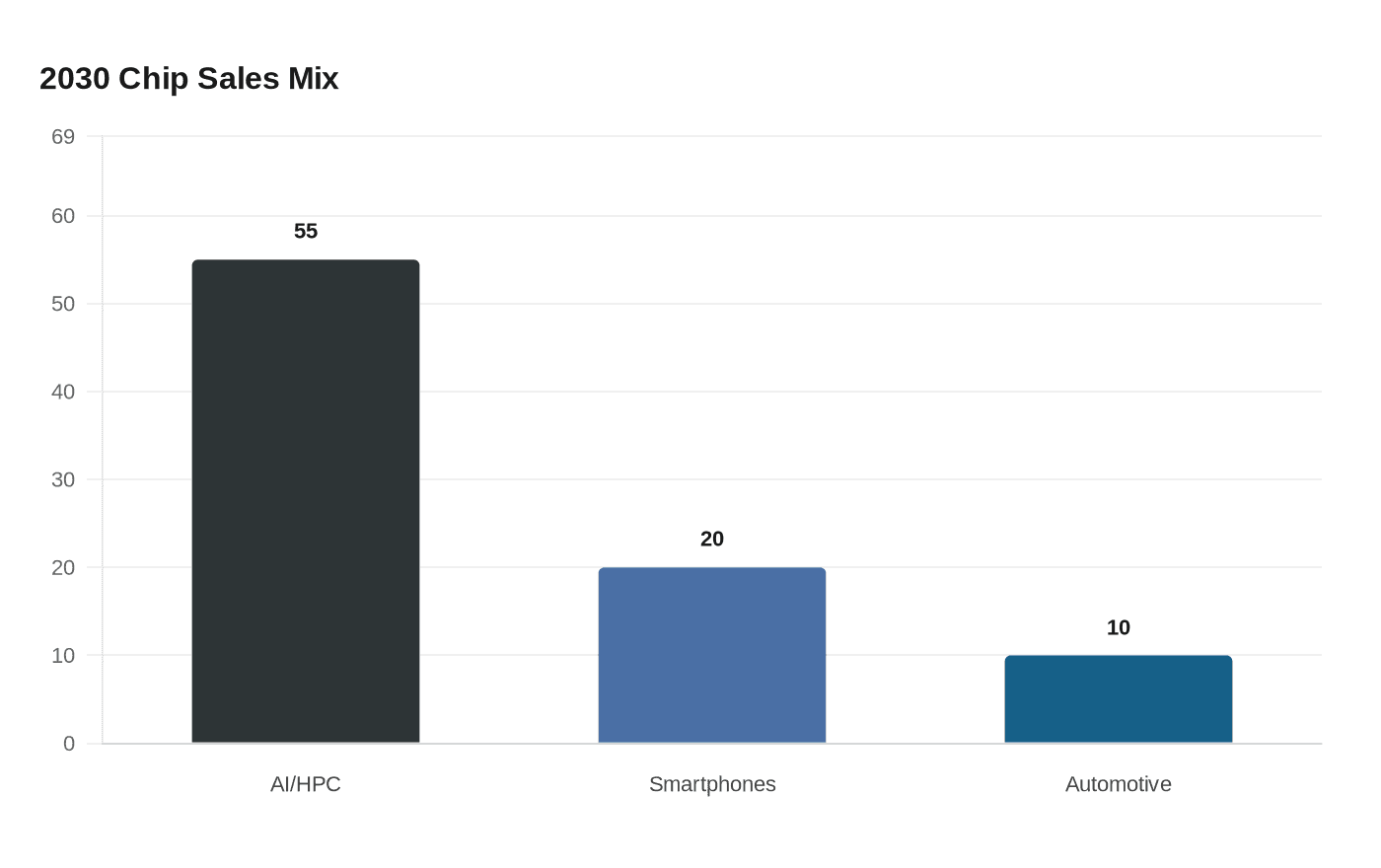
The company’s presentation materials break that market into a distinctly AI-shaped mix. Artificial intelligence and high-performance computing are expected to account for 55% of the total by 2030, while smartphones would still make up 20% and automotive applications 10%. That is a useful reality check: AI is becoming the center of gravity, but the broader chip economy still depends on handsets, cars and a long tail of connected devices.
For that forecast to hold, the buildout has to keep moving far beyond model training. TSMC has been expanding capacity faster in 2025 and 2026 and plans to build nine phases of wafer fabs and advanced packaging facilities in 2026 alone. It also said in its 2025 investor materials that it expected capital spending of US$38 billion to US$42 billion, with about 70% going to advanced process technologies and roughly 10% to 20% to advanced packaging, testing, mask-making and related uses. That spending pattern shows where the bottleneck sits: not only in leading-edge wafers, but in the packaging and manufacturing steps that turn raw silicon into chips dense enough for AI accelerators and data-center systems.
The numbers in TSMC’s first-quarter 2026 results show why management is leaning in. Revenue reached NT$1,134.10 billion, net income was NT$572.48 billion and diluted earnings per share came to NT$22.08. Revenue rose 35.1% from a year earlier, while net income and diluted EPS both jumped 58.3%. In its investor materials, TSMC said its 2024 to 2029 strategic financial objective is revenue growth approaching 25% annually in U.S. dollar terms, with gross margin at 56% or higher and return on equity in the high-20s through the cycle.
That kind of ambition assumes the AI buildout stays global. TSMC’s 2026 Technology Symposium was scheduled across Hsinchu, Santa Clara, Austin, Boston, Amsterdam, Shanghai and Yokohama, a reminder that the race to secure chip supply runs through Taiwan, the United States, Japan and Europe. The company, which says it has been the world’s dedicated semiconductor foundry since 1987, filed its 2025 annual report on Form 20-F with the U.S. Securities and Exchange Commission on April 16, 2026. If the $1.5 trillion forecast proves right, it will mean AI demand kept widening into manufacturing, packaging, energy infrastructure and geopolitics. If it slips, the pressure will likely show up first in data-center spending, power constraints and the ability of chipmakers to keep scaling fast enough.
This article was produced by Prism’s automated news system from verified source data, official records, and press releases, then run through automated quality and moderation checks before publishing. The system is built and supervised by the people who set the standards it runs under. Read our full AI policy.
Did this article answer your question?

