Carney reshapes Canada-US advisory panel ahead of trade review deadline
Carney replaced nearly all of Ottawa’s U.S. trade advisers as the July 1 CUSMA review nears, a move that could sharpen Canada’s stance on autos, farm goods and energy.

Mark Carney’s overhaul of Canada’s U.S. advisory team signals that Ottawa is moving to centralize a file that will shape autos, agriculture and energy flows across North America before the July 1 CUSMA review deadline. By replacing nearly all of the previous council and keeping only four members from Justin Trudeau’s panel, Carney has chosen reset over continuity just as the trade relationship enters its most sensitive phase.
The new Advisory Committee on Canada-U.S. Economic Relations has 24 members and will be chaired by Dominic LeBlanc, the minister responsible for Canada-U.S. Trade, Intergovernmental Affairs, Internal Trade and One Canadian Economy. Its first meeting is set for April 27, 2026. The lineup brings in a wider mix of business, investment, trade and labour voices, including Jean Charest, Erin O’Toole, Lisa Raitt, Lana Payne, Flavio Volpe, Candace Laing, Jean Simard, Darryl White, Tracy Robinson, Ron Bedard, Ken Seitz, Dennis Darby, François Poirier, Émile Cordeau, Luc Thériault, Magali Picard, Jonathan Price, Susan Yurkovich, Michael Harvey, Tabatha Bull, Cameron Bailey, Valérie Beaudoin, P.J. Akeeagok and Ralph Goodale.
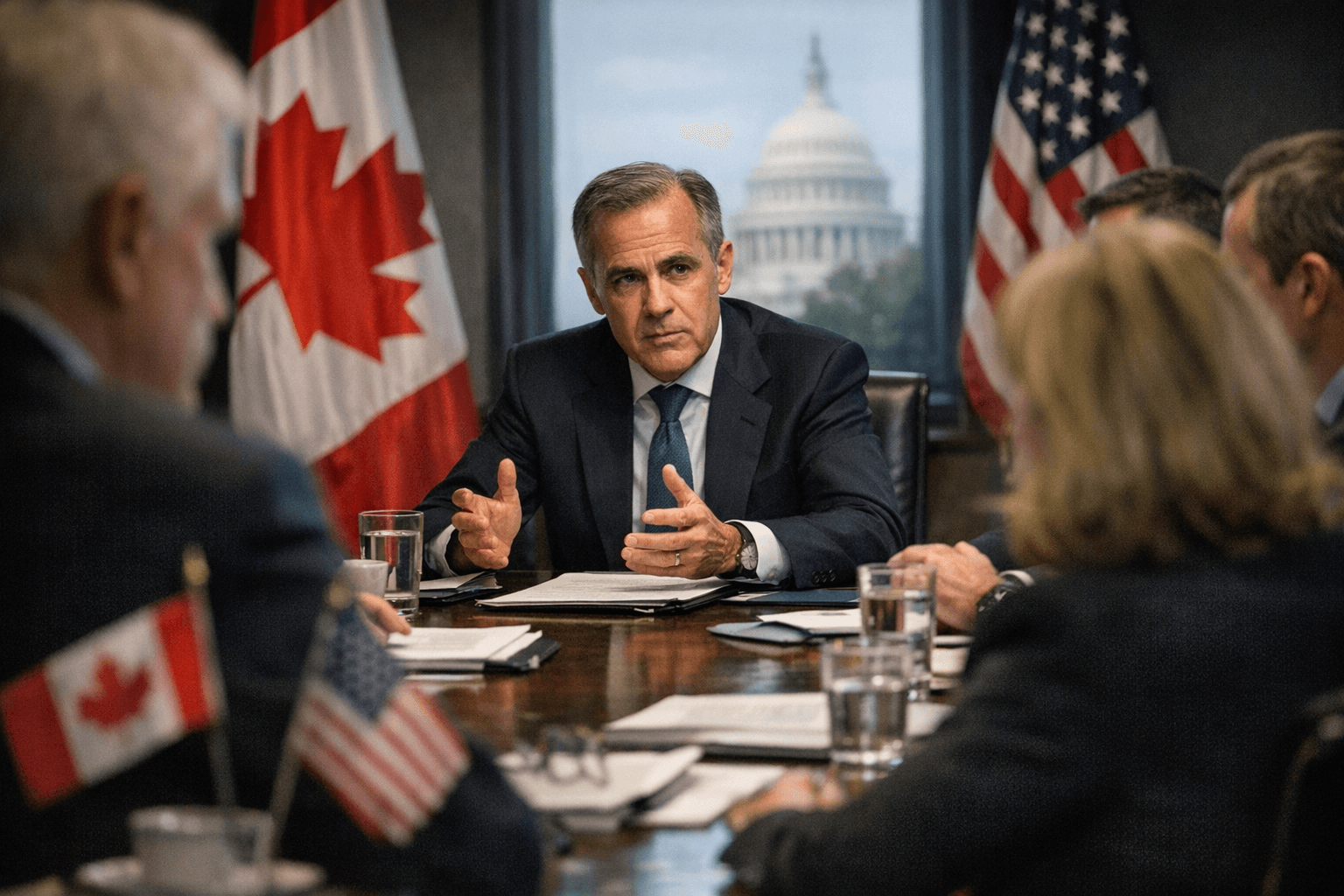
The timing is deliberate. CUSMA, the Canada-United States-Mexico Agreement, entered into force on July 1, 2020, and its first mandatory joint review lands in 2026. Ottawa’s 2025 public consultations drew 5,143 submissions, up sharply from 137 written submissions in the initial 2024 round, with stakeholders backing a do no harm approach while pressing for predictable, tariff-free North American trade and stronger supply-chain resilience. Global Affairs Canada says the agreement still covers 85% of Canada’s trade with the United States tariff-free, and that Canada and the United States move about Can$3.6 billion in goods and services across the border each day.
For American businesses, the exposure is clearest in autos, agriculture and energy. Auto suppliers and parts makers on both sides of the border depend on integrated production lines that can be disrupted by tariff shifts or tighter rules of origin. Farmers and food processors face the risk that a political fight over market access could spill into grain, livestock and dairy flows. Energy producers and pipeline-linked firms are watching closely because cross-border flows of oil, natural gas and electricity are deeply embedded in the bilateral relationship. With the United States accounting for 51% of Canada’s foreign direct investment stock in 2024, the stakes go beyond trade volumes to plant location, capital spending and long-term supply-chain planning.
Carney’s committee is meant to give Ottawa a faster, more politically balanced read on those pressures as the review begins. The message is that Canada wants leverage, discipline and a broader base of advice before negotiations with Washington and Mexico harden into the summer.
This article was produced by Prism’s automated news system from verified source data, official records, and press releases, then run through automated quality and moderation checks before publishing. The system is built and supervised by the people who set the standards it runs under. Read our full AI policy.
Did this article answer your question?


