Cepeda surges in Colombia poll, left poised to extend Petro legacy
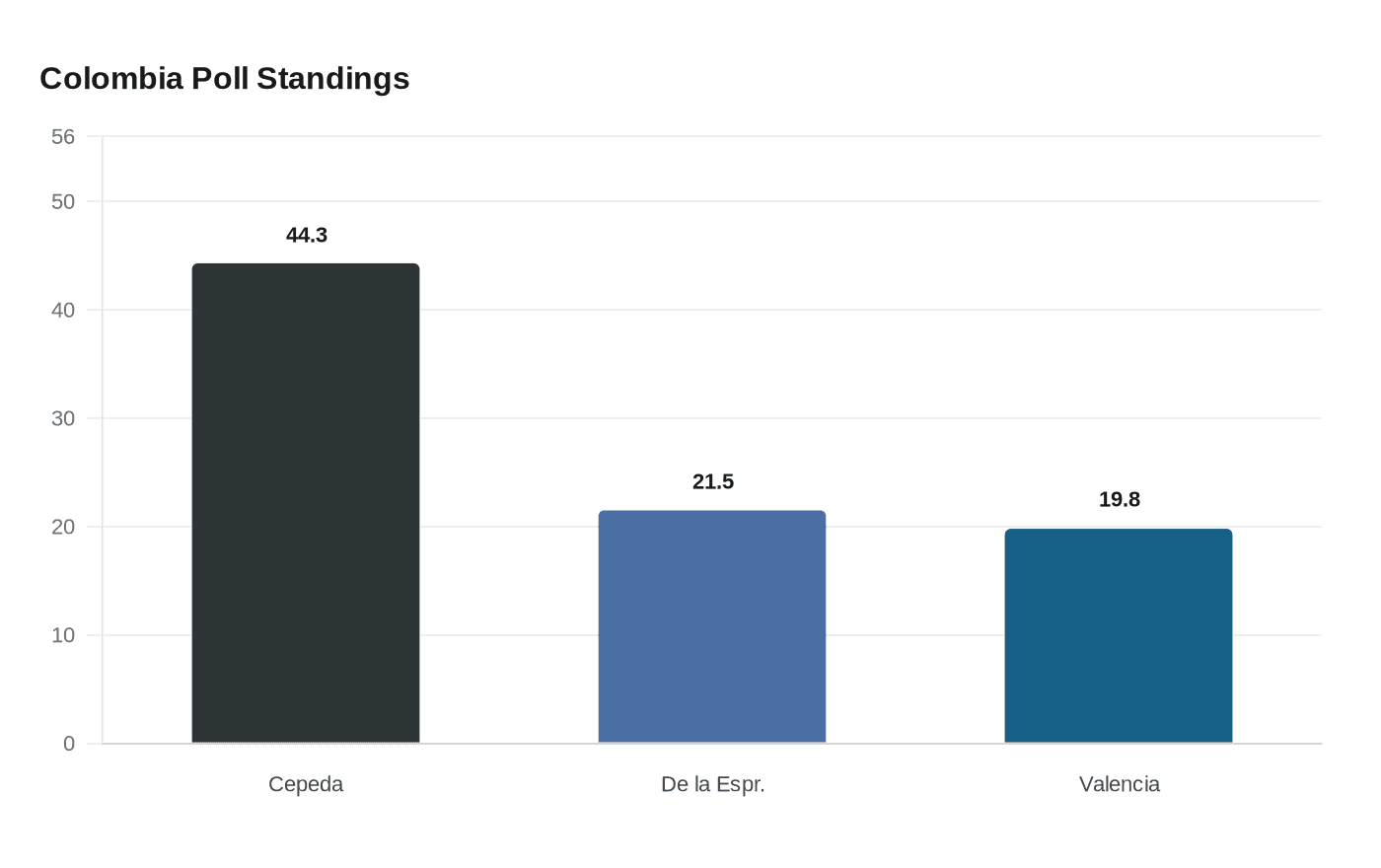
Iván Cepeda led a crowded Colombia race with 44.3 percent, giving Petro's left a clear path to the June runoff and a shot at extending its agenda.
Iván Cepeda has opened Colombia’s 2026 presidential race with a commanding lead, giving Gustavo Petro’s left its strongest sign yet that the president’s political project can survive beyond his single term in office. A new Invamer poll put Cepeda at 44.3 percent, well ahead of businessman Abelardo de la Espriella at 21.5 percent and hardline conservative Paloma Valencia at 19.8 percent.
The survey points to a race in which the left’s advantage is being built as much on opposition weakness as on ideology. Cepeda, the candidate of the Historic Pact coalition, has become the clearest heir to Petro’s promises of social reform, poverty reduction and lower inequality. Petro, elected in 2022 as the first left-wing president in Colombia’s modern history, is barred from seeking a consecutive second term, making the contest a direct test of whether his movement can turn a polarizing presidency into a durable governing force.
The numbers also show how difficult it may be for the right to consolidate quickly enough to stop that outcome. The poll, based on 3,800 in-person interviews across 149 municipalities from April 15 to April 24, carried a margin of error of about 1.89 percent in other reporting. Cepeda’s support rose 7.2 points from Invamer’s February survey, while Valencia gained 9.8 points and de la Espriella added 2.6 points, underscoring a fluid field that still has not settled into a single opposition lane.

In a head-to-head runoff, Cepeda would beat de la Espriella 54.6 percent to 42.6 percent and Valencia 51.2 percent to 46.6 percent. That suggests that while the right can still compete, it has not yet found a candidate who can unite voters around one anti-Petro banner. Centrist former mayors Claudia López and Sergio Fajardo remain far behind, leaving the campaign dominated by a left-right polarization that has squeezed out much of the political middle.
The election calendar raises the stakes further. More than 41 million Colombians will vote in the first round on May 31, and a runoff will follow on June 21 if no one wins more than half of valid votes. The next president is due to take office on July 28 for a single four-year term, with no immediate reelection allowed. The 2022 runoff, when Petro defeated Rodolfo Hernández after no first-round majority, ended with turnout of 58.17 percent, the highest since 1998.
Security is shadowing the campaign as well. Attacks in Colombia’s southwest have heightened concern ahead of the vote, and the race has already been marked by violence, including the assassination of Miguel Uribe Turbay last year, the first killing of a Colombian presidential candidate in more than 30 years. For now, the poll suggests the governing left is not just leading, but setting the terms of Colombia’s political center of gravity.
This article was produced by Prism’s automated news system from verified source data, official records, and press releases, then run through automated quality and moderation checks before publishing. The system is built and supervised by the people who set the standards it runs under. Read our full AI policy.
Did this article answer your question?


