Charter Board Approves Dogwood Virtual School Split from Pine Springs
The Charter School Review Board unanimously approved Pine Springs’ request to spin off its virtual program into Dogwood Virtual School, affecting more than 3,500 statewide students and local oversight of virtual education.

The North Carolina Charter School Review Board voted unanimously to allow Pine Springs to separate its statewide remote program into a new standalone charter, Dogwood Virtual School. The move, enabled by a 2025 law that fast-tracks remote academies with at least 250 students into independent charters without a planning year, shifts oversight and accountability questions for Wake County families and the thousands of students enrolled.
Pine Springs’ Virtual Academy currently enrolls more than 3,500 students from across the state and was approved as a virtual program in 2024. The program is expected to graduate its first senior class next year. Under the CSRB approval, Dogwood would become North Carolina’s third statewide virtual charter, joining N.C. Virtual Academy and N.C. Cyber Academy.
Steven Walker, general counsel for the CSRB, said the Pine Springs petition marks the first formal separation sought under the new law and that the legislation was intended largely to address administrative and reporting issues while allowing the same governing board to continue overseeing both schools. CSRB members pressed Pine Springs for follow-up data before renewal, asking for comparative results against other virtual charters and for longitudinal outcomes for students who remain enrolled over multiple years.
Board member Lindalyn Kakadelis framed that demand in stark terms for renewal planning: “When you come back for renewal, I want to know your legacy. The students who’ve been with you for five years, how are they performing?” The request signals the board’s focus on entry proficiency, sustained academic growth, and cohort outcomes as central metrics of accountability for virtual programs.
The decision arrives amid broader expansion and scrutiny of remote charter academies. Reporting shows at least eight remote academies were slated to operate in the 2025-26 school year, after five launched in 2024 when the legislature first cleared remote academy approvals. Some approved academies have deferred launches, and the Office of Charter Schools has been asked to confirm plans for upcoming school years.
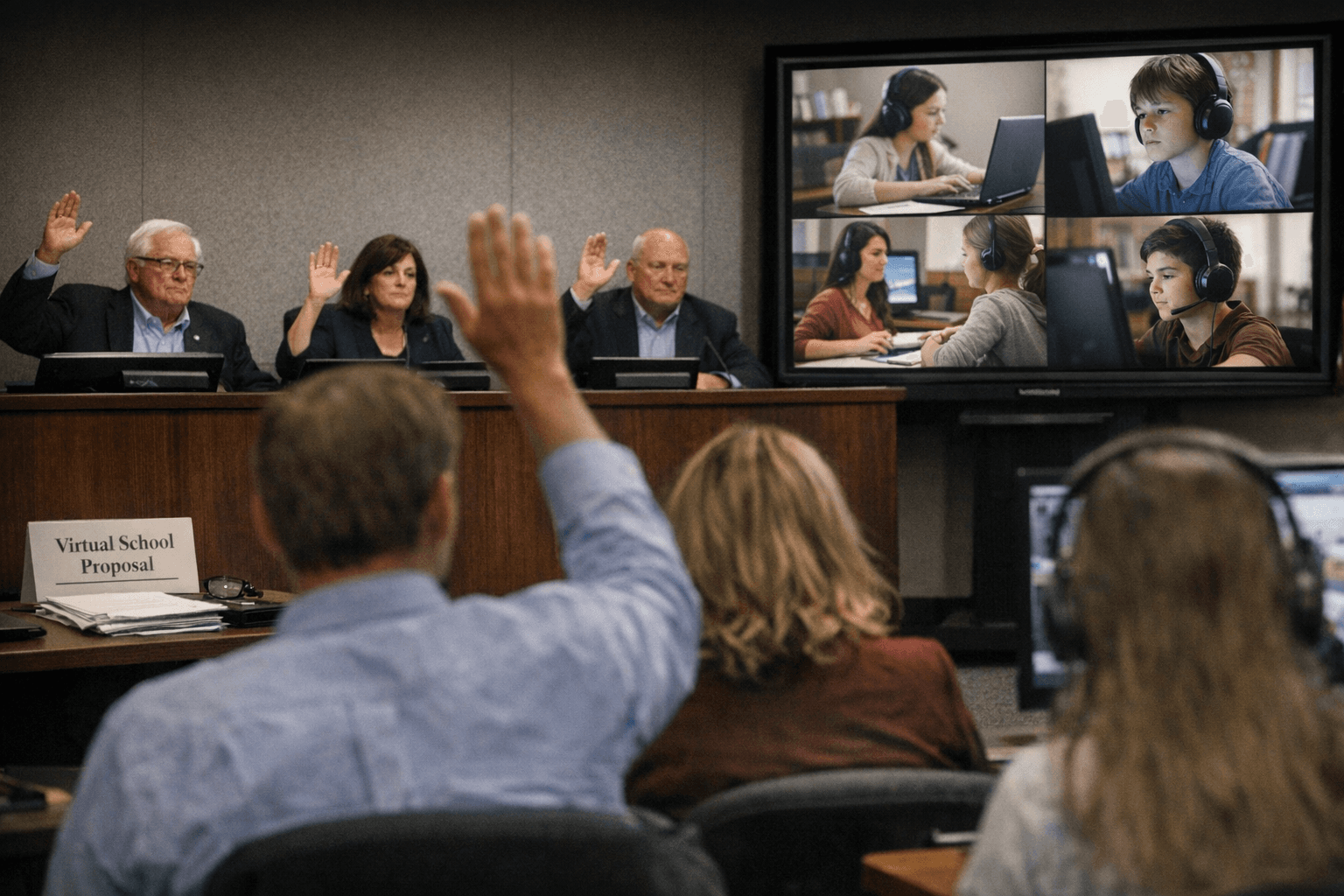
Advocacy groups have raised financial and performance concerns about statewide virtual charters. PublicSchoolsFirstNC, citing NCDPI Office of School Business figures, reported leftover fund balances of $16.0 million for N.C. Virtual Academy and $9.7 million for N.C. Cyber Academy as of the end of 2025, and described long-running performance issues for those programs. The group also pointed to litigation tied to operators of other virtual schools as part of a broader accountability conversation. Those claims remain contested and are the subject of ongoing review and public records checks.
For Wake County residents, the approval highlights both opportunity and risk. Virtual options expand access for families seeking flexibility, health accommodations, or alternatives to neighborhood schools. At the same time, virtual programs raise persistent equity concerns around broadband access, special education supports, social-emotional services, and how state funds and reserves are used to serve students rather than sit idle. CSRB’s demand for comparative and longitudinal data is an early test of whether the new separation law will be accompanied by strengthened reporting and oversight.
Next steps include Pine Springs and the newly christened Dogwood Virtual School returning to the CSRB with the requested outcome data ahead of charter renewal, and local stakeholders watching governance plans, financial disclosures, and enrollment policies that will determine how the split affects Wake County students and families.
Know something we missed? Have a correction or additional information?
Submit a Tip