China captures early lead in the global humanoid robot market
Nearly 90% of humanoid robots sold in 2025 were Chinese, fueling rapid exports, big shipments and state-backed scaling that reshape the sector.

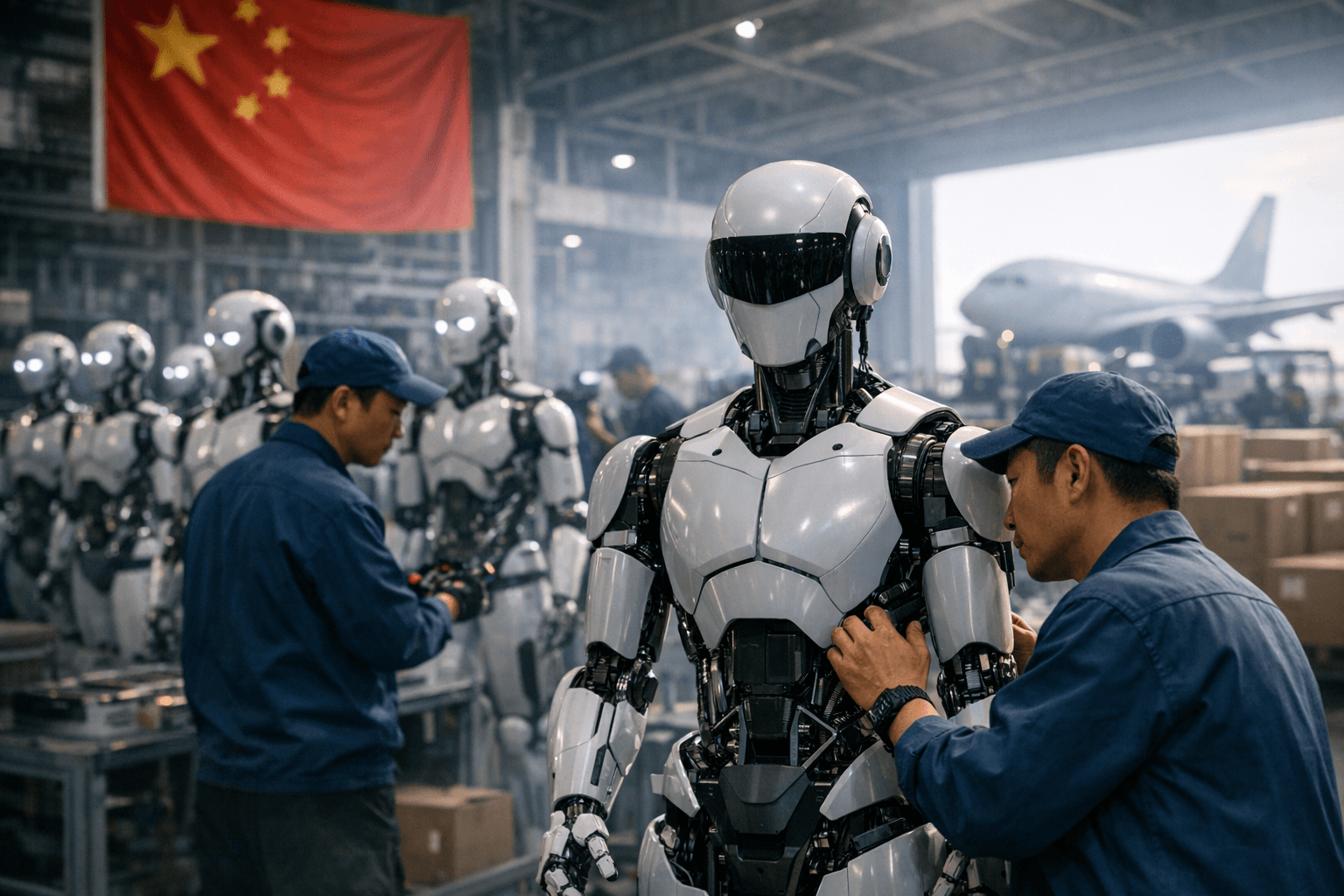
Nearly 90% of all humanoid robots sold globally in 2025 were Chinese, a market surge that left domestic firms shipping at scale and winning overseas orders from trade shows to desert deployments. Industry data project global shipments of about 13,000 humanoid units in 2025, and one maker, Zhiyuan, claimed roughly 39 percent of that market, with Unitree close behind, underscoring how quickly Chinese companies have moved from prototypes to production.
That commercial momentum is the result of an explicit industrial push. The 14th Five-Year Plan designated humanoid robots as a priority sector in 2021, Beijing’s Ministry of Industry and Information Technology issued a guideline in November 2023 to accelerate development, and state funding has been deployed for testing infrastructure and to back individual firms. “China’s early advantage is due to ‘a combination of policy support, public investment, mature supply chain, and advancements made in AI software and hardware,’” said Lian Jye Su, a tech analyst at consultancy firm Omdia.
Manufacturing advantages rooted in existing supply chains are central to the story. Engineers and analysts point to overlap between electric vehicle parts networks and robotics components, which gives Chinese teams cost and scale benefits. “Chinese humanoid robotics vendors are using more and more local components in their robotics design, which helps with cost efficiency, supply chain security, and driving local innovation and time to market,” Lian Jye Su added.
That integration extends beyond suppliers to research institutes and start-ups. “China’s strongest advantage is obviously the tight integration between its hardware supply chain, research institutes and emerging robotics companies… That lets teams prototype quickly, test aggressively and bring full-stack electromechanical systems to maturity far faster than we typically see in the US or Europe,” said Hallewell, writing on industry dynamics.
The result is a fast-moving commercial landscape. Robots displayed at CES 2025 reportedly sold out and Chinese firms described growing orders from the Middle East; manufacturers showcased deployments ranging from exhibition halls to trials in the Dubai desert. The Asia-Pacific Robot World Cup drew technical support from Chinese vendors after an organiser visited factories in 2025 and declared that “currently, only Chinese robots can meet our requirements,” citing performance, programmability and self-righting ability.
Market forecasts vary widely but point to rapid growth. One databook put China’s humanoid-robot revenue at about $64.6 million in 2023 and projected roughly $195.5 million by 2030. China Center for Information Industry Development and conference research offered larger yuan-denominated projections that range into the tens of billions of yuan within this decade, reflecting different definitions and scopes of the market.
Technical limits remain. “At the moment, the latest models and dataset that the humanoid robots trained on are sufficient for specialized tasks, but remain insufficient to perform daily tasks handled by highly skilled workers or the complex household work handled by a housekeeper in a highly complex environment with constant interference from human beings and other moving objects,” Lian Jye Su warned, signaling that mass deployment for general domestic work is not yet realistic.
Strategic partnerships between Chinese AI firms and hardware makers aim to close that gap: major AI groups are combining models with robot platforms to pursue embodied AI. Western rivals, including Tesla’s Optimus program, still face a steeper path to match China’s rapid iteration, integrated supply chains and state-backed testing environments. For now, the industry’s near-term winners are clear: policy, capital and factory-floor integration have translated into robots that are built, shipped and bought at scale.
This article was produced by Prism’s automated news system from verified source data, official records, and press releases, then run through automated quality and moderation checks before publishing. The system is built and supervised by the people who set the standards it runs under. Read our full AI policy.
Did this article answer your question?