China demands Japan retract prime minister’s Taiwan comments, raises stakes at U.N.
China on December 16 renewed a forceful call for Japan to retract Prime Minister Sanae Takaichi’s November remarks about a potential Taiwan contingency, escalating a dispute that has unsettled bilateral ties. The public demand, voiced at both the foreign ministry and the United Nations, highlights rising diplomatic risk in East Asia and could complicate Tokyo’s security calculations and regional alliance management.
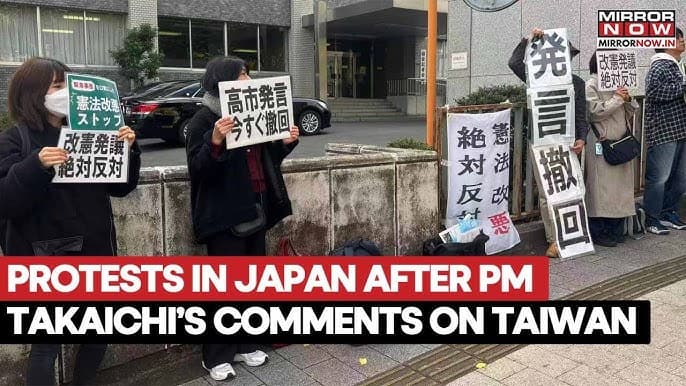
China’s foreign ministry in Beijing on December 16 repeated its demand that Japan take back comments made by Prime Minister Sanae Takaichi about a possible Taiwan contingency, accusing Tokyo of provocation and warning of serious consequences for bilateral relations. The ministry said Japan must “seriously reflect on and repent for its wrongdoing” and “simply retract Prime Minister Takaichi’s erroneous remarks, stop playing with fire, and avoid going further down the wrong path.” The statement added that attempts by Tokyo “to grab attention and reap public support by provoking China is malign in nature and very dangerous” and warned China “will never flinch in defending its sovereignty and territorial integrity.”
The demand was echoed at the United Nations where China’s ambassador to the world body restated the call for a retraction, signaling Beijing’s intent to press the issue on multiple diplomatic fronts. State and official Chinese outlets have amplified the message, arguing that Japan is attempting to obfuscate the matter and that Beijing “firmly opposed” the substance of Takaichi’s remarks.
The row traces back to comments Takaichi made in Diet proceedings on November 7, when she outlined scenarios in which an attack on “democratically governed Taiwan” might require Japan to exercise collective self defense. Her remarks noted the prospect that China could use force and even attempt to shut down sea lanes, framing such contingencies as potential triggers for Japan’s defensive obligations. The exchange drew support within Tokyo on December 3 from a senior ruling party figure, intensifying the domestic political dimension of the dispute.
Japanese commentators have warned that the episode has thrown Sino Japanese relations into turmoil, with several outlets revisiting the 1972 Joint Communiqué that normalized ties between the two countries. Some of those outlets quoted the communiqué as saying “The Government of Japan fully understands and respects this stand of the Government of the People’s Republic of China, and it firmly maintains its stand under Article 8 of the Potsdam Proclamation,” reflecting how legal and historical references are being deployed in the diplomatic debate.

Beijing’s messaging goes beyond a demand for a formal apology or retraction. Chinese statements have urged Tokyo to “approach the Taiwan question with extra prudence,” and to “stop abetting and aiding separatist forces’ attempt to seek ‘Taiwan independence’ and resist reunification through military buildup.” The language is calculated to link Tokyo’s security discourse to wider Chinese red lines on sovereignty and reunification.
For Tokyo, the incident presents a delicate diplomatic balancing act. The government must manage domestic political support for a more assertive security posture while containing fallout with China, a major trading partner whose cooperation is critical on regional economic and security issues. For the wider region, the spat underscores how public rhetoric on Taiwan can quickly become a bilateral flashpoint with international reverberations.
Diplomats in both capitals said the dispute will be watched closely by Washington and other regional capitals that are sensitive to any escalation across the Taiwan Strait. With Beijing signaling its unwillingness to relent and pressing the issue at the United Nations, the coming days will test whether Tokyo chooses quiet diplomacy to defuse tensions or doubles down on a more explicit security posture.
This article was produced by Prism’s automated news system from verified source data, official records, and press releases, then run through automated quality and moderation checks before publishing. The system is built and supervised by the people who set the standards it runs under. Read our full AI policy.
Did this article answer your question?


