Myanmar's Military Chief Min Aung Hlaing Chosen as Next President
The coup leader who ignited Myanmar's civil war traded his uniform for a presidential title, as parliament — 90% military-aligned — confirmed Min Aung Hlaing on Friday.
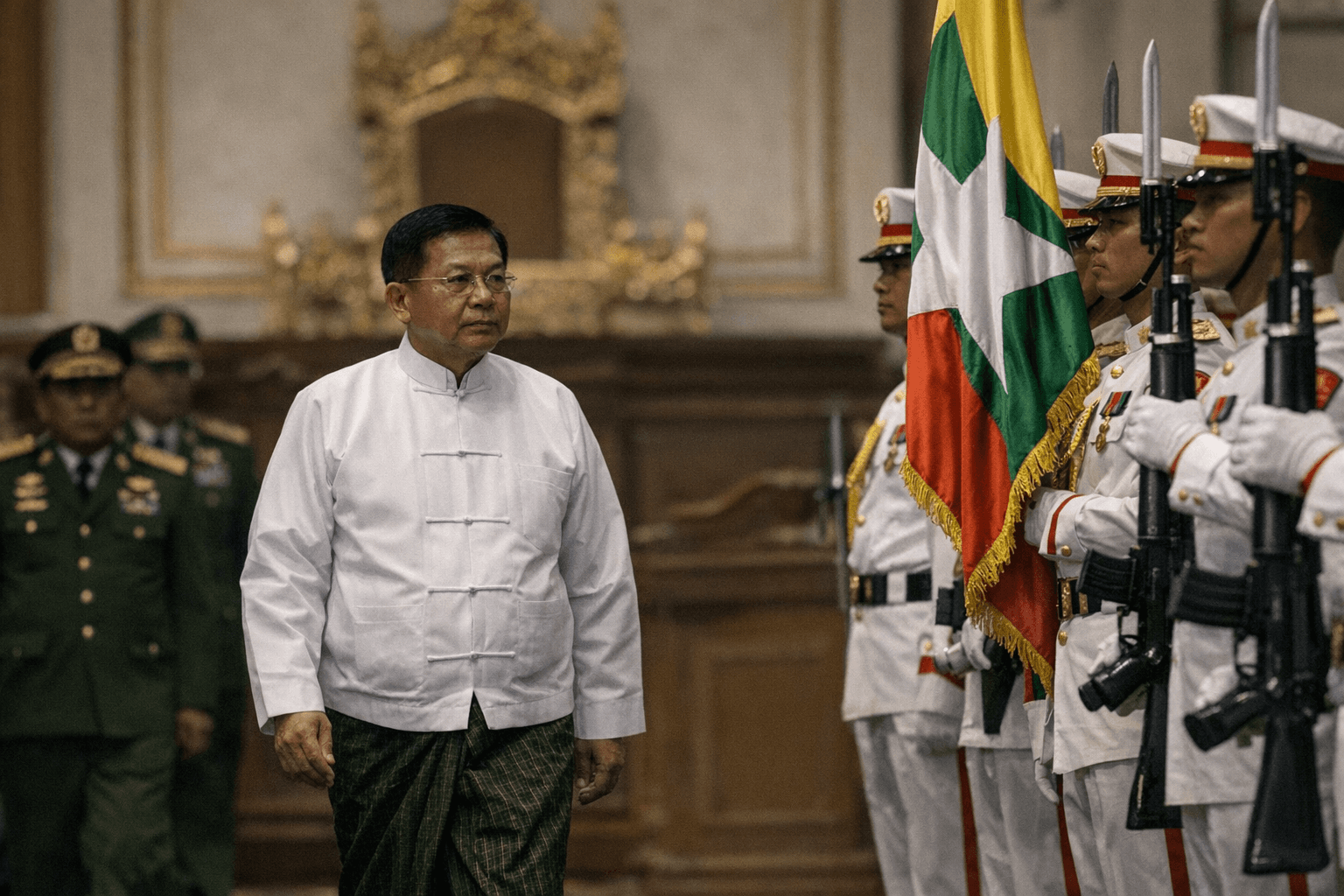
Myanmar's parliament confirmed Min Aung Hlaing as the country's new president on Friday in a vote that formalizes what has effectively been his personal rule since the 2021 coup, offering the 69-year-old general a civilian title without meaningfully redistributing the power he already holds.
The confirmation completed a process that began March 30, when Min Aung Hlaing retired as Commander-in-Chief of the Tatmadaw, Myanmar's armed forces, and was nominated as a vice-presidential candidate by Union Solidarity and Development Party lawmaker Kyaw Kyaw Htay. He secured 247 of 260 lower house votes to advance to the final round, where parliament chose among three vice presidents. The other two, Nan Ni Ni Aye and Nyo Saw, were loyalist placeholders with little chance of prevailing.
The legislature that confirmed him was assembled through elections held in three phases between December 28, 2025, and January 25, 2026, elections that banned the main opposition parties, criminalized public criticism of the vote, and took place in only 263 of Myanmar's 330 townships, with large portions of the country beyond the junta's control. Military officers hold a constitutionally mandated 25% of parliamentary seats; together with representatives of the junta-backed USDP, the military bloc controls roughly 90% of the bicameral body. Turnout reached approximately 55%, well below the 70% recorded in previous elections.
The shift in title does not alter the chain of command that has prosecuted a brutal civil war now in its fifth year. The conflict has killed nearly 93,000 people and displaced more than 3.6 million, according to estimates cited by democracy and human rights monitors. Resistance forces, including ethnic armed organizations and pro-democracy fighters aligned with the shadow National Unity Government, continue to contest large swaths of territory, and the presidency does nothing to resolve those battlefield dynamics. What changes is the legal veneer: Min Aung Hlaing moves from acting president and junta chairman to elected head of state, complicating the international community's ability to frame him solely as a military actor.
On New Year's Day, Min Aung Hlaing appeared on camera and said, "We will hand over power to the government that emerges after the election and continue to work hard to ensure that the second chapter is successful." The new administration is widely described by analysts as a proxy structure stacked with former generals exchanging uniforms for civilian portfolios.
International leverage remains real but fragmented. Western nations, including Australia and members of the European Union, have imposed broad sanctions on Min Aung Hlaing and junta-linked businesses. He has responded by deepening ties with Russia, China, and India, with Beijing playing an increasingly active role as a conflict mediator to protect its Belt and Road infrastructure interests and border stability. ASEAN, which suspended Myanmar's participation from its summits, faces pressure from within its own membership to normalize relations now that a technically civilian government is in place, a development the International Crisis Group has warned could erode the bloc's already limited leverage.
For the millions of displaced Burmese, the presidency changes little on the ground. Humanitarian access remains severely constrained, the conscription law Min Aung Hlaing activated in February 2024 to draft 60,000 young people into the Tatmadaw continues to be enforced, and the apparatus of repression that drew a second-place ranking on the Economist Intelligence Unit's 2022 authoritarian governance index is now dressed in a suit.
This article was produced by Prism’s automated news system from verified source data, official records, and press releases, then run through automated quality and moderation checks before publishing. The system is built and supervised by the people who set the standards it runs under. Read our full AI policy.
Did this article answer your question?