China increasingly sees Trump’s America as declining, dangerous power
Beijing now treats Trump’s U.S. as both weakening and volatile, a shift that is reshaping trade, Taiwan risk and China’s long game.
A harder Chinese reading of American power
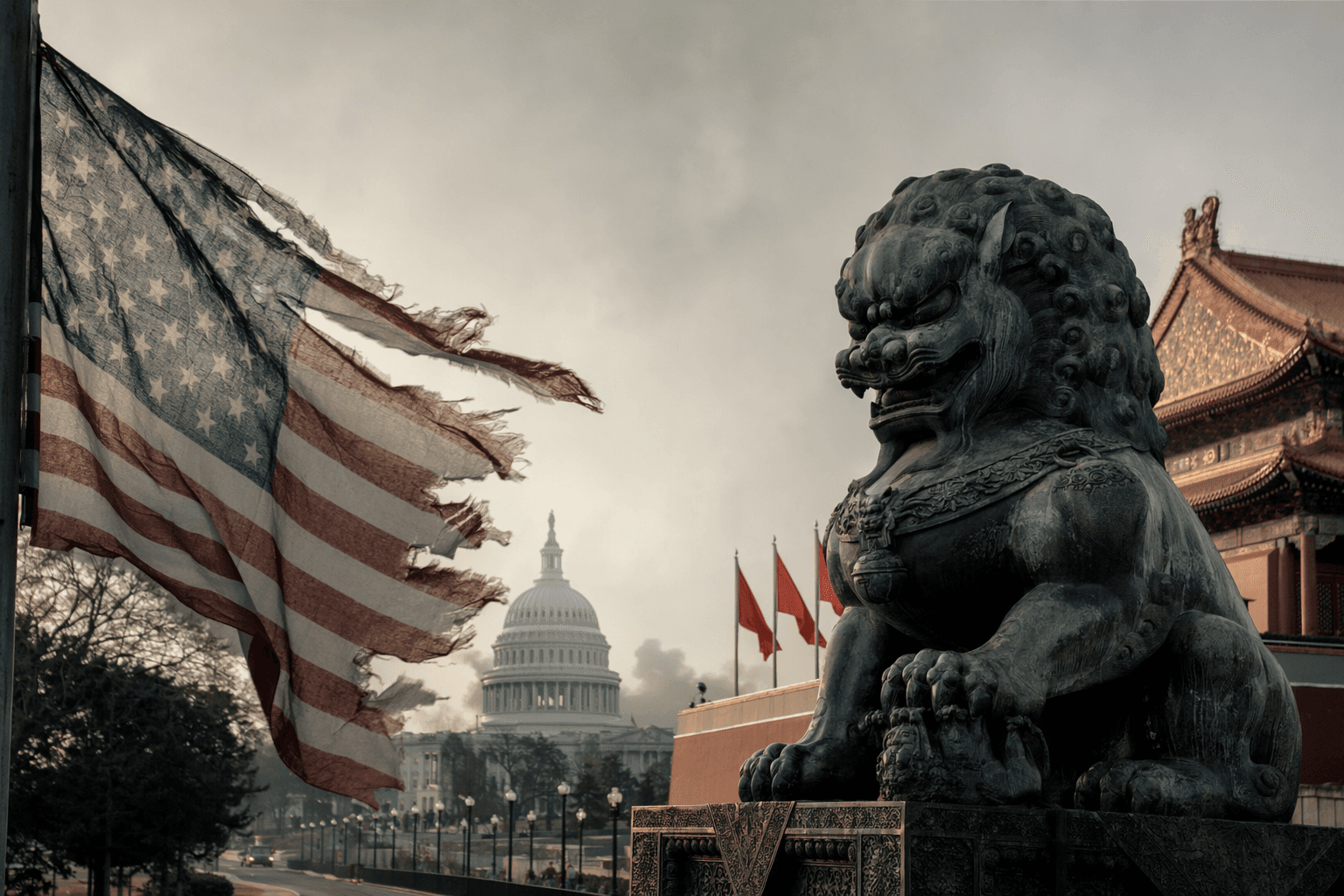
China’s top political and media voices are increasingly describing the United States as a power in decline, but still one that can lash out. That mix matters because it is changing how Beijing thinks about trade, diplomacy and risk around Taiwan, especially under Donald Trump’s second-term volatility.
A March 2026 essay in China Leadership Monitor argued that Chinese leadership, state media and foreign policy analysts now broadly see the United States as a declining but dangerous power. Jonathan A. Czin and Allie Matthias said that outlook has endured since Michael Swaine’s 2021 analysis, even though the intensity of the language has risen and fallen over time. In Beijing’s view, weakness does not mean harmlessness. It can mean unpredictability.
How Xi and state media frame the rivalry
Xi Jinping helped harden this framing in a 2023 speech to new Central Committee members, saying Western countries were “increasingly mired in difficulties” and contrasting the “rise of the East and decline of the West” with “order in China and chaos in the West.” That line does more than flatter domestic audiences. It signals a leadership view that the balance of power is shifting, and that China should wait out American turbulence rather than assume Washington can easily restore its authority.
State media has pushed that message further during Trump’s second term. In October 2025, Beijing Daily described the United States as a failed state and said it was “dying from within,” pointing to polarization, protests and a federal shutdown while arguing that tariffs were backfiring on ordinary Americans. The tone is less about ideology than about perception of competence. Beijing is not just saying America is weaker; it is suggesting America is becoming less governable.
That distinction helps explain why Chinese officials and commentators can sound more confident without necessarily becoming more reckless. Czin and Matthias argued that the belief in U.S. decline has often encouraged Chinese officials to think time is on China’s side, while still cautioning against provoking a United States that could retaliate sharply even as it weakens.
What Chinese public opinion shows
The shift is not limited to elite rhetoric. A March 2026 survey by The Carter Center and Emory University found 73% of Chinese respondents viewed the United States as a national security threat, up from 61% in July and August 2025. Sentiment toward the United States was still very low overall, falling from 37 out of 100 in mid-2025 to 34 out of 100 in late 2025 and early 2026.
The same survey shows how selective that hostility is. Among those who saw the United States as a threat, 83% pointed to Taiwan as the main issue, and 80% said international economics and trade were also major threat areas. Yet majorities still said the two countries share interests in international economics and trade, global security, technological innovation and public health. That combination is important: Chinese attitudes are hardening, but not into a blanket rejection of cooperation.
In other words, Beijing’s public mood is not simply anti-American. It is strategic. The United States is seen as a rival with overlapping interests, one that is dangerous precisely because it remains powerful enough to impose costs.
Trade has become the clearest pressure point
The most concrete change has come in commerce. In March 2026, economist Chad P. Bown at the Peterson Institute for International Economics wrote that China essentially stopped buying U.S. exports in April 2025 after Trump launched a new tariff war early in his second term. He said U.S. goods exports to China were 26% lower in 2025 than in 2024, a drop that pushed them to levels not seen since the 2008 to 09 global financial crisis.
Bown also estimated that without Trump’s trade wars, U.S. exports to China in 2025 would have been nearly 60% higher, or about $90 billion annually. That is not a marginal distortion. It is a major reordering of bilateral commercial flows, and it reinforces Chinese assumptions that Washington is willing to weaponize trade even at high cost to itself.
The U.S.-China Economic and Security Review Commission later reported that China’s exports to the United States fell 20% to $419.5 billion in 2025. The same report said China’s export growth shifted toward Africa, Southeast Asia and Latin America, and those three regions accounted for nearly three-quarters of China’s overall export growth. That reorientation suggests Beijing is already building buffers against U.S. pressure by diversifying demand and deepening its commercial reach elsewhere.
Why the volatility matters for regional risk
This is why Trump’s unpredictability matters beyond tariffs. A CSIS expert survey found only 26% of experts thought U.S.-China relations were more stable in December 2025 than a year earlier. That low confidence reflects a broader reality: Chinese planners cannot assume a durable American policy line when the White House can swing sharply from dealmaking to confrontation.
Brookings added another layer to that view, saying Chinese analysts read Trump’s 2025 National Security Strategy as a transitional document rather than a settled blueprint. That interpretation is revealing. It suggests Chinese policymakers may see the current U.S. line not as a coherent grand strategy, but as another phase in a longer period of American drift and internal disagreement.
For Beijing, that combination is dangerous and useful at the same time. It can encourage patience on trade and diplomacy, since Chinese officials may believe pressure will mount inside the United States over time. But it can also sharpen risk-taking around Taiwan and other flashpoints, because a weaker and more fractured America may seem less able to respond consistently.
The central lesson is straightforward. China is not concluding that the United States is finished. It is concluding that the United States is less predictable, more polarized and still capable of inflicting damage. That is a far more consequential diagnosis, because it shapes not only how Beijing talks about Washington, but how far it thinks it can push.
This article was produced by Prism’s automated news system from verified source data, official records, and press releases, then run through automated quality and moderation checks before publishing. The system is built and supervised by the people who set the standards it runs under. Read our full AI policy.
Did this article answer your question?