Climate change fuels record global fires, scientists warn of worse ahead
More than 150 million hectares burned in four months, and scientists warn the clash of warming and El Niño could push the season even higher.
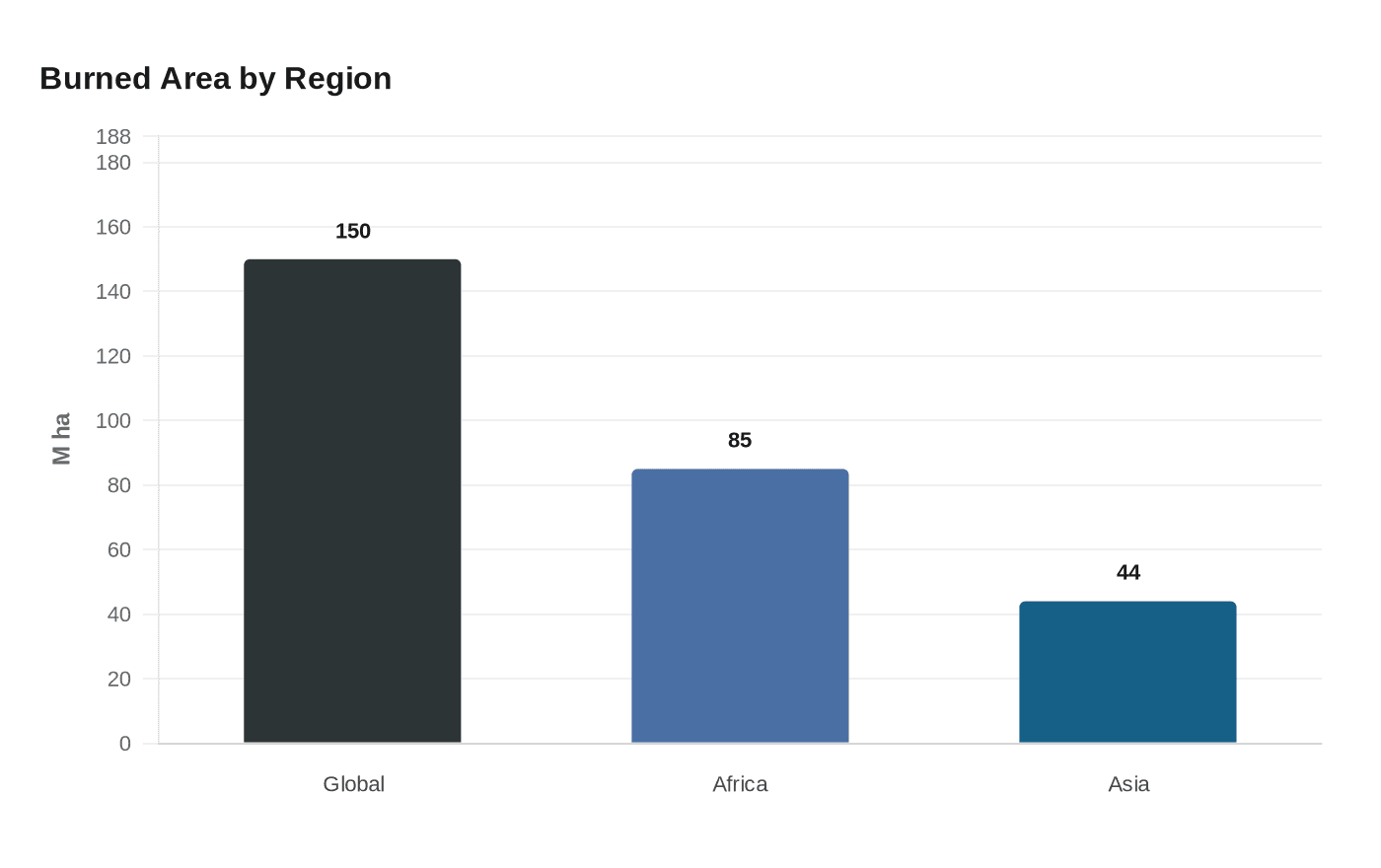
A record wave of fire has already swept across the planet, with more than 150 million hectares burned globally between January and April 2026, the highest figure on record for that period. World Weather Attribution said that was about 50 percent above the 2012 to 2025 average for the same months and almost double the amount burned in early 2024, a sign that the fire season has opened far earlier and more violently than usual.
Africa bore the heaviest toll. WWA said about 85 million hectares burned there in the first four months of the year, the highest since tracking began in 2012 and 23 percent above the previous record of 69 million hectares. The burn scar stretched across the Sahel and West Africa, including Senegal, Mali, Niger, Nigeria, Chad and Sudan, as well as Gambia, Guinea, Mauritania, Ghana, Togo, Benin, Burkina Faso, Cameroon, the Central African Republic and South Sudan.
Scientists said the scale of the African fires reflected a dangerous swing from very wet conditions to very dry ones. Heavy rain in the previous growing season left behind more grass and vegetation, then rapid drying turned that growth into fuel for savannah fires. WWA has described that pattern as hydroclimate whiplash, and it is one of the reasons fire risk can rise sharply even in places that are not usually in the global spotlight.
Asia also saw extreme fire activity. WWA said about 44 million hectares burned across the continent, nearly 40 percent above the previous record of 32 million hectares set in 2014. India, China, Laos, Myanmar and Thailand were among the hardest hit countries. In India, major outbreaks in Andhra Pradesh, Chhattisgarh and Madhya Pradesh worsened when agricultural burning escaped under very dry conditions. In Laos, Thailand and Myanmar, severe drought helped drive the losses.
Theodore Keeping, a wildfire expert at Imperial College London who works with World Weather Attribution, said the rapid start to the global fire season, combined with the forecast arrival of El Niño, could make 2026 a particularly severe year. Friederike Otto, another Imperial College climate scientist and co-founder of WWA, warned that the overlap between climate change and El Niño could produce unprecedented weather extremes.
Forecasts cited in the reporting give a 61 percent chance that El Niño will emerge during the May to July period and persist through the end of the year, raising the odds of heat and drought in many regions. The United States and Australia have already seen unseasonably high burned areas, suggesting the threat is not confined to the tropics or the Sahel.
The warning now is not just about fire on the ground. Smoke, heat, food supplies, infrastructure, insurance losses and forced displacement can all move together when the climate loads the dice. With the northern hemisphere summer still ahead, scientists say the world may be entering one of the most dangerous fire seasons in recent history.
This article was produced by Prism’s automated news system from verified source data, official records, and press releases, then run through automated quality and moderation checks before publishing. The system is built and supervised by the people who set the standards it runs under. Read our full AI policy.
Did this article answer your question?