China manufacturing barely returns to growth as demand stays weak
China’s factory PMI was seen edging to 50.1 in June, but weak retail sales, softer property demand and thin domestic orders showed a fragile rebound.
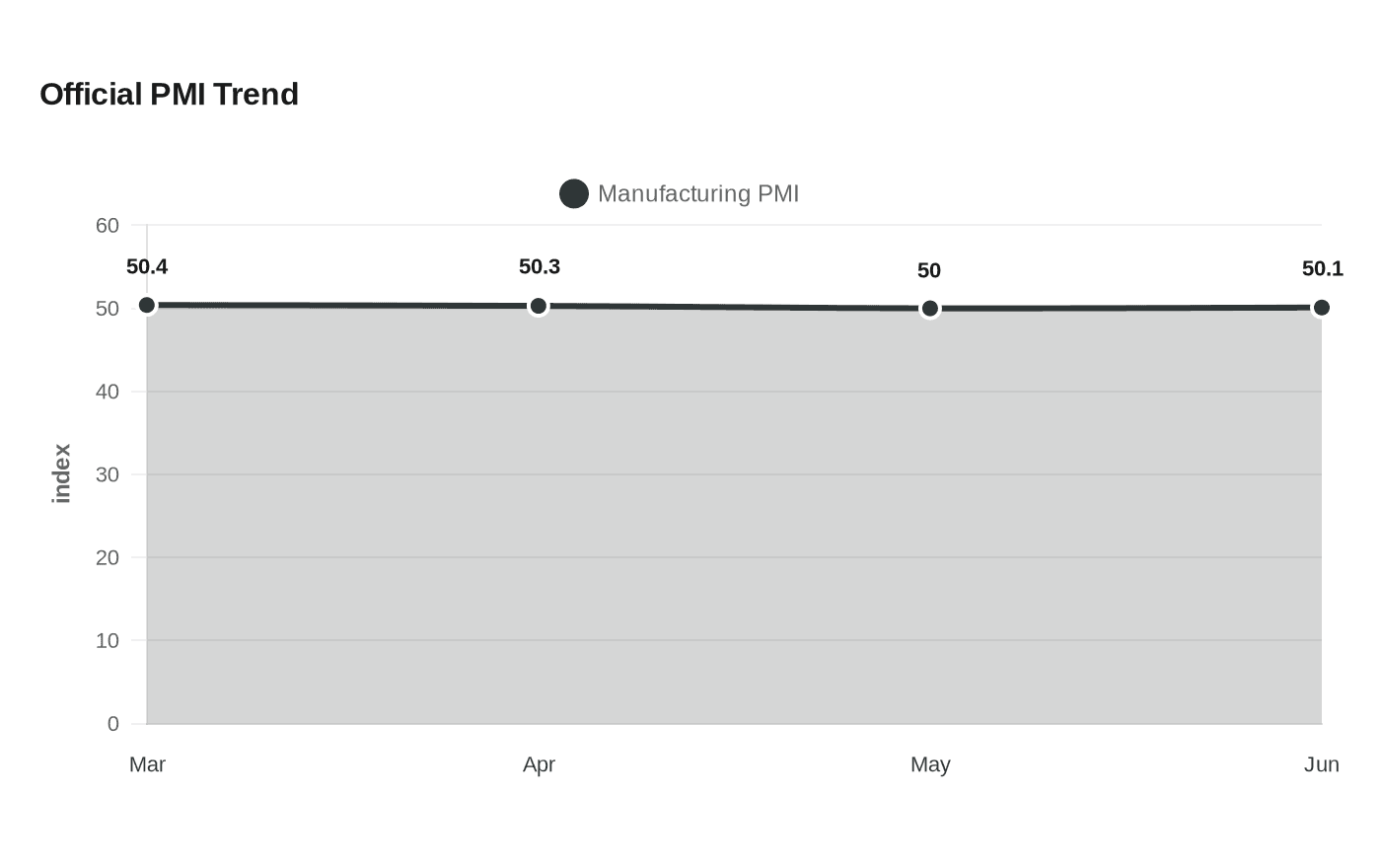
China’s factory activity was set to inch back above the growth line in June, but only barely. A poll of 23 economists put the official manufacturing purchasing managers’ index at 50.1, just above the 50-point mark that separates expansion from contraction and only a hair higher than May’s 50.0.
That marginal move offered little sign of a broad recovery. China’s manufacturing PMI had already slipped from 50.3 in April to 50.0 in May, after reaching 50.4 in March. The National Bureau of Statistics said May manufacturing output remained in expansion, but market demand softened, underscoring how narrow the rebound has been. The private Caixin/S&P Global survey painted a similarly uneven picture, with its manufacturing PMI rising to 50.4 in June from 48.3 in May, while new export orders stayed in negative territory.
The export picture was stronger, but only in a limited set of industries. Shipments of automated data-processing equipment jumped more than 60% from a year earlier in value terms, reflecting demand tied to the global AI boom. Furniture exports rose just 1.9% over the same period, a reminder that the upswing has not spread evenly across the industrial base. Xu Tianchen of the Economist Intelligence Unit said exporters accelerated shipments because of U.S. trade-policy uncertainty. He warned that late July could become important when new Section 301 tariffs are expected to take effect.
Inside China, the strain is even clearer. Retail sales fell in May for the first time in more than three years, while new home prices dropped 0.2% month on month, a faster decline than April’s 0.1%, according to calculations based on official data. The property downturn continues to drag on spending across the roughly $20 trillion economy, leaving downstream manufacturers under pressure even as upstream sectors and the computer industry recorded sharper gains.
The policy response suggests Beijing still sees weak demand as the central problem. China’s central bank instructed some commercial banks to increase lending this month, a sign that officials remain concerned about sluggish credit growth. For now, the economy appears to be leaning on a narrow band of export-led strength while domestic demand, especially in housing and retail, remains too weak to carry the recovery on its own.
This article was produced by Prism’s automated news system from verified source data, official records, and press releases, then run through automated quality and moderation checks before publishing. The system is built and supervised by the people who set the standards it runs under. Read our full AI policy.
Did this article answer your question?