China surges as Latin America's top growth market, U.S. still leads
China bought Latin American goods faster than any other market, but the U.S. still took the biggest share of the region’s trade. The split is sharpening Washington’s leverage fight.
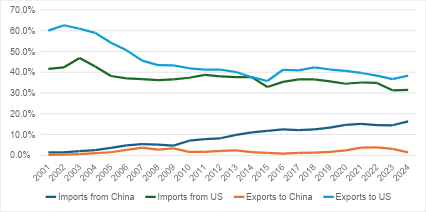
China bought Latin American and Caribbean goods faster than any other market in the first quarter of 2026, but the United States still anchored the region’s trade. An Inter-American Development Bank study released June 16 showed exports from Latin America to China jumping 25% from a year earlier, outpacing gains to the rest of Asia, the European Union and the U.S., even as Washington remained the region’s single most important market.
The numbers point to a region pulled in two directions at once. Imports from China into Latin America rose 29% in the quarter, far faster than the 4% increase in imports from the U.S. That left the U.S. share of Latin America’s imports near a record 22%, with China at 9.6%. The trade balance underscores the strategic tug-of-war: China is becoming a more powerful buyer, especially in South America, while the U.S. still dominates trade with Mexico and Central America.

The IDB said overall Latin American exports rose almost 16% in the quarter, roughly double the 8% annual growth seen through 2025. Commodities drove much of that advance. Gold prices soared 64% from January to April, while copper, oil and soybeans also moved higher. Coffee and sugar, by contrast, fell more than 20%, showing how uneven the region’s export boom was and how exposed producers remain to commodity swings.
The external backdrop also got harsher. The U.S.-Israeli war with Iran pushed fuel prices higher, adding pressure to import-dependent economies and lifting freight and fertilizer costs even for oil exporters. Venezuela was a weak spot: total exports fell 8.7% in the quarter, despite a slight improvement in shipments to the U.S. That is a reminder that even where Chinese demand is growing, country-level trade outcomes can still be dragged down by sanctions, prices and energy costs.
The broader contest is long term. China has spent more than two decades deepening economic and security ties across Latin America, and it is already South America’s top trading partner. At a May 2025 summit in Beijing, Xi Jinping announced a $9 billion investment credit line for the region. European Parliament researchers say China could overtake the U.S. as Latin America’s most important trading partner by 2035, a forecast that captures what Washington now faces: a rival that is not replacing the U.S. market, but steadily narrowing the gap around it.
This article was produced by Prism’s automated news system from verified source data, official records, and press releases, then run through automated quality and moderation checks before publishing. The system is built and supervised by the people who set the standards it runs under. Read our full AI policy.
Did this article answer your question?